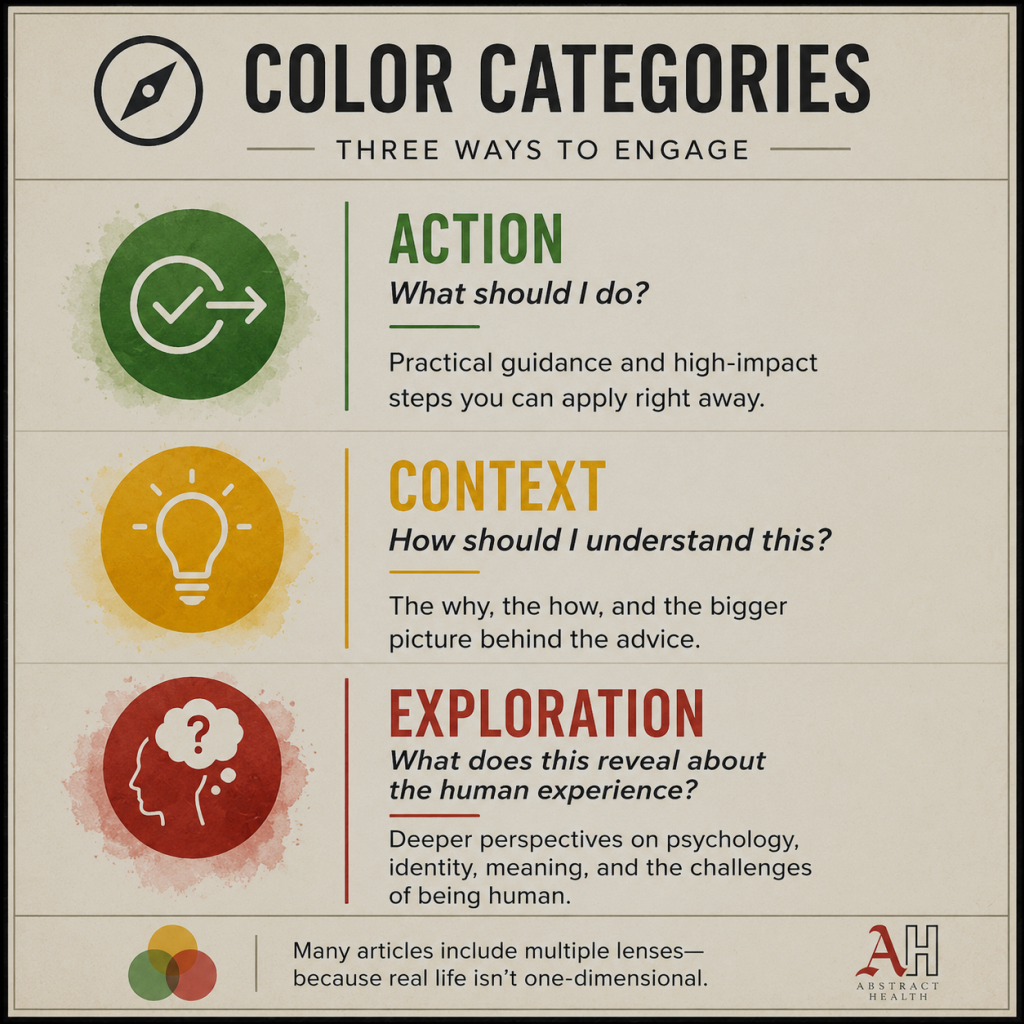
One of the challenges of modern health information is that not every question requires the same kind of answer.
Sometimes you simply need to know what to do.
Sometimes you need enough context to understand why it works.
And sometimes the question isn’t really about health at all—it’s about being human.
Rather than forcing every topic into the same format, Abstract Health organizes content into three categories. Each represents a different purpose and way of thinking.
The colors are not rankings. They don’t indicate importance or difficulty.
Instead, they help answer a simple question:
“What is this article trying to help me do?”
Whether you’re looking for quick guidance, a deeper understanding, or thoughtful exploration, you can choose the level of engagement that best fits what you need today.
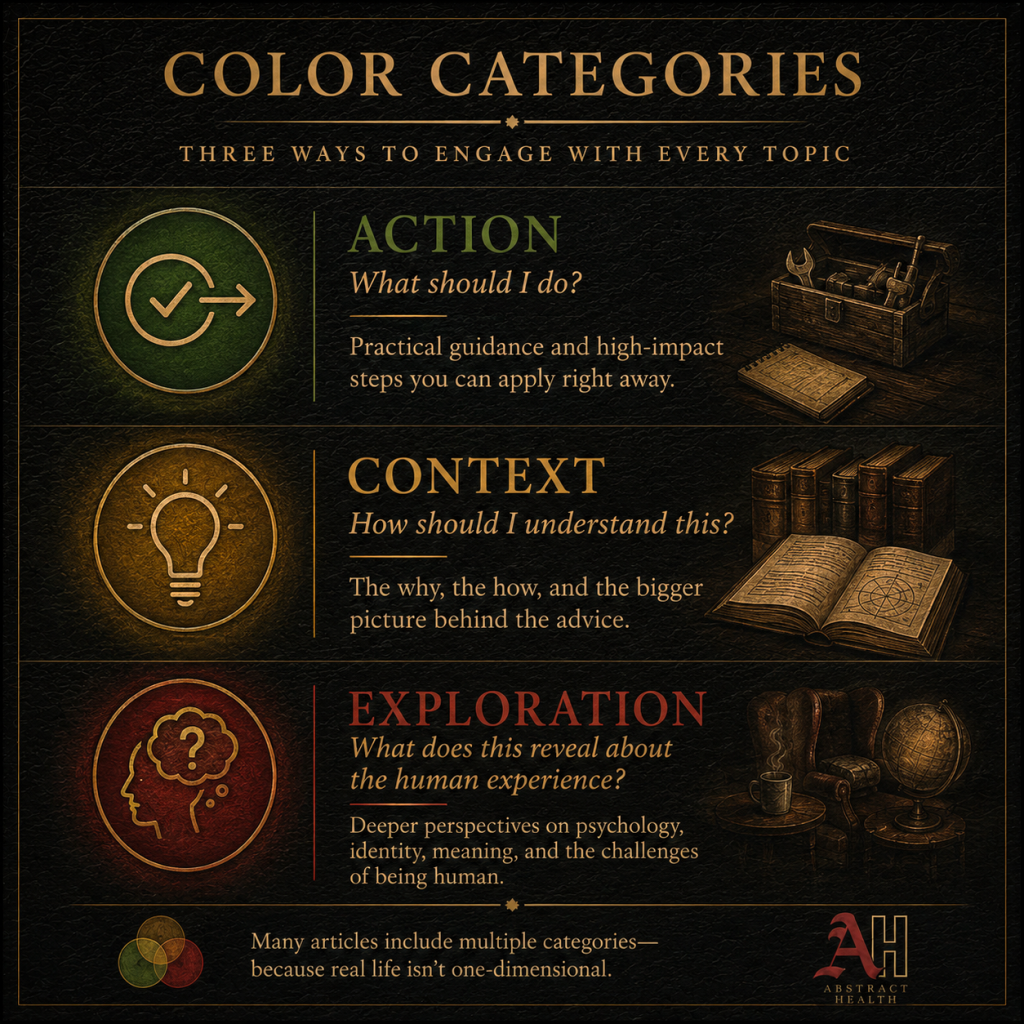
🟢 Green — Directive
Action: What should I do?
Green articles focus on practical guidance.
Their purpose is to reduce confusion and help you take meaningful action without requiring you to become a health expert first.
They emphasize the highest-leverage behaviors—the actions that are most likely to improve health for most people, most of the time.
If you’re feeling overwhelmed by conflicting advice or simply want straightforward recommendations, Green is the place to start.
Topics may include:
- Building balanced meals
- Sleep fundamentals
- Walking and movement
- Grocery shopping
- Protein intake
- Simple daily habits
Green doesn’t attempt to explain every exception, mechanism, or debate.
Its purpose is to answer one question clearly:
What should I do?
🟡 Yellow — Interpretive
Context: How should I understand this?
Knowing what to do is valuable.
Understanding why often makes it easier to continue doing it.
Yellow articles provide context that helps health advice fit into the real world.
Rather than adding complexity for its own sake, they help organize it.
You’ll often find:
- Mental models
- Analogies
- Frameworks
- Tradeoffs
- Nuance
- Common misconceptions
- Reality-based expectations
Yellow articles help recalibrate perception.
They don’t simply explain facts—they help you see those facts through a more functional lens.
Some Yellow articles may become fairly detailed or explore scientific topics more deeply than the average health article. Others remain simple and approachable.
What unites them isn’t their complexity.
It’s their purpose.
They answer the question:
How should I understand this?
🔴 Red — Existential
Exploration: What does this reveal about the human experience?
Some health questions can’t be answered with nutrition facts or exercise recommendations alone.
They involve identity.
Fear.
Meaning.
Comfort.
Responsibility.
Relationships.
Culture.
Modern life.
Red articles explore the deeper forces that shape human behavior.
Some examine philosophical or psychological questions.
Others discuss the realities of healthcare, science, communication, or professional practice.
Some may resonate most with clinicians, educators, researchers, or readers who enjoy exploring ideas at a deeper level.
Others may simply help anyone better understand themselves.
Red isn’t defined by technical difficulty.
It’s defined by purpose.
Its goal isn’t merely to explain health.
Its goal is to explore the human condition through the lens of health.
Rather than asking:
“What should I do?”
Red asks:
“Why is this difficult?”
or
“What can this teach us about ourselves?”
Not every Red article will provide a clear answer.
Some exist to ask better questions.
When Colors Combine
Some topics naturally span more than one category.
A practical guide may also provide important context.
A philosophical discussion may reshape the way you think about everyday habits.
When that happens, you’ll see multiple colors listed at the beginning of the article.
The primary color tells you the article’s main purpose, while the additional color simply reflects another layer of the discussion.
One Mission, Three Perspectives
Although the colors serve different purposes, they all exist to support the same mission:
To reduce the burden of modern health information by helping people understand what matters most.
Some days you need direction.
Some days you need understanding.
Some days you need reflection.
None is inherently better than the others.
They simply represent different ways of engaging with the same goal:
Building the capacity to live well.
Because health isn’t just about correcting problems.
It’s about developing the physical, mental, and emotional capacity to participate more fully in life.