When life changes what matters most
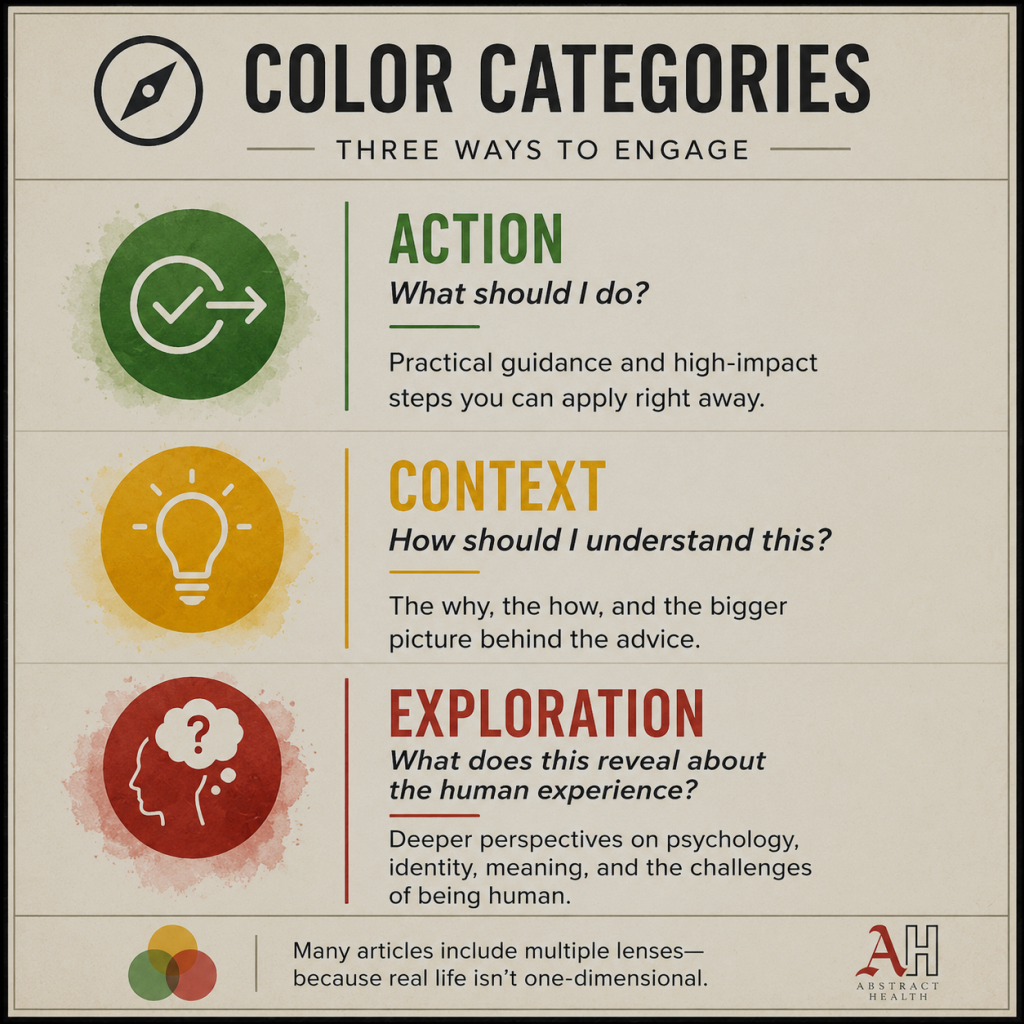
🔴🟡
We’ve previously discussed the Big Three, and how sleep, movement, and nutrition tend to make up a vast proportion of our foundation of health.
The weight of their importance is not speculation. It is the understanding that has developed from decades of rigorous research and proven outcomes.
It is simply where the evidence has led us.
But that doesn’t mean the conversation ends there.
Because while sleep, movement, and nutrition may form the foundation of physiological health, human beings do not live in laboratories.
We live in the real world, and the real world is messy.
A Hierarchy, Not a Rulebook
One of the recurring problems in health is our tendency to flatten everything into equal importance.
Sleep matters.
Movement matters.
Nutrition matters.
Stress matters.
Relationships matter.
Mental health matters.
Environment matters.
Purpose matters.
Everything matters.
But when everything becomes a priority, nothing really is.
The point of creating a hierarchy isn’t to suggest that everything outside the foundation is unimportant.
It’s to help us decide where our limited attention, energy, time, and resources are most likely to matter.
For most of us, most of the time, sleep, movement, and nutrition are reasonable places to invest.
But most of us, most of the time is an important qualifier.
Because life sometimes randomizes our hierarchy.
Not everything that influences our health is within our control.
Genetics. Environment. Access to healthcare. Life circumstances. Random chance.
And sometimes these variables create problems important enough to change our focus.
Foundational Doesn’t Always Mean First
Health Isn’t Magic — It’s Maintenance
Imagine we are maintaining a vehicle.
Oil changes matter. Tire rotations matter. Routine maintenance matters.
But if the alternator fails tomorrow, we don’t schedule an oil change first simply because oil changes are foundational to maintaining the vehicle.
We fix the alternator.
If water gets into the gas tank, we deal with the water.
If a tire blows out on the highway, tire pressure recommendations suddenly become irrelevant.
We address the most immediate threat to function and then return to maintaining the system.
Health isn’t all that different.
Someone living in an unsafe environment may have more pressing concerns than improving their exercise routine.
Someone experiencing immense psychological distress may need help addressing that before worrying about whether their nutrition is optimal.
Someone trapped in a destructive relationship may need to devote enormous amounts of physical and emotional capacity to changing their circumstances.
Someone experiencing grief, instability, trauma, addiction, or financial hardship may simply have a different hierarchy today than they did six months ago.
Sleep still matters.
Movement still matters.
Nutrition still matters.
They didn’t suddenly become physiologically irrelevant. Something else simply became more urgent.
What matters most in general is not necessarily what matters most right now.
The Reality of Capacity
This becomes especially important when we consider our capacity.
Health advice often seems to assume that we have an unlimited supply of time, money, attention, motivation, and emotional energy.
Improve your diet, exercise, sleep, stress levels, mental health, relationships, personal skills, professional skills, etc.
Every recommendation might be reasonable in isolation.
Together, they can become overwhelming.
Human beings have finite resources.
Sometimes improving our health means doing more.
Sometimes it means deciding what deserves our attention right now—and allowing other things to temporarily be good enough.
That isn’t abandoning our health.
It’s prioritizing it.
So What Comes After the Big Three?
Once our sleep, movement, and nutrition are reasonably supported, what deserves our attention next?
This is where the hierarchy becomes less defined.
Mental health.
Stress management.
Drug and alcohol use.
Relationships.
Environment.
Safety and stability.
Access to appropriate healthcare.
Purpose and fulfillment.
Growth and development.
And undoubtedly more.
Unlike the Big Three, I’m not convinced there is a universally correct order for everything that follows.
Things quickly become far more situational and personal.
One person may have supportive relationships but struggle immensely with stress.
Another may have purpose and fulfillment but live in an environment that makes healthy behavior difficult.
Someone else may exercise regularly, eat reasonably well, and sleep adequately while quietly struggling with their mental health.
Our averages begin to lose some of their usefulness as we move closer to the individual.
The question becomes less: What should everyone prioritize next?
And more: What is currently limiting this person’s ability to live well?
A Hierarchy Helps Us Prioritize. A Web Describes Reality.
There is another complication.
None of these variables exist in isolation.
Movement can influence our stress, mood, sleep, and physical capacity.
Sleep can influence our emotional regulation, decision-making, memory, appetite, and willingness to be active.
Healthy relationships can provide support that makes taking care of ourselves easier.
Unhealthy relationships can do the opposite.
Our environment influences what food is available, where we can move, how we sleep, what stressors we encounter, and what behaviors are considered normal.
Our mental health can influence nearly all of them.
And nearly all of them can influence our mental health.
There are thousands of permutations of this equation.
So perhaps a hierarchy is useful for deciding where to look first, while a web is more accurate for understanding how health actually works.
Sometimes improving one area creates enough capacity to begin improving more.
Moving the Odds
This complexity doesn’t mean we abandon hierarchy. It makes hierarchy more important. We are still trying to consistently move the odds in our favor using the variables we can meaningfully influence.
Health is based on probabilities, not absolutes.
We cannot control our genetics.
We cannot eliminate randomness.
We cannot always choose our environment, our circumstances, or what happens to us.
But we can look honestly at the life in front of us and ask where our effort might matter most.
Sometimes the answer will be sleep. Sometimes movement. Sometimes nutrition.
Sometimes it will be getting help.
Leaving an unhealthy environment.
Repairing a relationship.
Treating a mental health condition.
Reducing alcohol or drug use.
Finding community.
Creating stability.
Finding something worth getting out of bed for.
And sometimes the answer will change again.
That’s simply the variability of human existence.
Health Is Bigger Than Physiology
Physiological health matters.
Psychological health matters.
Philosophical health matters.
Ultimately, our pursuit of health involves addressing the things that meaningfully interfere with our capacity to flourish and live fully.
That doesn’t mean every possible health variable deserves equal attention.
And it certainly doesn’t mean every conceivable optimization strategy deserves a place in our hierarchy.
Cold plunges. Red light therapy. Continuous glucose monitors. Supplement stacks. Longevity protocols.
There will always be another variable we can measure, manipulate, purchase, or optimize.
But before we worry about squeezing another percentage point from the margins, it may be worth looking at the life carrying the physiology.
Are we safe and stable?
Are we connected?
Are we psychologically well?
Do we have enough capacity to participate in our own lives?
Do we have something meaningful to participate in?
These questions are harder to package into a protocol.
But that doesn’t make them less important.
Because ultimately, health isn’t the destination.
The purpose of health is life.
The Purpose & Burden of Health
We invest in ourselves so that we have more capacity to experience it.
To create.
To explore.
To love.
To contribute.
To show up for the people who matter to us.
To find meaning—and perhaps help others find their own.
The meaning of life is to give it meaning.
Health is simply the medium through which that pursuit travels.
So we clear the path as best we can.
Sometimes that means sleep, movement, and nutrition.
Sometimes life puts something else in the way.
And when it does, we address what is in front of us.
Then we keep moving.