When Information Becomes Identity
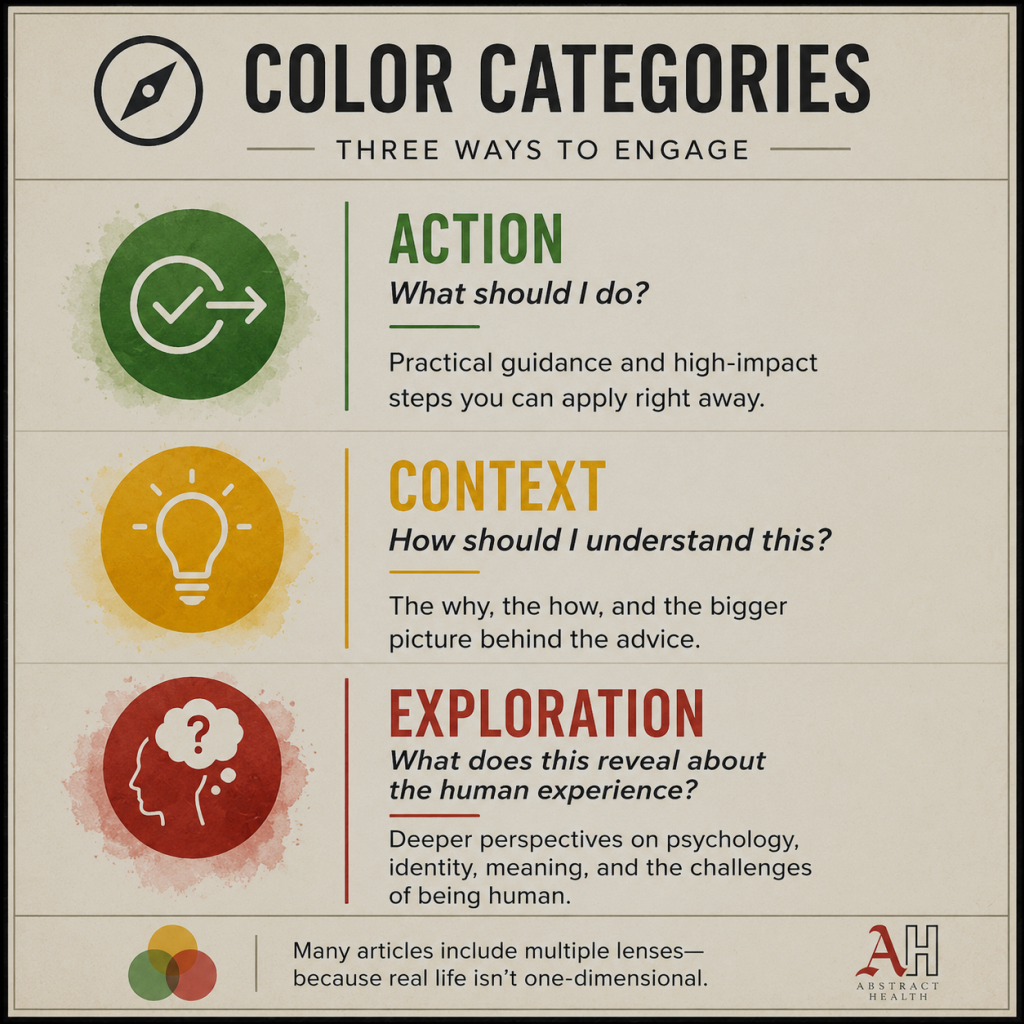
🟡
The biggest mistake we make isn’t being wrong.
Everyone is wrong sometimes. Science evolves, evidence accumulates, and our understanding improves over time. Recommendations change. Our own experiences change. Being wrong is not a character flaw—it’s an inevitable part of learning.
The real mistake is becoming the kind of person who is no longer equipped to discover they’re wrong.
That can happen more easily than we realize because human beings don’t simply collect information. We organize it into beliefs, habits, and eventually identities. Once a belief becomes part of who we are, changing our mind no longer feels like updating our understanding of reality. It feels like changing ourselves.
This isn’t just a health problem. It’s a human problem. Health simply gives us one of the clearest places to observe it.
From Information to Identity
Most ideas follow a similar progression. We encounter new information, interpret what we think it means, and gradually weave those conclusions into our broader worldview. Much of the time this process is helpful. It allows us to navigate an increasingly complex world without reevaluating every decision from scratch.
The difficulty begins when our conclusions stop being tools and start becoming part of our identity.
There’s a reason we do this. Building an identity helps us simplify an overwhelmingly complex world. It gives us stability, creates a sense of belonging, and allows us to move through life without constantly reevaluating every belief we hold.
The problem isn’t having an identity.
The problem is forgetting that it was meant to serve us—not imprison us.
Identity is a lot like the roots of a tree.
Roots provide stability. They anchor us. They determine where we draw nourishment.
The purpose of roots isn’t to keep a tree from changing. It’s to make growth possible.
Healthy roots don’t resist growth.
They make it possible.
You might think of it as three stages:
- Information: What have I encountered?
- Belief: What do I currently think this means?
- Identity: What does believing this say about who I am?
Information is what we encounter. Beliefs are how we organize it. Identity is what we build around it.
Once that shift occurs, our objective quietly changes. Instead of asking, What is most likely to be true? we begin asking, often without realizing it, What kind of person does accepting this make me?
The initial goal of accuracy slowly gives way to self-preservation.
Identity doesn’t just influence our conclusions. It quietly shapes the questions we ask, the evidence we notice, and the information that feels important enough to consider. Long before we consciously evaluate a claim, our identities have already influenced what captures our attention and what quietly fades into the background.
Why Updating Is So Difficult
Human beings naturally crave stability. We like routines, certainty, and the feeling that we’ve figured something out. Remaining genuinely open to new information is uncomfortable because it requires acknowledging that our current understanding may be incomplete.
That discomfort isn’t a weakness—it’s simply part of learning.
Bruce Lee famously encouraged us to “be like water.” Water doesn’t stubbornly resist reality; it adapts to it. Healthy thinking works the same way. We should be able to stay intact while remaining flexible in our conclusions.
That flexibility isn’t something we’re born with.
It’s a skill we develop over time by repeatedly choosing curiosity over certainty.
The more comfortable we become with updating our thinking, the less threatening new information feels.
When Health Stops Being a Tool
This pattern appears everywhere in health.
We stop saying, “I’ve found an approach that works well for me,” and begin saying, “This is who I am.”
The specific topic almost doesn’t matter. It may be a particular diet, an exercise philosophy, a supplement protocol, or an opinion about medicine itself. What matters is the psychological shift. The framework stops being something we use and starts becoming something that defines us.
Once that happens, discussions become more emotional. We become more defensive, criticism feels more personal, and disagreement begins to feel like disrespect.
Tribalism becomes attractive because it reinforces our sense of belonging, while shame and fear become effective tools for persuading others to stay within the group.
At that point we are no longer debating ideas. We are protecting identity.
Updating a health belief no longer feels like correcting a map. It feels like betraying ourselves—or the community we have attached ourselves to.
Identity Has More Than One Face
This process doesn’t only happen in wellness culture. It happens everywhere.
Sometimes identity is built around long-standing habits, traditions, and environments. People may resist healthier behaviors because those behaviors feel inconsistent with their upbringing, community, or lifestyle. The resistance isn’t always about the evidence itself. Sometimes it’s about what changing would symbolize.
But identity can also form in the opposite direction.
Many people begin by questioning conventional health advice, and that instinct can be incredibly valuable.
Healthy skepticism has challenged weak ideas, improved scientific understanding, and advanced medicine throughout history. Without skepticism, progress would likely be much slower.
The problem arises when skepticism quietly becomes an identity rather than a method.
A person may leave one mindset—
“I trust conventional health advice.”
—only to adopt another—
“I see through conventional health advice.”
The reasoning subtly shifts from asking, Is this claim well supported? to asking, Is this sufficiently anti-establishment for someone like me to believe?
The person has escaped one tribe only to join another.
The mechanism is exactly the same.
The Difference Between Skepticism and Contrarianism
Healthy skepticism asks questions because it wants better answers.
Contrarianism rejects answers because they come from the wrong place.
That distinction matters.
Healthy skepticism remains willing to accept a conclusion if the evidence supports it. Contrarianism begins with the assumption that conventional thinking is probably wrong and then searches for information that confirms that expectation.
Ironically, both unquestioning conformity and reflexive contrarianism share the same underlying weakness: they allow identity to determine which evidence deserves consideration.
One says, “Authorities believe it, so it must be true.”
The other says, “Authorities believe it, so it must be false.”
Neither position is genuinely following the evidence.
Both are allowing allegiance to replace discernment.
Healthy skepticism lives somewhere between those extremes. It continually asks:
- How strong is the evidence?
- How confident should I be?
- What evidence would change my mind?
- Am I evaluating this claim, or defending my identity?
Those questions don’t protect our conclusions.
They protect our integrity.
Becoming a Better Steward of Information
Perhaps our goal shouldn’t be to become someone who is always right.
Perhaps it should be to become someone who updates well.
That requires humility, curiosity, and the willingness to let reality reshape our thinking. It also requires recognizing that we are not the source of truth. We are simply its temporary stewards—conduits rather than containers.
A container is designed to hold onto what is placed inside it. Once a belief enters, it becomes something to protect and preserve. Over time, those beliefs can begin to feel like possessions, and eventually they become part of our identity.
A conduit serves a different purpose. Information passes through it. Some ideas withstand repeated scrutiny and continue forward. Others gradually lose weight as new evidence emerges and are allowed to fall away. A conduit isn’t concerned with defending every conclusion it has ever held. Its responsibility is to faithfully pass along the best understanding available at that moment.
That doesn’t mean changing our minds every time a new headline appears, like the kite in the windstorm. It means allowing the weight of evidence—not the comfort of certainty—to determine what we continue to believe and communicate.

Information isn’t something we own. It’s something we are entrusted with for a time. As stronger evidence emerges, our responsibility is to let go of weaker conclusions without feeling as though we’ve lost part of ourselves.
In many ways, intellectual honesty resembles good physical health. It isn’t a destination we reach once. It’s an ongoing practice that requires continual maintenance.
To read about the maintenance of health click here:
Health Isn’t Magic — It’s Maintenance
Root Your Identity in Learning
Perhaps our goal shouldn’t be to become someone who is always right.
Perhaps it should be to become someone who updates well.
That requires humility, curiosity, and the willingness to let reality reshape our thinking.
There is nothing wrong with recognizing consistent patterns and holding strong beliefs.
But there is something dangerous about holding our beliefs so tightly that they—and we—can no longer evolve.
The question isn’t whether we’ll build an identity. We all do.
The question is what we’ll root it in.
If our identity is rooted in being right, every challenge feels like a threat.
But if it’s rooted in the willingness to learn, new evidence becomes nourishment rather than danger.
That doesn’t mean changing our minds every week.
It means remaining willing to change when reality gives us a good reason to.
Trees don’t become stronger by refusing to bend toward the light.
They become stronger because they’re rooted deeply enough to keep growing toward it.
Health was never meant to become a belief system.
It was meant to help us navigate reality more effectively and improve our capacity to live well.
The body is governed by physiology, not ideology.
The people who make the greatest progress are rarely those who are always right.
They’re the ones who remain willing to become more right.
Learning From Experts
The willingness to update doesn’t apply only to ourselves.
It also changes how we relate to the people we learn from.
Every expert, researcher, clinician, and educator is working with an incomplete understanding of an endlessly complex reality. Some will be more accurate than others. Some will change their minds as new evidence emerges. Others won’t.
The goal is not to find people who are always right.
The goal is to become the kind of person who can recognize good reasoning—even when it comes from someone they disagree with—and flawed reasoning, even when it comes from someone they admire.
Because our favorite experts will get things wrong.
The question is whether both the teacher and the learner are willing to be comfortable with that.
Knowledge grows through imperfect understanding. As uncomfortable as that can be for our psychology, it is also the reality that allows us to move forward.
The next challenge isn’t learning how to think for yourself. It’s learning how to think with experts—without turning them into authorities who can never be questioned or adversaries who can never be trusted.
0 Comments
1 Pingback