Exploring the space between science and self.

Category: Uncategorized

Nutrition — Resources for Life

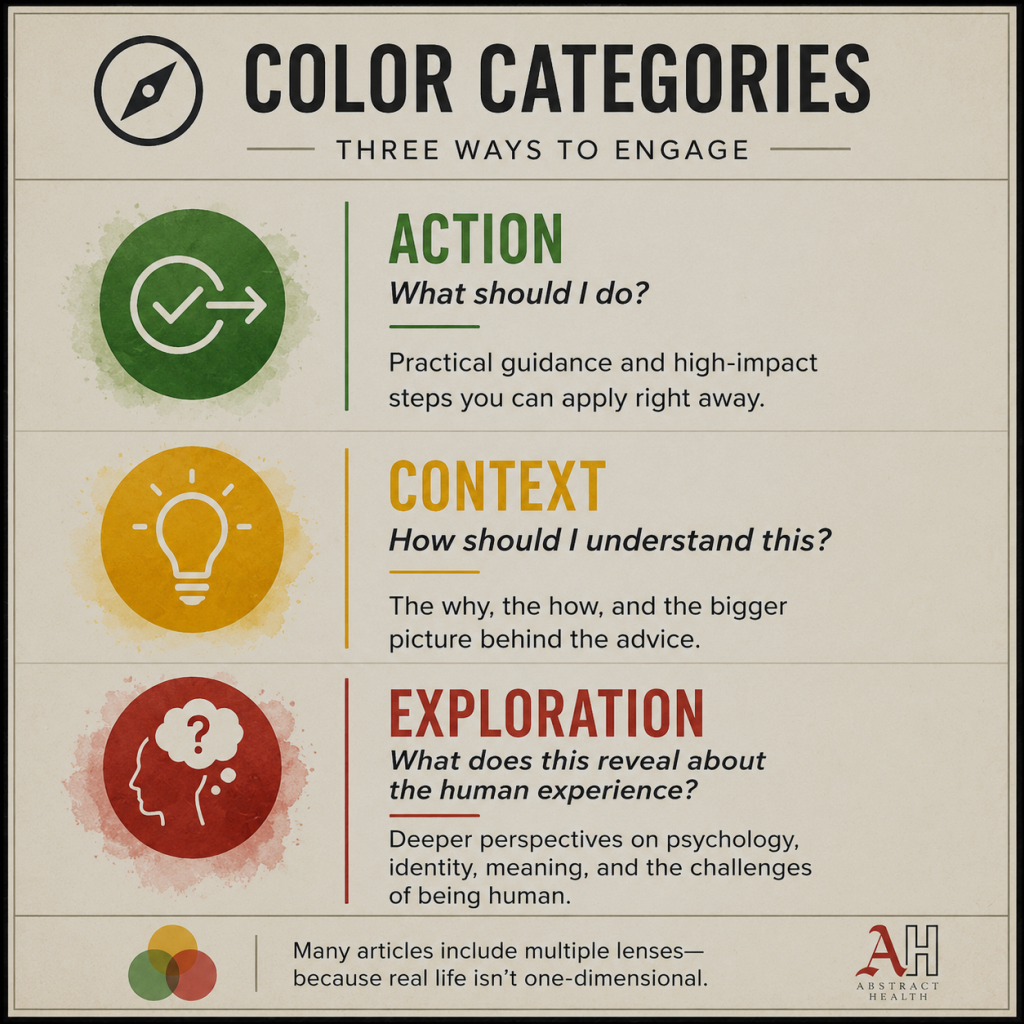
🟡🟢

This article is part of a series exploring what we’ve called The Big Three—sleep, movement, and nutrition. These foundational elements influence nearly every aspect of health, and each one strengthens the others. If you’re new to the concept, I recommend starting with The Big Three before continuing.

🟡 Our Challenges

Nutrition is difficult.

Realistically, it always has been.

There was a time when the greatest concern was simply having enough food. In other places and times, it was food safety, nutrient deficiencies, or the limits of what could be grown and preserved.

These days our challenges are different.

Not necessarily because we don’t know what to do, but because we did what humans have always done—we tried to improve things.

We improved transportation, communication, medicine, engineering, computing, and manufacturing. When we encounter a problem, we naturally look for ways to make it better.

Food was no exception.

We wanted food that tasted better, lasted longer, cost less, required less preparation, and could be available whenever we wanted it. In many ways, we succeeded. Food became safer, more affordable, more abundant, and more convenient than at almost any point in human history.

But every improvement comes with tradeoffs.

We became exceptionally good at making food rewarding. It became sweeter, saltier, richer, more shelf-stable, and easier to access. As a result, food also became easier to overconsume. Sometimes we improved nutritional quality along the way. Sometimes we sacrificed it.

At the same time, nutrition science was rapidly evolving. Researchers were asking better questions, collecting better evidence, and refining what we thought we knew. That’s exactly what science is supposed to do, but it also meant that recommendations changed as our understanding improved.

Then came marketing.

Health became profitable. Supplements, detoxes, miracle foods, fad diets, and endless nutrition claims all competed for our attention. Somewhere in the middle of all of that, nutrition stopped feeling straightforward.

Not because there wasn’t truth.

Because there were suddenly thousands of voices trying to explain it.

This idea was introduced briefly in Why Abstract Health?

So What Is Food Actually For?

When we strip away the marketing, the labels, and the trends, food has a remarkably simple purpose.

It provides the resources your body needs to build, repair, adapt, and function.

That’s what nutrition is.

It’s not a diet. It’s not an identity. It’s not a collection of rules.

It’s a resource delivery system.

Every heartbeat, every muscle contraction, every immune response, every hormone, and every act of repair depends on having the resources to do so. The body doesn’t respond to diet labels or marketing terms. It responds to nourishment.

Once you begin looking at food through that lens, much of nutrition becomes easier to understand.


Why Real Food Matters

Real food isn’t valuable simply because it’s natural.

It’s valuable because it tends to provide the resources your body needs in abundance.

Protein.

Fiber.

Vitamins.

Minerals.

Healthy fats.

Water.

And countless other compounds that support normal physiology.

That doesn’t mean every real food is equally valuable, nor does it mean every processed food lacks value. Most foods exist somewhere along a spectrum. Some provide many of the resources the body needs. Others provide fewer. Most fall somewhere in between.

The goal isn’t to memorize where every food belongs on that spectrum.

The goal is to build an overall pattern that consistently provides your body with the resources it needs to thrive.


Returning to the Fundamentals

Fortunately, the body has never cared much about trends.

It doesn’t know whether you’re eating Mediterranean, vegetarian, high-protein, or something else entirely. It simply responds to the nutrients and energy it receives—and the quantities in which it receives them.

That’s why the fundamentals continue to matter.

Not because they’re exciting.

Because they’re what the body is actually responding to.

This isn’t an argument against nutritional science. Clinical nutrition, medical nutrition therapy, biochemistry, and individualized recommendations all have an important place. As health becomes more complex, nutrition often becomes more specific.

But many people arrive at those conversations only after years of neglecting the fundamentals.

Think back to our discussion about vehicle maintenance. A well-maintained vehicle rarely needs specialized repairs. An aging vehicle with years of neglected maintenance often does. The increasing complexity reflects the condition of the system—not the foundation of maintenance itself.

The same principle applies to nutrition.


🟢 What to Do

1. Make Real Food Your Foundation

Build most of your meals from foods that reliably provide the resources your body needs. Protein-rich foods, vegetables, fruits, legumes, starchy tubers, whole grains, dairy, nuts, and seeds all make it easier to obtain protein, fiber, vitamins, minerals, and other nutrients that support healthy function.

The goal isn’t to eliminate every processed food.

It’s to make resource-rich foods the foundation rather than the exception.


2. Build Balanced Meals

Instead of asking whether an individual food is healthy, ask whether the meal is balanced.

Aim to include a source of protein, plenty of plant foods, and enough energy to support your body’s needs.

You don’t need to build the perfect plate.

You need a consistently well-built one.


3. Repeat the Fundamentals

Nutrition isn’t determined by your healthiest meal.

It’s determined by the pattern you repeat over weeks, months, and years.

Drink water regularly.

Leave room for foods you genuinely enjoy.

Recognize that some foods provide more resources than others, but don’t let perfection become the enemy of consistency.

The greatest benefits in nutrition rarely come from finding the perfect food.

They come from building a pattern you can sustain.


The Recalibration

Nutrition has become complicated because food became more rewarding, science became more detailed, and health became more marketable.

But the body’s needs never became nearly as complicated.

It still asks for the same things it always has.

Enough energy.

Enough protein.

Enough nutrients.

Enough consistency.

Food isn’t the goal.

Capacity is.

Nutrition matters because it provides the resources your body needs to build, repair, adapt, and preserve the capacity to live well.

That doesn’t require perfection. It requires a consistently balanced diet built primarily from real food.
Sleep — The Foundation in the Dark

🟡🟢

This article is part of a series exploring what we’ve called The Big Three—sleep, movement, and nutrition. These foundational elements influence nearly every aspect of health, and each one strengthens the others. If you’re new to the concept, I recommend starting with The Big Three before continuing.

We exist in a complex system that requires rest—even when we would prefer not to.

Life is busy.
Hectic.
Chaotic, at times.

And sometimes the only time we get to decompress is when we should be sleeping.

So we make a trade.

We barter time for recovery—
trying to maintain balance as best we can,
trying not to demand too much of the night,
so the day doesn’t demand too much of us.

For a while, it works.

Until it doesn’t.

We all have different relationships with sleep.

Some long for it but have a hard time finding it.
Some fight it.
Some feel most creative and alive at the exact time they should be deep into it.
Some would take a nap every day if life allowed it—drawn to the comfort, the stillness, the peace.
Others see it as an interruption. Something that gets in the way of doing more.

The idea that sleep is important is common knowledge. It goes without saying.
We understand its role in health.
And we feel the consequences when it’s missing—
mentally, physically, emotionally.

But understanding something in theory, and navigating it in real life, are not the same thing.
The clinical need for sleep must pass through the human condition.
And that reality reshapes our relationship with what we should do.

What Sleep Actually Is

Sleep is one of the few states where conscious control fades, and the brain shifts into a different mode of operation.

We don’t just shut off.
The system continues working—
organizing,
repairing,
regulating—

just outside of our awareness.

The Creative Potential of Sleep

There’s a long history of ideas that didn’t come from effort—but from rest.

Dmitri Mendeleev saw the structure of the periodic table in a dream.
Mary Shelley described Frankenstein as she was emerging from a restless night.
Paul McCartney woke up with the melody for “Yesterday” already formed.
These aren’t just interesting stories.
They point to something functional.

During the day, the mind is structured—focused and directed.

At night, that structure loosens just enough to allow new connections.

Creativity isn’t always about pushing harder.
Sometimes it’s about stepping back long enough for the system to do its work.

Sleep as a Foundational Lever

Out of the Big Three—sleep, movement, and nutrition—
sleep is arguably the most foundational.

They all influence one another.

But sleep often becomes the rate-limiting step—
the point at which the system can no longer keep up.

You can think of sleep as an internal organization process.
Like a librarian cleaning up, organizing, and restoring the environment after a full day of activity.

Everything you experienced during the day—
conversations,
stress,
information,
decisions—
all get sorted.

Some things are strengthened. Some are discarded.
Some are connected in ways they weren’t before.

Without that process, things don’t pause.

They accumulate.

Sleep Cycles, Simplified

Sleep isn’t one continuous state.

It moves through cycles—roughly every 90 minutes—
shifting between lighter sleep, deeper sleep, and REM sleep.

Deep sleep supports physical repair.
REM sleep supports learning, memory, and emotional processing.

Deep sleep restores the body.
REM sleep reorganizes the mind.

When sleep is shortened or fragmented,
these cycles get cut short—
and the system doesn’t complete its work.

The Tradeoff We Misunderstand

We often treat sleep as a tradeoff.

More time awake feels like more opportunity.
More productivity.
More control.

But the trade isn’t neutral.

You gain time—but lose clarity, efficiency, and stability.

At a certain point, you’re no longer gaining more time.
You’re simply getting less out of the time you have.

Sleep doesn’t just affect how you feel.
It changes how the system operates.

When sleep is compromised:
Hunger becomes less regulated.
Emotions become more reactive.
Stress responses become amplified.
Recovery slows.
Energy becomes less stable.
Mental precision becomes dulled.

You don’t just feel different.

You function differently.

More effort—less return.

Insight

We often try to fix other inputs.

Better diet.
Better workouts.
More effort.

But sleep sits underneath all of it.

It’s part of the maintenance system—
the one that determines whether anything else actually works.

You can tolerate imperfect nutrition for a while.
You can get by with low movement—for a time.

But when sleep is consistently compromised—
the system begins to shift. And everything built on top of it becomes less reliable.

Before we try to optimize everything else, it makes sense to stabilize the foundation.

Not perfectly. But consistently enough that the system can respond.

Because once sleep is in place—
everything else doesn’t just improve.
It becomes easier to improve.

🟢 What to Do (High-Leverage Actions)

Do it well. Do enough. Do it often.

Start Here (Highest Return for the Effort)

Wake up around the same time every day (±30–60 minutes). The closer to a consistent time, the better—but anything helps. Waking up at a consistent time builds sleep pressure that can help make bedtime easier.

Get light exposure as soon as possible after waking. This helps anchor your circadian rhythm, making it easier to fall asleep that night.

Limit caffeine after early afternoon (~1–2 PM).

Dim lights and reduce screen exposure 1–2 hours before bed.

QUALITY — Sleep Better While You’re There

Keep your room cool, dark, and quiet.

Remove or cover unnecessary light sources (TVs, LEDs, clocks).

Use blackout curtains, a sleep mask, or white noise if needed.

Reserve your bed for sleep and sex.

Avoid alcohol and heavy meals within 2–3 hours of bedtime.

Build a simple, repeatable wind-down routine.

QUANTITY — Give Your Body Enough Time

Aim for 7–9 hours of sleep.

Set a consistent wake time first, then work backward to determine your bedtime.

Don’t rely on weekend catch-up sleep.

Protect sleep like any other important appointment.

CONSISTENCY — Stabilize the System

Keep sleep and wake times within about an hour or less—even on weekends.

Get daily sunlight exposure.

Avoid large late-night meals—not because eating late is inherently “bad,” but because digestion and reflux can interfere with sleep.

Keep exercise timing relatively consistent. Training too close to bedtime may delay sleep onset.

Minimize These

Late caffeine

Late-night screens and bright light

Irregular sleep schedules

Alcohol as a sleep aid

Long or late naps

If You Can’t Sleep

Don’t stay in bed frustrated.

Get up, keep the lights low, and do something relaxing.

Return to bed when you feel sleepy.

Train the association:

Bed = sleep, not stress.

Tips for Sleep Onset

Read a book.

Listen to relaxing music.

Drink warm tea (caffeine-free) or warm milk.

Take a warm shower or bath (keeping lights dim).

Practice deep breathing.

Journal.

Write tomorrow’s to-do list so it isn’t competing for your attention.

Bottom Line

Sleep doesn’t need to be perfect.

It needs to be repeatable and sufficient.

Get this right, and everything else—

nutrition,
movement,
stress—

becomes easier to improve.

Why Abstract Health

Why Abstract Health Exists

Health is supposed to improve our lives.

To increase the value and potential of each day—because we have the capacity to build a better life.
To whatever degree we choose.

But for many, it can feel like the opposite.

Something that should contribute to function and freedom often becomes another source of pressure—

another set of rules to follow.

Another area of life that feels like it constantly needs attention… or else we’re falling behind.

These days, there’s more information than ever — more experts, more opinions, more systems, more headlines.

Yet people often feel more confusion than comfort.

Most people want to listen, but it can be incredibly difficult to find the core signal amidst all the noise.

The modern health space is incredibly loud.

News outlets and social media feeds are filled with supplement ads, research headlines, expert disagreements, personal experiences, podcasts, books, and endless streams of advice.

We often laugh at health-related marketing from decades past, but every day brings new claims, warnings, optimization strategies, fearmongering, and so on that are often equally as ridiculous.

The sensationalism, aggressive marketing, and performative health can feel like an assault to the senses.

What’s worse, appropriate prioritization and nuance get drowned out by the loudest voices.

The least important topics get the most attention.

And the most important ones—foundational, simple, and often unexciting—are barely detectable.

It starts to feel like trying to pick out the sound of someone’s voice in a crowded cathedral—sifting through the infinite roar of echoes.

At a certain point, it becomes difficult to determine what’s actually true, and we get annoyed by the wasted energy of trying.

For many, the health space has become so chaotic and convoluted that they choose to disengage with the topic entirely.

This is understandable, and respectable.

We have lives to live, and boundaries need to be set whenever the cost of an endeavor is more than the benefit it provides.

The unfortunate reality is that the benefit hidden within that noise is well worth the effort
we just need better guidance through it.

The term “health” also means much more than we typically give it credit for.

Health is physical.

Health is mental.

Health is also emotional, social, relational, existential…

We don’t experience health in isolation.

We experience it through our thoughts, emotions, behaviors, relationships, environment, and the broader context of our lives.

When these layers are ignored, we end up trying to solve complex human problems with simplified, often short-sighted solutions that don’t take our individual lives into account.

We can start to believe that our lack of health is a product of not having the perfect meal plan, exercise routine, supplement, equipment, fitness clothing, morning routine, etc.

While some of these solutions may be useful, they are rarely enough on their own.

Pattern recognition is important.

If you work in any field long enough, you begin to notice common threads—the core, foundational principles that continue to hold up, regardless of trends, debates, or new waves of information.

And we realize the exciting, complex insight that often pulls people into health-related fields is less useful in everyday life.

What feels like depth often turns out to be detail.

And that detail, while valuable in the right context, is rarely what most people are actually missing.

At some point, it becomes necessary to step outside of the field.

We have to expand our view to include behavior, habits, beliefs, and even the health conversation itself.

Not to reject it.
But to better understand it.

An unexpected path.

A few years ago, someone asked me why I hadn’t started a health blog or YouTube channel.

My answer was immediate.

I didn’t want to add to the noise.

My external response was calm and direct.
My internal response was much more jarring—visceral.

The thought of adding another source of information, and noise, felt wrong.

It felt irresponsible to add another voice. Another echo in the cacophony of noise.

But over time, that perspective shifted. The noise didn’t go away, but my position in relation to it changed.

Abstract Health exists as a way to step outside of that noise.

Not to add another system. Not to compete for attention.

But to examine the conversation itself.

To explore the space between science and self.

Between what we know… and how well we live.

This is a space for perspective more than prescription.

It’s about identifying the signal amidst the noise—while still honoring the reality in which the signal exists.

It’s about relieving pressure.

Most people just want to know how to take care of themselves and those they care about.

They shouldn’t have to study like they’re trying to become a health professional just to do that.

You won’t find fear-based messaging here.

Or exaggerated claims.

Or constant pressure to optimize every little thing.

Just grounded, honest perspectives intended to make health feel a little more understandable—and a little less overwhelming.

Because the goal isn’t optimization.

It’s clarity.

It’s relief.

And the ability to move forward without constantly feeling like you’re doing it wrong.

Welcome to Abstract Health.

A different way of approaching something that was never meant to feel this complicated.

Or this heavy.

© 2026 Abstract Health

Theme by Anders NorenUp ↑