Exploring the space between science and self.

Author: Abstract Health (Page 1 of 2)

Health Marketing and the Inversion Principle

🟡

We have never had more access to health information.

Nutrition, exercise, sleep, supplements, hormones, longevity, gut health, inflammation, metabolism, recovery, environmental exposures—the list is nearly endless. Books, podcasts, documentaries, social media, advertisements, experts, organizations, and algorithms all compete for some portion of our attention.

Access to information is no longer the primary problem.

Knowing how much importance to assign to it might be.

Health information does not reach us in proportion to how much it matters. Some ideas receive enormous amounts of attention. Others quietly sit in the background. And over time, it becomes easy to assume that the things we hear about most must also be the things that matter most.

Unfortunately, those two things are not always related.

Information Has to Travel

There is an important distinction between reality and the information we eventually receive about it.

Research attempts to describe reality. Experts interpret research. Organizations synthesize it into recommendations. Educators, journalists, companies, influencers, and other communicators translate it again before eventually presenting some version of it to us.

In very simplified form, we might imagine something like:

Reality → Evidence → Experts and Organizations → Media and Communicators → Us → Behavior

Some amount of filtering is unavoidable.

In fact, it is often useful.

Most of us cannot personally evaluate every study relevant to every decision we make. We depend on other people to organize, interpret, simplify, and communicate information. This is one of the great benefits of expertise.

But every layer also introduces its own limitations and incentives.

Organizations may favor stability and consensus. Researchers may be more interested in novel questions than settled ones. Media needs stories worth reporting. Companies need products worth buying. Content creators need something worth clicking, watching, sharing, or discussing.

None of this requires a conspiracy.

It simply requires incentives.

And incentives can change which information becomes most visible.

Attention Is a Selection Pressure

Imagine trying to build a successful health platform by repeating the same basic message every week:

Get enough sleep.

Move regularly.

Eat a reasonably balanced diet.

Exercise.

Don’t smoke.

Maintain a healthy body composition.

Build supportive relationships.

Manage stress as well as your circumstances allow.

There is plenty of nuance within those recommendations, but the basic message eventually becomes rather boring.

Now compare that with a new supplement, a newly discovered biological mechanism, a controversial ingredient, an unusual diet, a hidden toxin, a provocative research finding, or a previously unknown way to “optimize” something.

One gives us another reminder of something we probably already know.

The other gives us a reason to pay attention.

Modern information systems depend heavily on that attention. Views, clicks, purchases, shares, comments, subscriptions, and watch time all provide feedback about what captures it.

Over time, attention becomes a kind of selection pressure.

Ideas that attract it are reproduced.

Ideas that don’t are discussed less often.

That does not necessarily select for false information. Plenty of popular health information is accurate.

But it doesn’t necessarily select for importance, either.

And that creates a problem.

The Inversion Principle

We can think of health as a pyramid.

The broad base consists of relatively boring fundamentals: sleep, movement, nutrition, avoidance of major risks, and other behaviors that consistently influence our health over time.

As we move upward, we encounter increasingly specific questions.

Which foods?

Which exercises?

How much?

When?

Which supplements?

Which biomarkers?

Which recovery methods?

Which tiny optimization might provide another fraction of a benefit?

Those questions can be completely legitimate. Sometimes they matter considerably for a particular person or circumstance.

But generally, as we move upward, the potential effect also becomes smaller and more conditional.

Our attention often moves in the opposite direction.

The fundamentals are familiar. There isn’t always much new to say about them. They’re difficult to sell as discoveries because everyone already knows they exist.

The margins are different.

They offer novelty, specificity, controversy, optimization, fear, hope, and the possibility that we have discovered something everyone else has missed.

This creates what we might call the Inversion Principle:

The amount of attention a health topic receives can become inversely related to its practical importance.

The pyramid gets flipped.

The narrow margins receive enormous attention while the broad foundation quietly disappears into the background.

The Cost of the Inversion

This creates a second problem that may be even more important.

Attention is finite.

When marginal topics are aggrandized, something else has to give.

At best, the fundamentals simply receive less attention. Everyone acknowledges that sleep, movement, nutrition, and consistency matter, but they become the obligatory paragraph before returning to the more interesting subject.

At worst, those fundamentals have to be diminished to make the marginal claim seem more important.

The basics become outdated.

Calories supposedly don’t matter.

Exercise is insufficient.

Conventional nutrition is portrayed as fundamentally misguided.

Sleep is important, but what you really need is…

A well-supported principle gets weakened so that a smaller idea can occupy more space.

This is where health communication can become misleading even when individual statements remain technically true.

There is nothing wrong with discussing the margins. Science advances by exploring them. There is nothing wrong with discussing a small effect as long as we acknowledge that it is small.

The problem occurs when our communication no longer reflects the hierarchy of the evidence.

A person can make a series of technically accurate statements and still leave the audience with a deeply inaccurate understanding of what matters.

Whether intentional or not, there is a degree of intellectual dishonesty in that distortion.

Accuracy isn’t only about whether each individual statement is true.

It is also about whether we represent its importance honestly.

Why Good People Can Drift

We should be careful not to turn this into a story about villains.

Most distortion probably doesn’t begin with someone deciding to deceive an audience.

People adapt to their environments.

A researcher notices that certain findings generate interviews.

A physician discovers that confident statements travel farther than uncertain ones.

A dietitian realizes that a post about a supplement receives dramatically more attention than another reminder to eat more vegetables.

An educator discovers that disagreement generates more engagement than consensus.

The lesson arrives quietly:

People want more of this.

And so we give them more.

The incentives do not have to change someone’s beliefs. They can simply change what they choose to emphasize.

Over enough time, that can change the information environment itself.

Different Filters, Different Weaknesses

This is also why we shouldn’t respond by simply choosing one source of information and distrusting everything else.

Individuals and organizations have different strengths and weaknesses.

Organizations can be slow. Consensus can lag behind emerging evidence. Bureaucracies can compress complicated information into recommendations that lack satisfying detail.

But media and independent communicators have vulnerabilities in the opposite direction. They can move quickly toward novelty, controversy, certainty, and ideas that have not yet earned their place.

One system may be biased toward stability.

Another may be biased toward movement.

Neither bias automatically makes the information wrong.

It simply tells us something about the filter through which it passed.

The goal isn’t to find a source with no filters.

It’s to become better at recognizing them.

Restoring the Hierarchy

The solution is not to stop learning.

Curiosity is valuable. New research matters. Details matter. Sometimes what appears marginal today becomes foundational tomorrow.

The goal is simply to keep those ideas in proportion.

When we encounter a health claim, we can ask a few basic questions.

Where does this sit in the hierarchy?

How large is the likely effect?

How strong is the evidence?

What foundational behavior might matter more?

Is the confidence of the message proportional to the certainty of the evidence?

And perhaps most importantly:

Is this information changing what I should actually do?

Sometimes the answer will be yes.

Often it won’t.

That is okay.

Health Should Eventually Become Boring

There is a strange irony to becoming knowledgeable about health.

At first, learning creates complexity.

We discover mechanisms, competing theories, biomarkers, supplements, interventions, controversies, and endless opportunities for optimization.

Eventually, though, good understanding should begin simplifying things again.

We learn which details matter.

We learn which ones matter only sometimes.

And we learn which ones are interesting without being particularly important.

The goal isn’t to become cynical about health information, experts, organizations, media, or new ideas.

It is to become a better navigator of them.

Because the greatest challenge in modern health may no longer be finding information.

It may be assigning information the appropriate amount of importance.

The healthiest life is rarely built by consuming more and more health content. It is built by consistently applying a relatively small number of well-supported principles—and then allowing those principles to support the rest of our lives.

The margins can still be explored.

We just shouldn’t mistake them for the foundation.

The Strengths and Weaknesses of Expertise

Individuals, Organizations, and the Map of What We Know

🟡

As we discussed in Your Favorite Expert is Wrong, no single person can see the entire landscape.

That is true in almost every sufficiently complicated field, but it is especially obvious in health.

Nutrition alone spans metabolism, physiology, psychology, epidemiology, food science, behavior change, public health, medicine, statistics, economics, and more. We can spend an entire career studying a relatively narrow portion of that terrain and still reach the end knowing how much remains outside our view.

This is one reason expertise matters.

But it is also why expertise has limits.

An individual expert is a little like someone standing along the shoreline of an enormous island. From where they stand, they may be able to describe their section of the coast in extraordinary detail. They can identify rocks, coves, currents, elevations, and landmarks that someone standing miles away cannot see.

Move around the island, however, and the landscape changes.

Another expert may be looking at the same island from a completely different angle.

Their map may look different without necessarily being wrong.

This creates one of the central problems of expertise:

How do we build a useful map when no single person can see the whole island?

Building the larger map

One solution is to combine observations.

Professional organizations, scientific societies, governmental agencies, consensus panels, and other institutions attempt to do exactly this. Their structures and responsibilities differ, but they share an important function: reducing our dependence on the judgment of any single individual.

Researchers and professionals become the explorers and observers. Organizations help act as the cartographers. And the resulting guidance becomes the shared map.

Instead of relying on a single person’s interpretation of the evidence, we gather the observations of many people. We compare them. We look for areas of agreement. We examine where findings repeatedly overlap.

Over time, the shared portions of those maps begin to tell us something important.

If hundreds of researchers using different methods, populations, laboratories, and perspectives continually describe the same mountain, we become increasingly confident that the mountain is actually there.

This is one of the great strengths of organizations.

They reduce our dependence on any individual expert.

An individual can be unusually insightful. An individual can also be unusually wrong.

Organizations reduce some of that variability by forcing information through multiple layers of scrutiny before it becomes official guidance.

In that sense, organizations are not necessarily the authors of the map.

They are more like its cartographers.

They gather observations from across the landscape and attempt to create a representation that is useful enough for everyone else to navigate.

And when this process works well, the resulting map is extraordinarily valuable.

Why organizational guidance tends to be conservative

This also explains something about institutional recommendations that can otherwise be frustrating.

They tend to be conservative.

An interesting new study does not immediately redraw the coastline.

Neither should it.

Something generally has to meet a threshold before it becomes part of broad guidance. Findings need to be replicated. Methods need to withstand criticism. Alternative explanations need to be considered. The potential benefits of changing recommendations need to outweigh the possibility that the original observation was misleading.

This acts as a kind of filter.

Ideas that fail basic standards of rigor are prevented from entering the map.

But intriguing ideas near the frontier may also be withheld until we understand them better.

That means organizations tend to perform best in the overlapping areas of the map—the portions of the island we have examined repeatedly enough to describe with reasonable confidence.

They are usually less useful at describing the unsettled edges.

This is often a point of frustration for many professionals in a field, especially the ones who pay attention to emerging trends in science and research.

But the hesitation and rigor aren’t necessarily failures. They are partly what these organizations are designed to provide.

We want public-health guidance to be more resistant to speculation.

We want clinical recommendations to require more evidence than interesting hypotheses, even if those hypotheses might eventually become guidance.

The obvious cost of that stability is speed.

The same filter creates blind spots

The mechanisms that protect organizations from prematurely embracing weak ideas can also make them slow to embrace good ones.

Maps take time to update.

Evidence may accumulate for years while official recommendations remain largely unchanged.

Institutions develop procedures, committees, standards, reputations, and bureaucracies. Updating a guideline is not equivalent to one individual simply changing their mind.

And institutions are composed of human beings.

That means they inherit some distinctly human problems.

Status can matter. Hierarchies can develop. Professional identity can become entangled with particular ways of thinking.

Consensus can occasionally become something we perform rather than something we continue to update.

At its worst, professionalism can subtly transform from maintaining intellectual standards into performing professional conformity.

Those are not the same thing.

A field benefits enormously from standards. It benefits much less when those standards become a substitute for thinking.

Organizations also operate within political and economic realities. They need funding. They interact with governments, industries, advocacy groups, and other institutions.

They may have to balance scientific precision against what is practical at a population level.

Years ago, I came across an idea that has stuck with me ever since: science is often simplified for the sake of a clear public-health message. That simplification can be necessary, but it also means some nuance, uncertainty, and individual variability are inevitably lost in translation.

That does not mean we should assume corruption whenever we dislike a recommendation.

It simply means organizations have incentives and vulnerabilities just as individuals do.

The biases are different.

Why we still need the individuals

Fortunately, the official map is not the entire landscape.

Individual professionals continue standing along the shoreline.

Some spend decades studying one particular section and discover details that would be impossible to include in a broad population-level map.

Some explore new territory. They ask questions that have not been answered yet. They notice inconsistencies. They challenge established assumptions.

Occasionally, they discover that a section of the map needs to be redrawn.

This is another reason individual expertise matters.

Organizations are very good at consolidating what has already been observed.

Individuals are often better positioned to explore what has not.

We need both.

But exploration introduces its own problems.

Not everyone standing beyond the edge of the established map is discovering new territory.

Sometimes we mistake uncertainty for opportunity.

Sometimes we become so excited by a new observation that we exaggerate its importance.

Sometimes we convince ourselves that because the official map lacks detail, whatever we have drawn must be superior.

And sometimes people go looking for treasure.

The frontier attracts genuine explorers, but it also attracts people who recognize that there is money, status, attention, or influence available to whoever claims to have discovered something first.

Those motivations can coexist.

A professional can genuinely care about their field while also enjoying the attention their ideas receive.

None of us are completely immune to incentives.

Which means individual freedom comes with an additional burden.

The burden of independent thought

When we move away from organizational guidance, we also move away from some of its safeguards.

There is no committee sitting beside us. There may be no formal review process.

Our judgment becomes more consequential.

That makes intellectual discipline increasingly important.

We have to ask whether we are following the evidence or simply finding evidence that supports what we already believe.

We have to recognize when expertise has begun turning into identity.

We have to separate the excitement of novelty from the strength of evidence behind it.

We have to remain aware that attention, ego, financial incentives, professional recognition, and belonging can quietly influence what we choose to emphasize.

Independent thinking is not simply freedom from authority.

It is accepting greater responsibility for the quality of our own reasoning.

The farther we venture beyond the established map, the greater that burden becomes.

That distinction matters.

“Do your own research” sounds empowering until we recognize how difficult good research actually is.

The goal should not be to replace institutional dogma with individual dogma.

It should be to use each level of expertise for what it does well.

We need the map and the explorers

There is a tendency in modern health conversations to ask which side deserves our trust.

The institution or the individual.

The guideline or the expert.

Consensus or the contrarian.

But that may be the wrong question.

The larger scientific system works because these forces can correct one another.

Individual professionals explore.

Researchers test.

Other researchers challenge.

Organizations consolidate.

Guidelines stabilize.

Then new observations eventually challenge the map again.

The process is imperfect because every part of it is populated by imperfect people.

But imperfection is not the same as uselessness.

Governmental and professional organizations help construct the shared map—the portions of the terrain that have been examined often enough that we can navigate them with reasonable confidence.

Individual professionals give us resolution.

They show us details along particular sections of the map. Some explore new frontiers. Some challenge parts of the existing map. Some discover genuine treasure.

And inevitably, some discover that selling maps can be more profitable than making them accurate.

Understanding those differences becomes increasingly important as information moves beyond science and into the public conversation.

Because once ideas leave the cartographers and explorers, they enter another environment entirely.

There, information does not compete solely on the strength of its evidence.

It begins competing for our attention.

Your Favorite Expert is Wrong

🟡

Your favorite expert is wrong.

And if they understand that, it may make them more likely to be right—at least until better information gives them reason to change.

It may also be one of the best reasons to trust them.

This does not mean the information they provide is useless, or that expertise is some elaborate illusion. It means something far less dramatic and much more important:

Even the most knowledgeable people are working with incomplete information.

They are building the clearest understanding they can from evidence that is still accumulating, experience that is limited, and a reality far more detailed than any one person can fully comprehend.

The job of an expert is not to become infallible. It is to be reliably useful while remaining willing to change.

This is uncomfortable for us because we want certainty. At a deep level, uncertainty feels dangerous. We want clear answers, definitive guidance, and something we can follow without hesitation. We want to find someone who has figured it out so that we no longer have to carry the burden of questioning it ourselves.

In the last article, we discussed what happens when information becomes identity. But experts can become part of that identity too.

We find someone whose ideas make sense to us. They may share our values, our background, or our frustrations. Their explanations feel coherent, their confidence feels reassuring, and their guidance may genuinely improve our lives.

Eventually, however, it can become difficult to separate our trust in the person from our evaluation of the information. We stop asking whether a particular claim is well supported and begin assuming it must be true because of who said it.

That is a dangerous amount of responsibility to give anyone.

The Blunt Edge of Knowledge

We often describe the most advanced thinkers in a field as being at the “tip of the spear.”

It is an appealing image because it suggests precision: a single sharp point representing the furthest edge of human understanding. One correct answer, with one expert standing valiantly at the peak.

But where serious and informed debate still exists, our knowledge may not be sharp enough to produce one definitive point.

The tip is often blunt.

Imagine our understanding as a cone. At the bottom, there is a wide range of possibilities. There is noise, contradiction, confusion, and relatively little ability to distinguish one explanation from another.

As knowledge improves, the cone narrows.

Patterns emerge. Principles become more reliable. Some possibilities are eliminated, and the signal becomes easier to distinguish from the noise.

But the cone does not always narrow into a perfect point.

Near the top, there may still be a small range of reasonable interpretations. Multiple perspectives can exist there simultaneously, each supported by credible evidence, experience, and reasoning.

At that level, disagreement is not always a battle between truth and ignorance. It may be a disagreement about nuance, context, application, or the relative importance of small differences.

This does not mean that every position is equally valid.

The cone has still narrowed considerably. There are ideas that have been filtered out because they are unsupported, implausible, or repeatedly contradicted by better evidence.

Uncertainty is not the same as knowing nothing.

It simply means that our current understanding may support a range of reasonable conclusions rather than one absolute answer.

Nutrition provides an easy example.

A well-constructed plant-based diet can support health, longevity, and performance. So can a well-constructed omnivorous diet.

There are meaningful differences between them. Individual needs, genetics, culture, access, preferences, and medical conditions can all affect which approach is most appropriate.

But arguing that one is universally superior in every possible context usually requires exaggerating relatively small distinctions while ignoring the large amount of territory the two approaches share.

Up close, the experts defending these positions may appear to be standing far apart—debating from a distance.

Zoom out, and they are often standing within the same narrow plateau, looking from slightly different angles.

The Map Is Not the Terrain

No single expert sees the entire landscape.

Each person builds a map from the evidence, education, and experience available to them. Some maps are exceptionally detailed, but usually only in certain areas.

A researcher may understand one mechanism with extraordinary depth. A clinician may see how that mechanism behaves in complicated human beings. Another discipline may reveal environmental, psychological, or social factors that further modify that person’s reality.

Each map can be valuable without being complete.

When we layer credible maps together, the overlapping areas become especially useful. Recurring patterns begin to reveal the parts of the terrain we can navigate with the greatest confidence.

This is why both depth and breadth matter.

Depth allows an expert to see details that most people cannot. Breadth prevents those details from being mistaken for the entire landscape.

Following one voice too closely can create a kind of blindness through precision. We may gain tremendous clarity in one direction while gradually losing perspective everywhere else.

Does this mean we all have to become experts at evaluating experts?

Not quite.

Not all sources deserve equal weight, and consuming a larger number of opinions does not automatically create a more accurate understanding. A fringe claim does not become credible simply because it provides an alternative perspective.

Track record matters.

Relevant education and experience matter.

Intellectual honesty matters.

The willingness to distinguish strong evidence from speculation matters.

We can also look for patterns across multiple credible sources. When respected researchers, experienced professionals, and reputable organizations independently arrive at similar conclusions, that overlap should carry more weight than the certainty of one unusually persuasive person.

Consensus is not infallible. But it is still meaningful.

It represents many imperfect maps pointing toward similar features in the terrain.

When the Margins Become the Main Discussion

One of the ways we cope with uncertainty is by giving disproportionate attention to the questions that have not yet been settled.

Rather than accepting “we don’t know yet,” we continue searching for increasingly specific answers.

Over time, marginal differences can become primary discussions—not because they are the most important parts of the field, but because they are among the few places where uncertainty remains.

The fundamentals become familiar, so they stop feeling interesting.

Meanwhile, the unsettled edges feel new. They provide room for debate, novelty, and confident interpretation. A subtle distinction gets enlarged until it appears to challenge everything we previously understood.

We begin asking small, preliminary, or highly context-dependent findings to resolve much larger questions than they are capable of answering.

The hierarchy becomes distorted.

The small area of uncertainty begins receiving more attention than the much larger foundation of agreement beneath it.

This is one reason experts can appear to disagree far more than they actually do. Public discussion tends to concentrate on the remaining areas of friction, while the enormous amount of shared understanding goes largely unmentioned.

We mistake refinement for contradiction.

But the fact that experts continue debating the final details does not mean the foundation has disappeared. It often means the foundation is strong enough that they now have the luxury of examining smaller and smaller differences.

The attraction to these margins can be especially strong early in a professional career.

When our own knowledge is expanding quickly, every new mechanism, study, or competing theory can feel as though it might reorder the entire map. What newer professionals often lack is not intelligence or effort, but the perspective that comes from watching promising ideas weaken, change, or disappear as the evidence develops.

Seasoned professionals have typically watched this cycle play out many times. They may remain curious about emerging ideas, but they are less likely to mistake novelty for importance.

They have seen findings that initially appeared revolutionary become narrow exceptions, minor adjustments, or historical footnotes. Many eventually realize that repeatedly gambling their attention on high-risk, high-reward ideas rarely produces guidance more useful than what already exists within the overlapping areas of the map.

Those overlapping areas are familiar for a reason.

They have survived repeated scrutiny.

Professional maturity does not mean ignoring the frontier or becoming resistant to change. It means allocating attention more proportionately. A mature expert can explore what might be true without allowing it to displace what has already proved reliable.

They continue investigating the edge.

They simply stop mistaking it for the foundation.

This progression is not guaranteed. Experience can also harden into complacency. But when expertise matures well, curiosity remains while hierarchy improves.

What Makes an Expert Trustworthy

The most trustworthy experts are not necessarily the people who sound the most certain.

They are the people whose confidence is proportional to the strength of the evidence.

They can speak clearly about what is well established without pretending that every remaining question has been resolved. They can hold a strong position while remaining willing to revise it.

They are comfortable saying:

“I don’t know.”

“I’m not sure.”

“I need to look into that further.”

“I’ve changed my mind.”

These statements are sometimes interpreted as weakness because we have learned to associate confidence with competence.

But humility is not the refusal to commit to anything. It is the ability to recognize where confidence is justified and where the limits of our knowledge begin.

Theoretical physicist John Archibald Wheeler captured this beautifully:

“We live on an island surrounded by a sea of ignorance. As our island of knowledge grows, so does the shore of our ignorance.”

As our knowledge expands, so does our awareness of what remains unknown. That growing boundary creates more territory to explore—but also more room for people willing to manufacture certainty.

An expert who stops adapting does not necessarily become wrong overnight. They become a time capsule.

They remain a representation of what was understood at a particular moment. As evidence accumulates and context changes, the distance between their map and our best current understanding may slowly begin to widen.

That is why disagreement can be valuable. It creates friction that forces ideas to be examined. It can reveal blind spots, expose weak assumptions, and clarify exactly where two perspectives begin to separate.

Not every opposing argument is correct, honest, or worth equal consideration.

But thoughtful disagreement among credible people is not a failure of expertise. It is one of the ways expertise improves. It is how we keep the map up to date.

The goal is not to abandon conviction.

It is to hold our convictions loosely enough that they can still be refined.

One of Many

We seek experts partly for convenience.

None of us has enough time to independently investigate every subject that affects our lives. We have to rely on other people. We have to decide which voices have earned more of our trust.

But trust should not require intellectual surrender.

Even the best source should not become our entire source of information. Once one person supplies our complete worldview, we are no longer evaluating their conclusions. We are inheriting them.

I hope Abstract Health becomes a source that people trust.

But I am one of many, and there should never be one.

My responsibility is not to present myself as the final authority. It is to gather what I can, think carefully, communicate honestly, and contribute another useful map.

Your responsibility is not to accept that map without question.

It is to compare it with other credible maps and consider how well it applies to the terrain of your own experience.

At the end of the day, being a professional—or communicating about any meaningful subject—is a little like being a parent. It is not about perfection.

It is about intention, attention, and adaptability.

No parent has every answer. No teacher does either. No scientist, physician, researcher, dietitian, or communicator does.

The responsibility is not to become infallible.

It is to guide carefully with the understanding we currently possess, remain honest about its limitations, and continue learning as that understanding evolves.

Absolute truth may be a destination we never fully reach.

But it can still provide a direction.

And the experts worth following are the ones willing to keep moving toward it.

Our Biggest Mistake

When Information Becomes Identity

🟡

The biggest mistake we make isn’t being wrong.

Everyone is wrong sometimes. Science evolves, evidence accumulates, and our understanding improves over time. Recommendations change. Our own experiences change. Being wrong is not a character flaw—it’s an inevitable part of learning.

The real mistake is becoming the kind of person who is no longer equipped to discover they’re wrong.

That can happen more easily than we realize because human beings don’t simply collect information. We organize it into beliefs, habits, and eventually identities. Once a belief becomes part of who we are, changing our mind no longer feels like updating our understanding of reality. It feels like changing ourselves.

This isn’t just a health problem. It’s a human problem. Health simply gives us one of the clearest places to observe it.


From Information to Identity

Most ideas follow a similar progression. We encounter new information, interpret what we think it means, and gradually weave those conclusions into our broader worldview. Much of the time this process is helpful. It allows us to navigate an increasingly complex world without reevaluating every decision from scratch.

The difficulty begins when our conclusions stop being tools and start becoming part of our identity.

There’s a reason we do this. Building an identity helps us simplify an overwhelmingly complex world. It gives us stability, creates a sense of belonging, and allows us to move through life without constantly reevaluating every belief we hold.

The problem isn’t having an identity.

The problem is forgetting that it was meant to serve us—not imprison us.

Identity is a lot like the roots of a tree.

Roots provide stability. They anchor us. They determine where we draw nourishment.

The purpose of roots isn’t to keep a tree from changing. It’s to make growth possible.

Healthy roots don’t resist growth.

They make it possible.

You might think of it as three stages:

  • Information: What have I encountered?
  • Belief: What do I currently think this means?
  • Identity: What does believing this say about who I am?

Information is what we encounter. Beliefs are how we organize it. Identity is what we build around it.

Once that shift occurs, our objective quietly changes. Instead of asking, What is most likely to be true? we begin asking, often without realizing it, What kind of person does accepting this make me?

The initial goal of accuracy slowly gives way to self-preservation.

Identity doesn’t just influence our conclusions. It quietly shapes the questions we ask, the evidence we notice, and the information that feels important enough to consider. Long before we consciously evaluate a claim, our identities have already influenced what captures our attention and what quietly fades into the background.


Why Updating Is So Difficult

Human beings naturally crave stability. We like routines, certainty, and the feeling that we’ve figured something out. Remaining genuinely open to new information is uncomfortable because it requires acknowledging that our current understanding may be incomplete.

That discomfort isn’t a weakness—it’s simply part of learning.

Bruce Lee famously encouraged us to “be like water.” Water doesn’t stubbornly resist reality; it adapts to it. Healthy thinking works the same way. We should be able to stay intact while remaining flexible in our conclusions.

That flexibility isn’t something we’re born with.

It’s a skill we develop over time by repeatedly choosing curiosity over certainty.

The more comfortable we become with updating our thinking, the less threatening new information feels.


When Health Stops Being a Tool

This pattern appears everywhere in health.

We stop saying, “I’ve found an approach that works well for me,” and begin saying, “This is who I am.”

The specific topic almost doesn’t matter. It may be a particular diet, an exercise philosophy, a supplement protocol, or an opinion about medicine itself. What matters is the psychological shift. The framework stops being something we use and starts becoming something that defines us.

Once that happens, discussions become more emotional. We become more defensive, criticism feels more personal, and disagreement begins to feel like disrespect.

Tribalism becomes attractive because it reinforces our sense of belonging, while shame and fear become effective tools for persuading others to stay within the group.

At that point we are no longer debating ideas. We are protecting identity.

Updating a health belief no longer feels like correcting a map. It feels like betraying ourselves—or the community we have attached ourselves to.


Identity Has More Than One Face

This process doesn’t only happen in wellness culture. It happens everywhere.

Sometimes identity is built around long-standing habits, traditions, and environments. People may resist healthier behaviors because those behaviors feel inconsistent with their upbringing, community, or lifestyle. The resistance isn’t always about the evidence itself. Sometimes it’s about what changing would symbolize.

But identity can also form in the opposite direction.

Many people begin by questioning conventional health advice, and that instinct can be incredibly valuable.

Healthy skepticism has challenged weak ideas, improved scientific understanding, and advanced medicine throughout history. Without skepticism, progress would likely be much slower.

The problem arises when skepticism quietly becomes an identity rather than a method.

A person may leave one mindset—

“I trust conventional health advice.”

—only to adopt another—

“I see through conventional health advice.”

The reasoning subtly shifts from asking, Is this claim well supported? to asking, Is this sufficiently anti-establishment for someone like me to believe?

The person has escaped one tribe only to join another.

The mechanism is exactly the same.


The Difference Between Skepticism and Contrarianism

Healthy skepticism asks questions because it wants better answers.

Contrarianism rejects answers because they come from the wrong place.

That distinction matters.

Healthy skepticism remains willing to accept a conclusion if the evidence supports it. Contrarianism begins with the assumption that conventional thinking is probably wrong and then searches for information that confirms that expectation.

Ironically, both unquestioning conformity and reflexive contrarianism share the same underlying weakness: they allow identity to determine which evidence deserves consideration.

One says, “Authorities believe it, so it must be true.”

The other says, “Authorities believe it, so it must be false.”

Neither position is genuinely following the evidence.

Both are allowing allegiance to replace discernment.

Healthy skepticism lives somewhere between those extremes. It continually asks:

  • How strong is the evidence?
  • How confident should I be?
  • What evidence would change my mind?
  • Am I evaluating this claim, or defending my identity?

Those questions don’t protect our conclusions.

They protect our integrity.


Becoming a Better Steward of Information

Perhaps our goal shouldn’t be to become someone who is always right.

Perhaps it should be to become someone who updates well.

That requires humility, curiosity, and the willingness to let reality reshape our thinking. It also requires recognizing that we are not the source of truth. We are simply its temporary stewards—conduits rather than containers.

A container is designed to hold onto what is placed inside it. Once a belief enters, it becomes something to protect and preserve. Over time, those beliefs can begin to feel like possessions, and eventually they become part of our identity.

A conduit serves a different purpose. Information passes through it. Some ideas withstand repeated scrutiny and continue forward. Others gradually lose weight as new evidence emerges and are allowed to fall away. A conduit isn’t concerned with defending every conclusion it has ever held. Its responsibility is to faithfully pass along the best understanding available at that moment.

That doesn’t mean changing our minds every time a new headline appears, like the kite in the windstorm. It means allowing the weight of evidence—not the comfort of certainty—to determine what we continue to believe and communicate.

Information isn’t something we own. It’s something we are entrusted with for a time. As stronger evidence emerges, our responsibility is to let go of weaker conclusions without feeling as though we’ve lost part of ourselves.

In many ways, intellectual honesty resembles good physical health. It isn’t a destination we reach once. It’s an ongoing practice that requires continual maintenance.

To read about the maintenance of health click here:
Health Isn’t Magic — It’s Maintenance


Root Your Identity in Learning

Perhaps our goal shouldn’t be to become someone who is always right.

Perhaps it should be to become someone who updates well.

That requires humility, curiosity, and the willingness to let reality reshape our thinking.

There is nothing wrong with recognizing consistent patterns and holding strong beliefs.

But there is something dangerous about holding our beliefs so tightly that they—and we—can no longer evolve.

The question isn’t whether we’ll build an identity. We all do.

The question is what we’ll root it in.

If our identity is rooted in being right, every challenge feels like a threat.

But if it’s rooted in the willingness to learn, new evidence becomes nourishment rather than danger.

That doesn’t mean changing our minds every week.

It means remaining willing to change when reality gives us a good reason to.

Trees don’t become stronger by refusing to bend toward the light.

They become stronger because they’re rooted deeply enough to keep growing toward it.

Health was never meant to become a belief system.

It was meant to help us navigate reality more effectively and improve our capacity to live well.

The body is governed by physiology, not ideology.

The people who make the greatest progress are rarely those who are always right.

They’re the ones who remain willing to become more right.


Learning From Experts

The willingness to update doesn’t apply only to ourselves.

It also changes how we relate to the people we learn from.

Every expert, researcher, clinician, and educator is working with an incomplete understanding of an endlessly complex reality. Some will be more accurate than others. Some will change their minds as new evidence emerges. Others won’t.

The goal is not to find people who are always right.

The goal is to become the kind of person who can recognize good reasoning—even when it comes from someone they disagree with—and flawed reasoning, even when it comes from someone they admire.

Because our favorite experts will get things wrong.

The question is whether both the teacher and the learner are willing to be comfortable with that.

Knowledge grows through imperfect understanding. As uncomfortable as that can be for our psychology, it is also the reality that allows us to move forward.

The next challenge isn’t learning how to think for yourself. It’s learning how to think with experts—without turning them into authorities who can never be questioned or adversaries who can never be trusted.

Nutrition — Resources for Life

🟡🟢

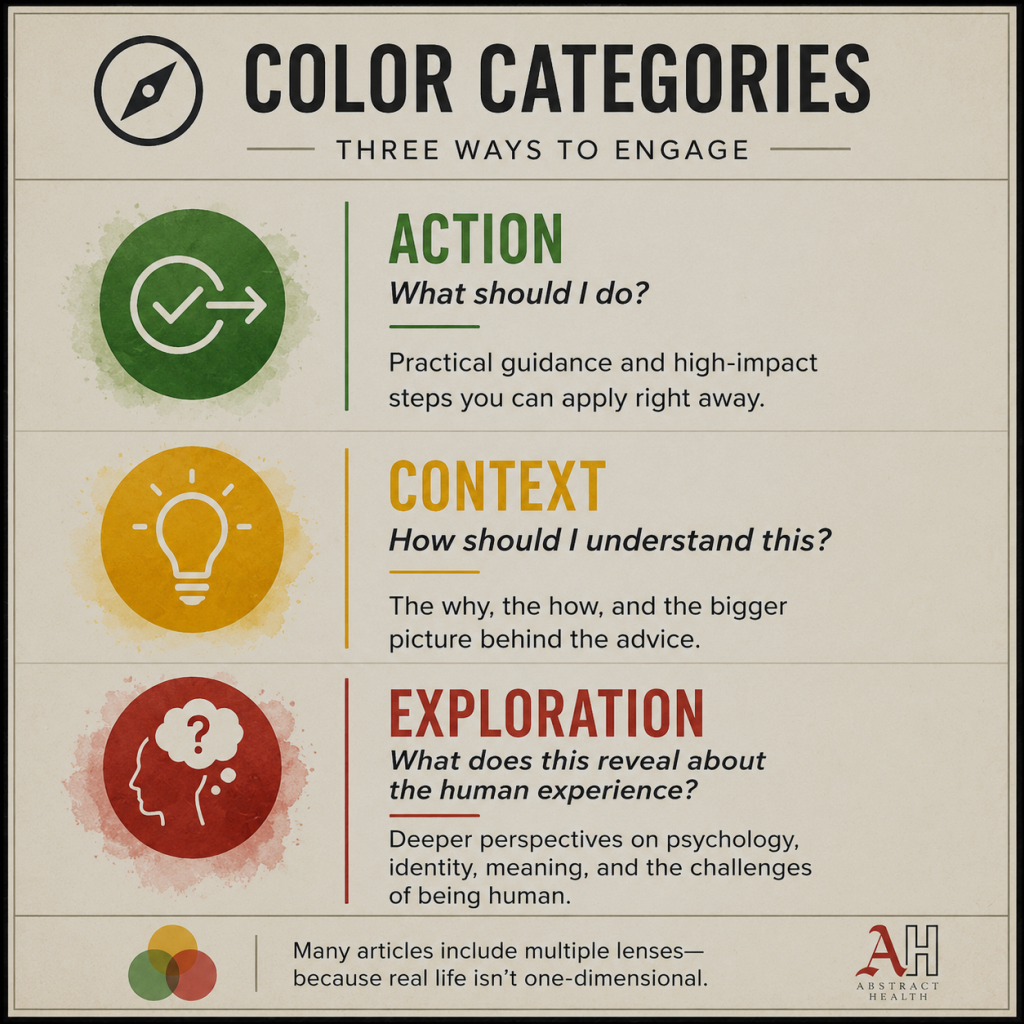
This article is part of a series exploring what we’ve called The Big Three—sleep, movement, and nutrition. These foundational elements influence nearly every aspect of health, and each one strengthens the others. If you’re new to the concept, I recommend starting with The Big Three before continuing.

🟡 Our Challenges

Nutrition is difficult.

Realistically, it always has been.

There was a time when the greatest concern was simply having enough food. In other places and times, it was food safety, nutrient deficiencies, or the limits of what could be grown and preserved.

These days our challenges are different.

Not necessarily because we don’t know what to do, but because we did what humans have always done—we tried to improve things.

We improved transportation, communication, medicine, engineering, computing, and manufacturing. When we encounter a problem, we naturally look for ways to make it better.

Food was no exception.

We wanted food that tasted better, lasted longer, cost less, required less preparation, and could be available whenever we wanted it. In many ways, we succeeded. Food became safer, more affordable, more abundant, and more convenient than at almost any point in human history.

But every improvement comes with tradeoffs.

We became exceptionally good at making food rewarding. It became sweeter, saltier, richer, more shelf-stable, and easier to access. As a result, food also became easier to overconsume. Sometimes we improved nutritional quality along the way. Sometimes we sacrificed it.

At the same time, nutrition science was rapidly evolving. Researchers were asking better questions, collecting better evidence, and refining what we thought we knew. That’s exactly what science is supposed to do, but it also meant that recommendations changed as our understanding improved.

Then came marketing.

Health became profitable. Supplements, detoxes, miracle foods, fad diets, and endless nutrition claims all competed for our attention. Somewhere in the middle of all of that, nutrition stopped feeling straightforward.

Not because there wasn’t truth.

Because there were suddenly thousands of voices trying to explain it.

This idea was introduced briefly in Why Abstract Health?

So What Is Food Actually For?

When we strip away the marketing, the labels, and the trends, food has a remarkably simple purpose.

It provides the resources your body needs to build, repair, adapt, and function.

That’s what nutrition is.

It’s not a diet. It’s not an identity. It’s not a collection of rules.

It’s a resource delivery system.

Every heartbeat, every muscle contraction, every immune response, every hormone, and every act of repair depends on having the resources to do so. The body doesn’t respond to diet labels or marketing terms. It responds to nourishment.

Once you begin looking at food through that lens, much of nutrition becomes easier to understand.


Why Real Food Matters

Real food isn’t valuable simply because it’s natural.

It’s valuable because it tends to provide the resources your body needs in abundance.

Protein.

Fiber.

Vitamins.

Minerals.

Healthy fats.

Water.

And countless other compounds that support normal physiology.

That doesn’t mean every real food is equally valuable, nor does it mean every processed food lacks value. Most foods exist somewhere along a spectrum. Some provide many of the resources the body needs. Others provide fewer. Most fall somewhere in between.

The goal isn’t to memorize where every food belongs on that spectrum.

The goal is to build an overall pattern that consistently provides your body with the resources it needs to thrive.


Returning to the Fundamentals

Fortunately, the body has never cared much about trends.

It doesn’t know whether you’re eating Mediterranean, vegetarian, high-protein, or something else entirely. It simply responds to the nutrients and energy it receives—and the quantities in which it receives them.

That’s why the fundamentals continue to matter.

Not because they’re exciting.

Because they’re what the body is actually responding to.

This isn’t an argument against nutritional science. Clinical nutrition, medical nutrition therapy, biochemistry, and individualized recommendations all have an important place. As health becomes more complex, nutrition often becomes more specific.

But many people arrive at those conversations only after years of neglecting the fundamentals.

Think back to our discussion about vehicle maintenance. A well-maintained vehicle rarely needs specialized repairs. An aging vehicle with years of neglected maintenance often does. The increasing complexity reflects the condition of the system—not the foundation of maintenance itself.

The same principle applies to nutrition.


🟢 What to Do

1. Make Real Food Your Foundation

Build most of your meals from foods that reliably provide the resources your body needs. Protein-rich foods, vegetables, fruits, legumes, starchy tubers, whole grains, dairy, nuts, and seeds all make it easier to obtain protein, fiber, vitamins, minerals, and other nutrients that support healthy function.

The goal isn’t to eliminate every processed food.

It’s to make resource-rich foods the foundation rather than the exception.


2. Build Balanced Meals

Instead of asking whether an individual food is healthy, ask whether the meal is balanced.

Aim to include a source of protein, plenty of plant foods, and enough energy to support your body’s needs.

You don’t need to build the perfect plate.

You need a consistently well-built one.


3. Repeat the Fundamentals

Nutrition isn’t determined by your healthiest meal.

It’s determined by the pattern you repeat over weeks, months, and years.

Drink water regularly.

Leave room for foods you genuinely enjoy.

Recognize that some foods provide more resources than others, but don’t let perfection become the enemy of consistency.

The greatest benefits in nutrition rarely come from finding the perfect food.

They come from building a pattern you can sustain.


The Recalibration

Nutrition has become complicated because food became more rewarding, science became more detailed, and health became more marketable.

But the body’s needs never became nearly as complicated.

It still asks for the same things it always has.

Enough energy.

Enough protein.

Enough nutrients.

Enough consistency.

Food isn’t the goal.

Capacity is.

Nutrition matters because it provides the resources your body needs to build, repair, adapt, and preserve the capacity to live well.

That doesn’t require perfection. It requires a consistently balanced diet built primarily from real food.

Movement — Capacity in Motion

🟡🟢

This article is part of a series exploring what we’ve called The Big Three—sleep, movement, and nutrition. These foundational elements influence nearly every aspect of health, and each one strengthens the others. If you’re new to the concept, I recommend starting with The Big Three before continuing.


🟡 The Meaning Behind Movement

We experience life in two primary ways—through our minds and through our bodies.

The mind thinks, feels, imagines, plans, prioritizes, and decides. The body carries those decisions into the world. Almost every conversation we have, every hug we give, every project we build, every adventure we pursue, and every achievement we celebrate eventually passes through movement.

Our capacity to move shapes our capacity to live.

Movement is how we interact with the physical world. It allows us to experience life, care for others, pursue our goals, and engage with the world around us. Like most human capacities, it grows with use and declines with neglect.

In many ways, movement is unique among the foundations of health.

Sleep has one fairly distinct doorway.

Basic nutrition has one fairly distinct doorway.

Movement has countless.

Sleep asks us to recover.

Nutrition asks us to nourish ourselves.

But movement can be expressed in almost endless ways.

We can walk, hike, dance, swim, garden, climb, lift weights, play sports, chase our children, explore new places, or simply choose the stairs instead of the elevator. Each asks something different of the body, but all remind it that it is still needed.

Different activities produce different adaptations, and some are better suited for particular goals. But when the goal is simply to become a healthier, more capable human being, there are far more valid starting points than most of us realize.

That’s one of the beautiful things about movement.

It doesn’t demand a single expression.

It simply asks to be expressed.

Unfortunately, we now live in a world where movement is no longer woven into daily life. Convenience has become one of humanity’s greatest achievements, but also one of its greatest challenges. Many of the physical demands that once maintained our capacity have quietly disappeared.

Movement now requires intention. And intention requires effort.

That effort can feel like another demand in a life already full of them.

So movement becomes another task. Another obligation. Another thing we’re told we “should” do.

We often justify it by focusing on appearance, weight loss, or avoiding disease. Those are valid reasons, but they’re incomplete.

Movement isn’t valuable because it’s exercise.

It’s valuable because it preserves capacity.

At one time, movement wasn’t something we scheduled. It was simply life. We hunted, gathered, built, carried, climbed, traveled, and played because survival depended on it.

Today, movement is much more optional.

Our biology, however, has not become optional.

It still expects activity. It still adapts to use. And it still declines without it.

So the question becomes:
Do we allow the machine to slowly diminish?
Do we let it become a memorial to life instead of something that actively lives it?
Or do we keep it running?

Movement is not simply about muscles or calories.
It is a conversation with the body.

Every walk. Every lift. Every climb. Every game. Every dance. Every hour spent in the garden.

Each one quietly says:

“Stay capable.”

The body responds accordingly.

Muscles strengthen.
The heart becomes more efficient.
Bones remain resilient.
The brain functions better.
Mood improves.
Blood sugar becomes easier to regulate.

Nearly every major system in the body responds because nearly every major system evolved expecting movement.

When we don’t move, adaptation still occurs.

Capacity gradually shrinks.
Tasks become harder.
Options become fewer.

This isn’t failure. It’s simply adaptation in the opposite direction of what most of us would prefer.

The body doesn’t respond to perfect plans.

It responds to repeated exposure.

Do it reasonably well.
Do enough.
Do it often.

Modern life makes movement feel like an upgrade.

In reality, it is a requirement that modern life has made easy to ignore.

The goal isn’t to become exceptional.

The goal is to preserve enough capacity that your body expands your options instead of quietly limiting them.


🟢 What To Do

Movement doesn’t need to be complicated.

It needs to become part of who you are.

The recommendations below aren’t designed to create elite athletes or maximize performance.

They’re meant to lower barriers, reduce noise, and help you build a lifelong relationship with movement.

Rather than prescribing one specific activity, think in terms of principles.

There are countless doorways into movement.

The principles remain the same.


1. Sit Less

If there’s one place almost everyone can begin, it’s here.

Long periods of sitting work against how the body is designed to function—even if you exercise regularly.

Stand up every 30–60 minutes when possible.

Take short walks.

Look for small opportunities to move throughout the day.

Movement doesn’t have to begin with a workout.

Sometimes it begins by simply sitting a little less.


2. Find a Doorway You’ll Keep Walking Through

Walking. Gardening. Dancing. Swimming. Weight training. Brazilian jiu-jitsu. Hiking. Recreational sports. Playing with your grandchildren.

The “best” activity is often the one that gets you moving safely and consistently.

Don’t spend months searching for the perfect doorway.

Walk through one. If you don’t like it, try another. The goal isn’t to choose perfectly—it’s to keep moving until you find an expression you can return to.


3. Challenge Your Body

The body adapts when it is asked to do something slightly beyond what it’s used to.

Sometimes that’s walking farther.
Sometimes it’s climbing a hill.
Sometimes it’s lifting a heavier object.
Sometimes it’s learning a new skill.

Whatever you choose, make sure it asks something of you.

Without challenge, capacity doesn’t grow.

Capacity grows when we consistently push just beyond our current abilities.


4. Build Strength Intentionally

Although movement has many valid doorways, modern life rarely asks us to meaningfully challenge our muscles.

For that reason, resistance training deserves special attention.

Aim for two or three sessions each week.

Start lighter than you think.

Learn good technique.

Progress gradually.

We’ll explore why muscle matters far beyond appearance in a future article.


5. Keep Your Body Moving Well

Move through different positions.

Reach overhead.

Squat.

Rotate.

Balance.

Get up from the floor occasionally.

Use the range of motion your body was designed to have.

Mobility isn’t another workout.

It’s how we keep movement available.


6. Progress Gradually

Capacity grows through repeated, recoverable challenge.

Don’t chase exhaustion. Build momentum.

Allow your body to adapt.

The goal isn’t to prove what you can do today.

It’s to gradually expand what you’ll be able to do tomorrow.


7. Stay Consistent

The body doesn’t reward occasional perfection.

It rewards repeated exposure.

Some weeks you’ll do more.

Some weeks you’ll do less.

Keep showing up.

Consistency compounds.


Closing

There isn’t one right way to move. There are countless ways to build capacity. Don’t let the search for the perfect program prevent you from beginning.

Choose a doorway. Walk through it.

Stay curious.
Keep learning.
Keep moving.

Because movement isn’t the goal.

Capacity is.

And the greater your capacity, the greater your ability to say yes to the people, places, experiences, and opportunities that make life meaningful.

If you decide you want to go deeper, there are many more layers to explore.

But this is enough to get started.

Sleep — The Foundation in the Dark

🟡🟢

This article is part of a series exploring what we’ve called The Big Three—sleep, movement, and nutrition. These foundational elements influence nearly every aspect of health, and each one strengthens the others. If you’re new to the concept, I recommend starting with The Big Three before continuing.

We exist in a complex system that requires rest—even when we would prefer not to.

Life is busy.
Hectic.
Chaotic, at times.

And sometimes the only time we get to decompress is when we should be sleeping.

So we make a trade.

We barter time for recovery—
trying to maintain balance as best we can,
trying not to demand too much of the night,
so the day doesn’t demand too much of us.

For a while, it works.

Until it doesn’t.

We all have different relationships with sleep.

Some long for it but have a hard time finding it.
Some fight it.
Some feel most creative and alive at the exact time they should be deep into it.
Some would take a nap every day if life allowed it—drawn to the comfort, the stillness, the peace.
Others see it as an interruption. Something that gets in the way of doing more.

The idea that sleep is important is common knowledge. It goes without saying.
We understand its role in health.
And we feel the consequences when it’s missing—
mentally, physically, emotionally.

But understanding something in theory, and navigating it in real life, are not the same thing.
The clinical need for sleep must pass through the human condition.
And that reality reshapes our relationship with what we should do.

What Sleep Actually Is

Sleep is one of the few states where conscious control fades, and the brain shifts into a different mode of operation.

We don’t just shut off.
The system continues working—
organizing,
repairing,
regulating—

just outside of our awareness.

The Creative Potential of Sleep

There’s a long history of ideas that didn’t come from effort—but from rest.

Dmitri Mendeleev saw the structure of the periodic table in a dream.
Mary Shelley described Frankenstein as she was emerging from a restless night.
Paul McCartney woke up with the melody for “Yesterday” already formed.
These aren’t just interesting stories.
They point to something functional.

During the day, the mind is structured—focused and directed.

At night, that structure loosens just enough to allow new connections.

Creativity isn’t always about pushing harder.
Sometimes it’s about stepping back long enough for the system to do its work.

Sleep as a Foundational Lever

Out of the Big Three—sleep, movement, and nutrition—
sleep is arguably the most foundational.

They all influence one another.

But sleep often becomes the rate-limiting step—
the point at which the system can no longer keep up.

You can think of sleep as an internal organization process.
Like a librarian cleaning up, organizing, and restoring the environment after a full day of activity.

Everything you experienced during the day—
conversations,
stress,
information,
decisions—
all get sorted.

Some things are strengthened. Some are discarded.
Some are connected in ways they weren’t before.

Without that process, things don’t pause.

They accumulate.

Sleep Cycles, Simplified

Sleep isn’t one continuous state.

It moves through cycles—roughly every 90 minutes—
shifting between lighter sleep, deeper sleep, and REM sleep.

Deep sleep supports physical repair.
REM sleep supports learning, memory, and emotional processing.

Deep sleep restores the body.
REM sleep reorganizes the mind.

When sleep is shortened or fragmented,
these cycles get cut short—
and the system doesn’t complete its work.

The Tradeoff We Misunderstand

We often treat sleep as a tradeoff.

More time awake feels like more opportunity.
More productivity.
More control.

But the trade isn’t neutral.

You gain time—but lose clarity, efficiency, and stability.

At a certain point, you’re no longer gaining more time.
You’re simply getting less out of the time you have.

Sleep doesn’t just affect how you feel.
It changes how the system operates.

When sleep is compromised:
Hunger becomes less regulated.
Emotions become more reactive.
Stress responses become amplified.
Recovery slows.
Energy becomes less stable.
Mental precision becomes dulled.

You don’t just feel different.

You function differently.

More effort—less return.

Insight

We often try to fix other inputs.

Better diet.
Better workouts.
More effort.

But sleep sits underneath all of it.

It’s part of the maintenance system—
the one that determines whether anything else actually works.

You can tolerate imperfect nutrition for a while.
You can get by with low movement—for a time.

But when sleep is consistently compromised—
the system begins to shift. And everything built on top of it becomes less reliable.

Before we try to optimize everything else, it makes sense to stabilize the foundation.

Not perfectly. But consistently enough that the system can respond.

Because once sleep is in place—
everything else doesn’t just improve.
It becomes easier to improve.

🟢 What to Do (High-Leverage Actions)

Do it well. Do enough. Do it often.

Start Here (Highest Return for the Effort)

Wake up around the same time every day (±30–60 minutes). The closer to a consistent time, the better—but anything helps. Waking up at a consistent time builds sleep pressure that can help make bedtime easier.

Get light exposure as soon as possible after waking. This helps anchor your circadian rhythm, making it easier to fall asleep that night.

Limit caffeine after early afternoon (~1–2 PM).

Dim lights and reduce screen exposure 1–2 hours before bed.

QUALITY — Sleep Better While You’re There

Keep your room cool, dark, and quiet.

Remove or cover unnecessary light sources (TVs, LEDs, clocks).

Use blackout curtains, a sleep mask, or white noise if needed.

Reserve your bed for sleep and sex.

Avoid alcohol and heavy meals within 2–3 hours of bedtime.

Build a simple, repeatable wind-down routine.

QUANTITY — Give Your Body Enough Time

Aim for 7–9 hours of sleep.

Set a consistent wake time first, then work backward to determine your bedtime.

Don’t rely on weekend catch-up sleep.

Protect sleep like any other important appointment.

CONSISTENCY — Stabilize the System

Keep sleep and wake times within about an hour or less—even on weekends.

Get daily sunlight exposure.

Avoid large late-night meals—not because eating late is inherently “bad,” but because digestion and reflux can interfere with sleep.

Keep exercise timing relatively consistent. Training too close to bedtime may delay sleep onset.

Minimize These

Late caffeine

Late-night screens and bright light

Irregular sleep schedules

Alcohol as a sleep aid

Long or late naps

If You Can’t Sleep

Don’t stay in bed frustrated.

Get up, keep the lights low, and do something relaxing.

Return to bed when you feel sleepy.

Train the association:

Bed = sleep, not stress.

Tips for Sleep Onset

Read a book.

Listen to relaxing music.

Drink warm tea (caffeine-free) or warm milk.

Take a warm shower or bath (keeping lights dim).

Practice deep breathing.

Journal.

Write tomorrow’s to-do list so it isn’t competing for your attention.

Bottom Line

Sleep doesn’t need to be perfect.

It needs to be repeatable and sufficient.

Get this right, and everything else—

nutrition,
movement,
stress—

becomes easier to improve.

The Big Three: A Framework for Prioritizing Health

There is no shortage of health information.

Open your phone, turn on the television, browse social media, or walk through a bookstore, and you’ll find an endless stream of advice.

Most of it isn’t wrong. In fact, much of it is genuinely useful. The problem is that it all competes for the same attention. When every article, podcast, influencer, and advertisement claims to hold another important piece of the puzzle, it becomes increasingly difficult to distinguish the foundational from the optional.

Some people become overwhelmed and stop trying altogether.

Others head in the opposite direction—pursuing increasingly smaller optimizations while overlooking the habits that produce the greatest return.

Health itself hasn’t become more complicated.

The human body hasn’t fundamentally changed.

Our attention has.


Most people already possess a surprising amount of health knowledge.

Ask someone what contributes to good health and you’ll likely hear familiar answers:

  • Sleep
  • Exercise
  • Eat well
  • Manage stress
  • Don’t smoke
  • Limit alcohol

They’re not starting from zero. The challenge isn’t a lack of information. It’s understanding the hierarchy of that information. Not all health information deserves the same amount of our attention. Some ideas meaningfully shape health. Others produce modest improvements. Some are only relevant under specific circumstances.  And some simply distract from what matters most.

When we lose sight of those differences, everything begins to feel equally important. Ironically, that’s when progress often slows.

Because when everything becomes a priority…

Nothing really is.


Rather than asking, “What’s the best thing I can do?”

a better question might be: “What are the largest things I can influence?”

That distinction matters.

Not everything that influences health is within our control.
Genetics matter. Environmental exposures matter. Access to healthcare matters. Life circumstances matter. Randomness matters.

But many of those variables are only partially—or not at all—under our control.

Instead of chasing complete control over our health, we should focus on maximizing the variables we can meaningfully influence.

Our goal isn’t perfect health.

It’s to consistently move the odds in our favor with the variables we can actually influence.


This idea resembles the logic behind Maslow’s Hierarchy of Needs. Before pursuing higher-level goals, we first satisfy the foundation. You don’t build a house starting with the roof. You don’t install drywall before pouring the concrete. The foundation isn’t exciting. But it determines how well everything else performs.

Health works much the same way. There is a difference between building health and optimizing health.

Optimization has become incredibly popular.
Cold plunges. Continuous glucose monitors. Supplement stacks. Longevity protocols.

Many of these have contexts where they may provide value. But they should never compete with the foundation for your time, attention, or energy.

The foundation comes first.

Everything else is built upon it.


For most people, three habits account for a disproportionate share of the health we can actually influence.

The Big Three

  • Sleep
  • Movement
  • Nutrition

Surprised? Probably not.

Good.

This isn’t about introducing something you’ve never heard before. It’s about revisiting familiar ideas and organizing them into a clearer hierarchy.

These aren’t the only things that influence health. They’re simply the best place to start. Because they influence nearly everything else.

Energy. Recovery. Mood. Metabolic health. Hormonal regulation. Cognitive performance. Physical function.

Sleep provides the opportunity for the body and brain to recover, repair, regulate hormones, consolidate memories, and prepare for the demands of the next day.

Movement preserves physical function, improves cardiovascular and metabolic health, strengthens muscles and bones, supports mental well-being, and helps maintain independence throughout life.

Nutrition supplies the energy and building blocks the body needs to function, recover, adapt, and protect itself from disease.

We’ll explore each of these topics in much greater depth throughout the following articles.

Without first addressing the Big Three, trying to identify the source of a health problem can become like searching for the source of a smell in a landfill.

The problem isn’t that the answer isn’t there. It’s that too many variables are competing for your attention before the foundation has been addressed.

The signal is buried beneath unnecessary noise.


Knowing what matters is only half the equation. The other half is understanding how to approach it.

Nearly every practical recommendation we’ll discuss can be filtered through three simple questions:

How well?

How much?

How often?

Or, stated another way:

Quality.

Quantity.

Consistency.

Let’s refer to this as The Health Triad.

This isn’t another rule. It’s a lens. A framework for evaluating nearly every future health discussion.

Whenever new information appears, ask yourself: Is this improving the quality, quantity, or consistency of one of the Big Three? Or is it simply another variable competing for attention?


Health recommendations are built around patterns that consistently help the greatest number of people.

They are probabilities—not absolutes. There will always be exceptions. Some people become ill despite doing almost everything right. Others remain healthy despite years of poor habits.

Individual stories matter. But they don’t replace population-level evidence.

Our responsibility is to make decisions based on what reliably shifts the odds in our favor, while remaining humble enough to recognize that certainty doesn’t exist.


Health information will continue to grow. New supplements will appear. New diets will emerge. New technologies will promise better outcomes.

None of those things are inherently bad.
But they should always be evaluated in relation to the foundation.

When the foundation is strong, optimization becomes more meaningful.
When the foundation is weak, optimization often becomes distraction.

We don’t control every outcome.
We influence the probability of outcomes.

And for most people, very few habits influence those probabilities more than sleep, movement, and nutrition. Everything that follows builds from that foundation.

Health doesn’t become confusing because we know too little.
It becomes confusing because we struggle to distinguish the foundational from the marginal.

The purpose of the Big Three isn’t to tell you everything that matters.
It’s to make sure you never lose sight of what matters most.
To restore hierarchy to the countless ideas competing for your attention.


From Framework to Action

Understanding the Big Three is only the beginning.

Knowing what deserves your attention is valuable.

Learning how to apply it is where meaningful change begins.

Over the next three articles, we’ll take a closer look at each of the largest controllable drivers of long-term health:

  • Sleep — Recovery, restoration, and the foundation upon which everything else is built.
  • Movement — Building and preserving the physical capacity to live well.
  • Nutrition — Supplying the body with the energy and resources it needs to function, adapt, and thrive.

We’ll continue using the same lens throughout:

Quality. Quantity. Consistency.

Because the goal isn’t to master every health topic.

It’s to consistently improve the habits that matter most.

Hyperoptimization and Diminishing Returns

🟡

“The perfect is the enemy of the good.” — Voltaire

Sometimes the pursuit of health starts to shift focus.

We begin by wanting to feel better. More energy. Less pain. Better mobility. Improved labs. More experiences. More years with the people we love.

These are reasonable goals.

But somewhere along the way, many people drift from pursuing health toward pursuing optimization. Those are not always the same thing.

Modern health culture often creates the impression that every variable and topic deserves equal attention. Every ingredient, every supplement, every meal timing strategy, every recovery tool, every environmental exposure, and every new biological “hack.”

But the human system does not weigh everything equally.

Some variables matter tremendously.

Others matter only slightly—if at all.

The difference between sleeping four hours and sleeping eight hours.

The difference between being sedentary and moderately active.

The difference between eating mostly nutrient-dense foods and eating mostly ultra-processed foods.

These are among the highest-return investments we can make in the health of the human system.

Yet once our foundational needs are reasonably met, the return on additional optimization often begins to shrink.

Not because nuance is meaningless. Not because marginal variables are useless.

But because our biology appears to reach a point of diminishing returns.

The foundational improvements tend to create the largest changes. Later improvements often require more effort for increasingly smaller outcomes.

This pattern is not unique to health.

The difference between no maintenance and routine maintenance on a vehicle is enormous.

The difference between routine maintenance and elite performance modifications is comparatively small.

Yet modern health culture frequently convinces people that the performance modifications are the priority.

This inversion creates confusion.

People begin obsessing over electrolyte packets, supplement stacks, peptides, cold plunges, seed oils, greens powders, red light therapy, and countless other strategies that promise incremental improvements.

Experimentation on top of a foundation of fundamentals is perfectly reasonable.

Deprioritizing adequate sleep, regular movement, sound nutrition, stress management, and other foundational behaviors in favor of that experimentation is not.

We also must consider the cost of optimization.

Every health strategy requires an investment of time, money, energy, attention, or mental bandwidth. As those investments grow, we should continually ask whether the benefits are truly worth what they displace.

Sometimes they are.

Often, they probably aren’t.

The body is influenced by nuance, but it is governed by fundamentals.

And unfortunately, fundamentals are difficult to market.

Sleep is not exciting.

Walking is not exciting.

Managing stress is not exciting.

Eating enough protein and vegetables is not exciting.

Consistency is not exciting.

These things are simple, repetitive, and often unremarkable. There is no secret knowledge attached to them. No exclusive club.

Marginal optimization, however, feels advanced. It creates endless discussion. Endless products. Endless content. And endless opportunities for monetization.

There was a demand for optimization, and naturally, a market emerged to meet it.

This is where the topic can easily start to sound cynical or conspiratorial, but that’s not necessarily the case. It’s simply the reality created by the right combination of variables.

As discussed in Back to the Primitive: Swapping Intensity for Intent

These systems didn’t emerge from a singular malicious intent.

They are the natural result of:

  • Consumer preference
  • Technological advancement
  • Economic incentive

This is where many people unknowingly become trapped. Not necessarily in poor health behaviors, but in the psychological burden of excessive optimization.

This happens when our perspective causes us weigh everything equally.

Diminishing returns are not just physiological.

They can become psychological. Logistical. Financial. Social.

A strategy that provides a tiny physiological benefit may simultaneously increase stress, consume time, create anxiety, complicate schedules, strain relationships, or reduce enjoyment of life.

At that point, we have to ask an important question: Is the tradeoff worth it?

Because health does not exist in isolation from life.

The purpose of health is not to become imprisoned by routines, fear, or perfectionism.

The purpose of health is function. Freedom. Resilience. Presence.

The ability to participate more fully in life.

Optimization becomes problematic when the pursuit itself begins consuming the life it was meant to improve. It can also become self-perpetuating as people lose sight of the difference between foundational practices and marginal refinements.

This idea echoes Goodhart’s Law: “When a measure becomes a target, it ceases to be a good measure.”

Health metrics are useful because they point us toward better health. But when optimizing the metrics becomes the primary objective, it’s easy to lose sight of why they mattered in the first place.

This does not mean nuance is irrelevant.

Elite athletes may care deeply about marginal gains. Certain medical conditions may require highly specific strategies. Some people genuinely enjoy optimization as a hobby.

There is nothing inherently wrong with that.

But for most people, the overwhelming majority of meaningful health outcomes are likely driven by foundational variables:

Sleep.

Movement.

Nutrition.

Stress management.

Relationships.

Purpose.

Avoiding major destructive behaviors.

These are the big rocks.

Everything else exists around them, like sand and pebbles that fill in the spaces between the monoliths.

Modern wellness culture often sells the final 5% as though it were the first 95%.

But most people would experience dramatically greater benefit by improving the fundamentals they already know matter.

Not perfectly. Just consistently.

Because the goal is not perfect health.

The goal is to build a life that health supports—not one that health consumes.

To use health as a means of better experiencing life.

Sometimes the healthiest thing we can do is stop trying to optimize every variable and start living the life our health was meant to support.

After all, the perfect is often the enemy of the good.

Human Stat Points and the Reality of Change

🔴🟡

Learning, improvement, and growth are built-in parts of the human experience.

From the moment we are born, we are constantly developing skills, behaviors, habits, beliefs, and ways of navigating the world. This process is influenced by family, environment, education, work, relationships, hobbies, interests, and countless other variables.

Interestingly, this process is not entirely unlike what we experience in many games.

In the gaming world, it is common to begin with a character that has a pre-loaded distribution of traits and attributes. Strengths and weaknesses. We then work to change that distribution. As the game unfolds, we gradually invest points into the areas we wish to improve or that become important to the way we play.

Human beings are remarkably similar.

Our consistent traits and habits are somewhat similar to stat points in a video game.

Over time, different behaviors and tendencies become more or less developed depending on environment, awareness, repetition, stress, social connections, personality, upbringing, resources, and circumstance.

Hydration. Daily movement. Sleep consistency. Cooking at home. Protein intake. Time outdoors. Emotional regulation. Walking. Resistance training. Deep breathing. Boundary setting. Interrupting sitting. Limiting alcohol. Meaningful conversation. Stress management. Recovery.

Some of these habits become strengthened naturally through supportive environments, passive reinforcement, and intentional growth.

Others deteriorate through neglect, chronic stress, injury, aging, trauma, circumstance, or poorly engineered modern environments.

If we are aware of the ability to increase these attributes—we can start to pursue change in a more realistic and meaningful way.  

A way that makes sense regarding the currently available resources in our actual life.

Sustainable consistency—not infrequent perfection.


This is where the Human Stat Points framework becomes useful.

Imagine life as a collection of sliders within various categories.
Health. Career. Parenting. Relationships. Finances. Recreation. Learning. Household responsibilities.

At any given moment, you possess a limited pool of resources to distribute among them.
Time. Energy. Attention. Motivation. Recovery capacity. Mental bandwidth. Emotional bandwidth.

The mistake many people make is assuming every slider should be maxed out all the time.

Reality does not work that way.

A new parent may temporarily invest more points into parenting and fewer into fitness.

Someone building a business may allocate more points toward work and fewer toward leisure.

Someone recovering from illness may need to direct points toward healing while other areas temporarily receive less attention.

These tradeoffs are not necessarily failures. They are often reflections of reality.
Life requires resource allocation. This does not mean improvement is impossible.

It means improvement must be prioritized.

Every meaningful change requires resources.
Time. Attention. Effort. Recovery.

Which means every “yes” is also a quiet “not right now” to something else.

Mature change is often less about adding everything and more about deciding what deserves investment during a particular season of life.

Most beneficial health recommendations are commonly known.
Walk more. Sleep more. Exercise more. Cook more. Read more. Connect more. Stress less. Spend more time outside. Prepare more meals at home. Limit alcohol. Lift weights. Do cardio. Practice mindfulness.

Each recommendation sounds reasonable in isolation, but they are presented to us as a package.

The burden comes from accumulation.

Every recommendation draws from the same finite pool of resources. Eventually the demands exceed available capacity. And what is often interpreted as laziness can simply be resource depletion.

Many people assume they are failing because they cannot do everything. In reality, they are attempting to satisfy more obligations than their current capacity allows.

This is one reason health advice often feels simultaneously helpful and overwhelming.

Each individual recommendation may be beneficial. But when dozens of beneficial recommendations are stacked together, they begin to feel like obligations rather than opportunities.

Over time, health transforms from a source of support into a source of burden.
And burden changes behavior.

It’s easer to mentally deprioritize something when it seemingly becomes more of a burden than a benefit. When people feel they must perform perfectly across every category, they often experience things like frustration, guilt, shame, decision fatigue, burnout, etc.

Part of the problem is that we often approach change irrationally.

Most people understand that major life changes rarely happen overnight.
Yet when it comes to behavior change, we often forget to apply that same logic.

We seek the overhaul.
The overnight transformation.
The cold turkey solution.
The resolution.

In mountaineering, climbers sometimes experience what is known as summit fever. The summit becomes the only acceptable outcome. As a result, they begin ignoring changing conditions, realistic pacing, fatigue, and risk.

Sometimes the only focus is to scratch and claw our way to the top.

Although we may know what to do, we often do not give ourselves time to figure out how to integrate the knowledge into the complexity of our unique lives.

Consistency and maintenance relies upon lived experience, not temporary application of information.

Change is incremental. It requires time. Consistency. Patience. Resilience.

If we are truly committed to change, we do not begin by sprinting toward the ideal endpoint.

We simply begin walking in the preferred direction.

Slowly. Consistently.
And we adjust as we go.

Is this the answer we want? No. But it is reality.

So why waste time on fiction?


Health is rarely a perfectly balanced character build.
Some people consistently hydrate well but struggle with sleep.
Some move regularly but overconsume alcohol.
Some eat nourishing meals but remain chronically overstimulated and mentally exhausted.
Some maintain physical health while neglecting emotional regulation and relationships.
Others struggle because the environment surrounding them creates friction against beneficial behaviors.

The goal is not perfect optimization or maxing every slider simultaneously.
The goal is not becoming biologically flawless.

The goal is gradually improving the areas where improvement is realistic, sustainable, and meaningful.
In a way that works best for the individual.
 

And importantly, awareness itself is often part of that progress.

Sometimes meaningful change begins long before behavior fully changes. Simply becoming aware of the forces influencing the system can fundamentally alter the relationship a person has with themselves.

Awareness creates the possibility of intentionality. And intentionality, repeated consistently over time, slowly begins moving the sliders.

This perspective also creates space for compassion.
Because many people are not failing due to laziness or lack of intelligence.

Often, they are attempting to distribute limited resources across an overwhelming number of competing demands while operating inside systems and environments that constantly pull beneficial habits off course.

We often think of a full list of stat points as the ideal, and we get frustrated with ourselves for not being able to achieve it.

We lose sight of how much progress we can make by just being consistent with small things and progressing as we go.

Other times we can’t keep up. Or perhaps choose not to.

That deferred maintenance can accumulate to the point of affecting the way we look at ourselves.

Eventually, people can stop viewing themselves as under-supported systems and begin viewing themselves as broken people.

One of the biggest misunderstandings in modern health culture is that people often try to negotiate directly with outputs while overlooking the inputs that influence them.

Sometimes the outputs are simply reflections of prolonged input imbalance, accumulated wear, and insufficient capacity.

And importantly:

Deferred maintenance may make things more difficult in the moment, but that doesn’t eliminate the opportunity for future improvement.

Stat points can still improve.

And that matters.

Perhaps that is the real goal of health.

Not perfection. Not optimization culture. Not becoming superior.

But understanding that life requires tradeoffs and then allocating resources intentionally according to your current reality and values.

The answer is rarely complete optimization.
The answer is rarely complete neglect.
The answer is usually found somewhere in between.

The healthiest life is rarely the most optimized life.
It is often the one that allocates its resources intentionally, adapts to changing circumstances, and continues moving in a better direction over time.

Not perfect.

Not complete.

Just progressively better.

« Older posts

© 2026 Abstract Health

Theme by Anders NorenUp ↑