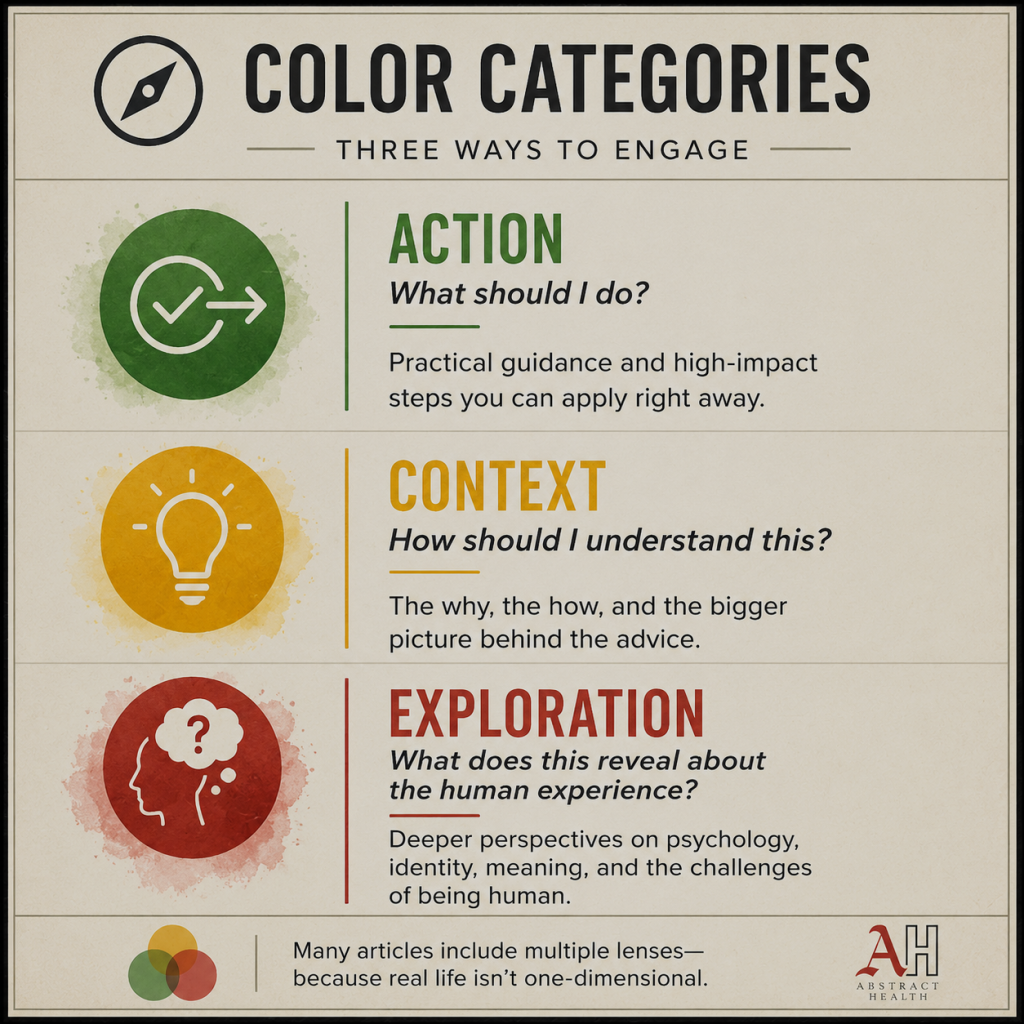
🔴🟡
We spend a lot of time talking about how to improve health.
Eat better. Move more. Sleep enough. Drink less. Manage stress. Build strong relationships. Protect our mental health. Reduce unnecessary risk.
All of this is reasonable.
We largely understand that the choices we make today can influence the quality and quantity of life available to us tomorrow. Naturally, we want to give ourselves the best opportunity to live long, healthy, fulfilling lives.
But somewhere along the way, another question deserves our attention.
What are we building all of that health for?
If the answer is simply more health, the logic becomes circular.
We eat well so we can be healthier.
We exercise so we can be healthier.
We sleep so we can be healthier.
We avoid risk so we can remain healthier.
And eventually, it becomes possible to protect our health so carefully that we begin protecting ourselves from the very life we were building our health for.
Health should expand our capacity to participate in life—not become an effort to eliminate all margin for experience and error.
That means there will occasionally be tradeoffs.
And those tradeoffs are where the idea of calculated risk begins.
There Is No Risk-Free Life
Nearly everything we do carries some combination of cost, benefit, and uncertainty.
Driving somewhere introduces risk. Playing sports introduces risk. Travel disrupts routines. Relationships expose us to disappointment. Parenthood brings stress alongside meaning. A demanding career may provide purpose and growth while consuming time and energy.
Even behaviors we consider healthy can carry costs when pushed far enough.
We make decisions within these tradeoffs every day, often without giving them much thought.
And that’s understandable. We couldn’t reasonably evaluate every decision as though it were a scientific experiment.
But when it comes to our health, we sometimes approach risk as though the ideal outcome would be to eliminate as much of it as possible.
In reality, that isn’t always practical, necessary, or even desirable.
A life without uncertainty would also be a life without many of the experiences that make it meaningful.
The goal, therefore, cannot realistically be the elimination of risk.
It is to become more intentional about which risks we accept, to what degree we accept them, and what we understand about their consequences.
That doesn’t mean risk is inherently valuable, or that accepting more of it somehow makes life more meaningful.
It simply recognizes that risk is one consideration among several when deciding how we want to live.
Health Is a Resource, Not a Destination
One way to think about health is as a form of capacity.
Exercise builds physical capacity.
Nutrition provides resources.
Sleep supports physiological and cognitive recovery.
Healthy relationships provide social and emotional resources.
Financial security can create options and freedom.
Psychological resilience helps us navigate difficulty without being consumed by it.
We invest in these things because they can expand what we are capable of doing with our lives.
Strength can help us remain independent as we age. Cardiovascular fitness can support our ability to travel, explore, and participate in activities we enjoy. Adequate sleep improves our ability to think clearly, manage emotions, and engage with the people around us.
All of these investments can contribute to a greater capacity for living.
But capacity is not quite the same thing as experience.
We might spend years building strength without stopping to appreciate what that strength allows us to do.
We might become so committed to our routines that disruptions begin to feel like failures.
We might even evaluate enjoyable experiences primarily through the lens of whether they improve or diminish our health.
This creates an important distinction:
Optimal health and optimal human experience are not always the same thing.
Sometimes the physiologically advantageous choice is not necessarily the one that contributes most to the life we want to experience.
And sometimes what appears to be a departure from a healthy routine may not represent a meaningful loss of health at all.
Sometimes Life Interrupts the Plan
The optimal sleep routine might have us going to bed at the same time every night.
But sometimes one of our children wants to talk. Sometimes friends are gathered around a fire. Sometimes we find ourselves at a concert that won’t happen again. Sometimes inspiration arrives at an inconvenient hour.
The most nutritionally advantageous meal might not include dessert. But sometimes that dessert comes from a grandmother who expresses love by feeding those she cares about.
Sometimes we find ourselves in a bakery in another country.
Sometimes we’re celebrating a child’s birthday.
Our training plan may call for a workout, but sometimes what we really want is a quiet afternoon watching movies with those close to us.
These aren’t necessarily examples of choosing something unhealthy.
They’re examples of recognizing that health exists alongside other things that matter.
A missed workout is not automatically a meaningful setback. A single late night doesn’t negate months of consistent sleep. Enjoying dessert doesn’t erase the nutritional value of everything else we’ve eaten.
In some cases, these experiences may contribute positively to our social or psychological well-being.
And that matters, too.
We can appreciate the value of consistent routines without allowing those routines to become rigid obligations.
Sometimes the purpose of building capacity is to have the flexibility to use it.
Sometimes We Spend What We Build
This brings us to the relationship between health investment and calculated risk.
They are not necessarily opposites.
In many ways, they can be complementary.
Health is a resource we invest in so that we have more life available to spend. Calculated risk is deciding, intentionally, what is worth spending some of it on.
Consistent sleep provides a strong foundation even when life occasionally keeps us awake.
Regular movement supports our physical capacity without requiring us to maximize activity every day.
A generally nutritious diet provides the resources we need while leaving room for foods chosen primarily for enjoyment.
In this sense, our investments can create flexibility.
But the metaphor has limits.
Our bodies do not maintain a simple balance sheet where healthy behaviors cancel unhealthy ones.
Ten salads don’t eliminate the consequences of smoking. Regular exercise doesn’t erase the potential harms of excessive alcohol consumption.
And not every departure from an ideal routine represents a meaningful withdrawal from our health.
Some choices carry relatively small or temporary consequences. Others involve risks that accumulate through repeated exposure. Still others carry the possibility of significant or lasting consequences, even when those outcomes are uncommon.
The magnitude, likelihood, frequency, and potential permanence of those consequences all matter.
So does our individual susceptibility.
What creates relatively little risk for one person may create substantially more for another.
Our investment in health can improve our capacity and resilience, but it doesn’t make us immune to the consequences of every decision.
Understanding those consequences isn’t meant to create fear or discourage enjoyment. It’s meant to give us a clearer picture of the choices we’re making.
We don’t need to place an ominous shadow over every activity that carries risk. Nor do we need to minimize or dismiss those risks for self-preservation.
We can simply acknowledge them for what they are.
The science can help us understand the potential consequences.
Our values, circumstances, and preferences help us decide what to do with that understanding.
Calculated Risk Is Not Risk at Random
We all accept risk.
But there is a meaningful difference between accepting it intentionally and accumulating it without much consideration.
Consider sleep.
We might willingly sacrifice a couple of hours because we’re spending a rare evening with someone we love.
That is a deliberate tradeoff.
But routinely staying awake longer than intended while watching television or scrolling through our phones introduces another question.
Are we choosing that experience because we find it worthwhile?
Or have we developed a habit that regularly costs us sleep without providing much additional enjoyment?
Watching a favorite show may be relaxing, entertaining, or exactly what we need after a difficult day.
The distinction isn’t whether the activity meets someone else’s definition of worthwhile.
It’s whether we’re making a choice that reflects our priorities or allowing a pattern to develop without examining it.
Alcohol provides another example.
Alcohol carries health risks, and many of those risks increase with greater consumption. Some accumulate over time, while others can occur during a single occasion.
Understanding that matters.
Some adults may decide that an occasional drink provides enough enjoyment, taste, ritual, celebration, or sense of social ease that they’re comfortable accepting some degree of risk.
Others may decide the potential costs aren’t worthwhile.
And for some individuals, certain health conditions, medications, circumstances, or difficulties controlling consumption may make avoiding alcohol particularly important.
We don’t all arrive at the same decision.
But we can benefit from an accurate understanding of the potential consequences rather than exaggerating or minimizing them.
The purpose of understanding risk isn’t to tell us what to choose. It’s to help us understand what we’re choosing.
And the same principle extends beyond alcohol, nutrition, exercise, or sleep.
Not Every Trade Is Physical
Some of our most complicated calculations involve other people.
Human relationships may be one of the clearest examples of how difficult it can be to separate cost from benefit.
People are imperfect.
Someone may frustrate us while still making us laugh harder than anyone else.
A friend may occasionally exhaust us while also carrying decades of shared history.
Family relationships may contain both obligation and extraordinary meaning.
A romantic relationship may require compromises that would look inefficient on a spreadsheet but feel deeply worthwhile within the context of two human lives.
We accept certain inconveniences because those relationships provide something we value.
We trade time for connection.
Vulnerability for intimacy.
Compromise for companionship.
And sometimes a certain amount of frustration for love.
Relationships don’t have to be perfectly optimized to be meaningful.
And frankly, they never are.
Of course, this doesn’t mean every relationship is worth preserving. Abuse, coercion, manipulation, and persistent harm should not be treated as necessary costs of connection.
But ordinary emotional complexity is part of the human experience.
We cannot eliminate every possibility of disappointment without also limiting our opportunities for connection.
And that reminds us that health is not merely a collection of physiological measurements.
It exists within the complexity of being human.
The Calculation Can Change
There is another important part of calculated risk.
The calculation is never permanent.
Something that once contributed positively to our lives may eventually change.
The occasional drink can become a nightly habit.
The demanding career that once provided purpose can become a source of chronic exhaustion.
The complicated relationship that once offered more connection than frustration may begin to feel different.
The hobby that brought adventure may eventually require adjustments as our abilities or circumstances change.
And late nights that once accompanied an exciting season of life can gradually become chronic sleep deprivation.
Our circumstances change. Our priorities change. Our capacity changes.
And sometimes the risks themselves change.
That makes reevaluation an important part of intentional living.
We can occasionally ask ourselves:
Are we still choosing this?
Are we receiving what we hoped to receive?
Have the costs changed?
Does this still reflect what we value?
Sometimes the answer will be yes.
Sometimes it won’t.
Neither outcome requires us to judge our previous decisions harshly.
We make decisions using the information, resources, and perspective available to us at the time.
As those things change, our choices can change with them.
Calculated risk requires honesty precisely because it gives us freedom.
Without reflection, even a deliberate exception can quietly become our default.
And without understanding the changing costs, we may continue accepting a tradeoff that no longer serves us.
What Is the Health For?
There are two extremes worth considering.
At one end is recklessness.
Every desire gets justified. Every consequence becomes tomorrow’s problem. Health is treated as though it will endlessly regenerate regardless of what we ask from it.
At the other end is hyperoptimization.
Every meal must be perfect. Every workout must be completed. Every hour of sleep must be protected. Every exposure must be minimized. Every biomarker must move toward some theoretical optimum.
Health slowly becomes another form of control.
Neither extreme fully captures what health is capable of giving us.
Nor do we need to establish a universal position somewhere between them.
We have different circumstances, responsibilities, preferences, and levels of comfort with uncertainty.
Some of us find greater freedom in reducing risk wherever reasonably possible. Others are comfortable accepting more uncertainty in particular areas of life.
The objective isn’t to establish how much risk everyone should accept.
It’s to develop enough understanding and perspective to make those decisions with greater intention.
Protect enough health to preserve our freedom. Spend enough of it to make that freedom worthwhile.
We can invest in the things that increase our capacity while recognizing that there will be moments when something else matters more to us than maximizing a particular aspect of health.
Sometimes that means staying up late. Enjoying the cake. Watching movies all day. Taking an unexpected trip. Loving imperfect people. Creating something. Celebrating.
Or simply allowing life to interrupt the plan.
Not because health doesn’t matter.
Because health has a purpose.
And as we become healthier, we may eventually encounter diminishing returns. The improvements become smaller, the effort required to achieve them may become greater, and the time, energy, and attention required to pursue them must come from somewhere.
Every investment has an opportunity cost.
At some point, the more important question may no longer be:
How much healthier can we become?
It may be:
What does this health allow us to do?
There is wisdom in investing in ourselves.
There is also wisdom in recognizing that the life we’re investing in is already happening.
We don’t need to wait until we reach some theoretical state of optimal health before allowing ourselves to experience it.
Calculated risk allows these ideas to coexist.
We aren’t building health so that we can recklessly burn through it.
But neither are we building health merely to reach the end of life having protected it perfectly.
We build capacity so we can use it.
Sometimes we trade a little health for fulfillment.
Sometimes we discover that the things contributing most to our fulfillment were supporting our health in ways we hadn’t considered.
And sometimes we choose differently because our understanding, circumstances, or priorities have changed.
None of that requires perfection.
Only perspective.
Health should support life—not consume it.
Calculated risk is not an argument for ignoring meaningful health risks or continuing behaviors that are causing harm. The size and nature of risk vary considerably between behaviors and individuals. Some risks may be substantial, lasting, or difficult to evaluate accurately. When alcohol, substance use, relationships, or other behaviors begin affecting our health, safety, responsibilities, or sense of control, seeking professional support can be an important part of protecting our well-being.
As one flawed human to another, we all need a hand from time to time. Recognizing when we need support, and being willing to seek it, is another way of investing in ourselves.