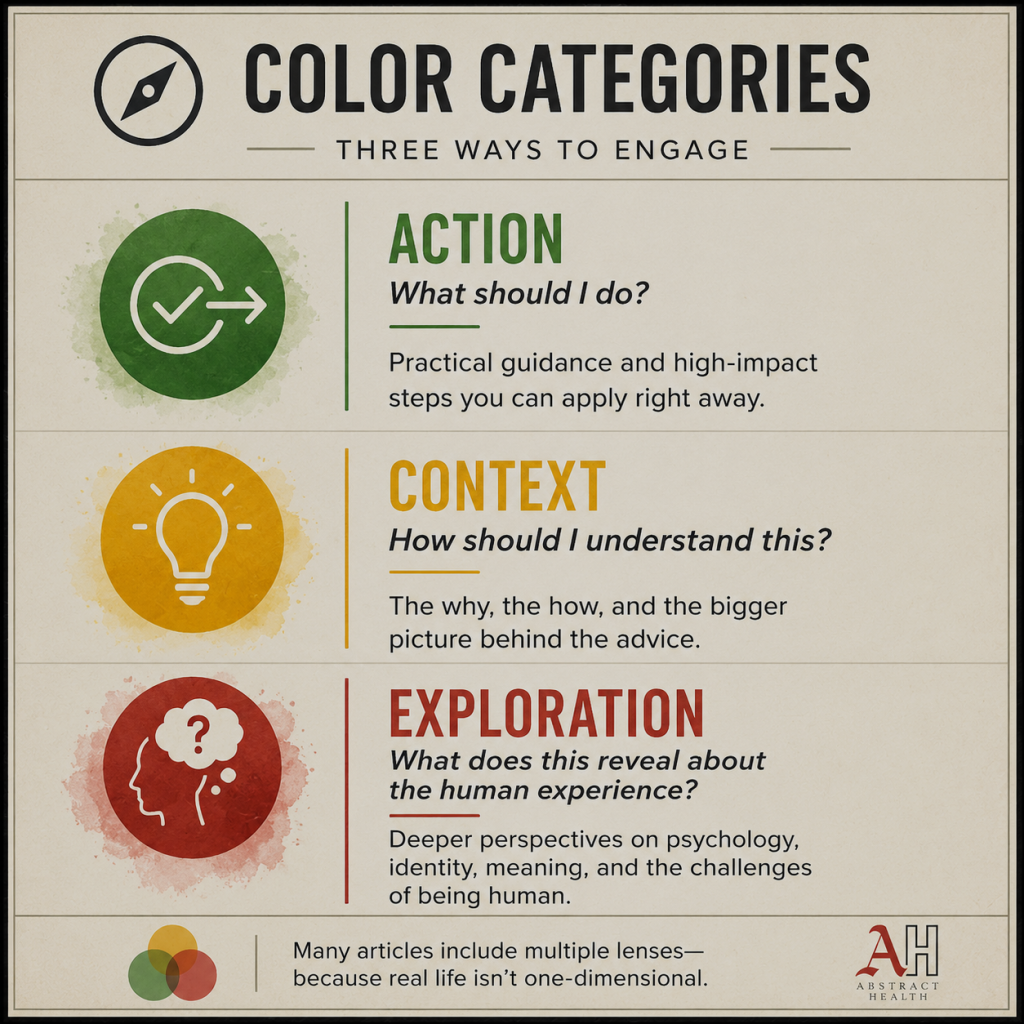
🟡🟢
There is a subtle difference we can draw between being thankful and being grateful.
Thankfulness often has a more immediate target.
We are thankful for something someone did, for an opportunity we received, for a problem that worked out, or for a moment of relief.
Gratitude can be broader. It can describe an appreciation for something simply because of the place it holds in our lives.
In everyday conversation, though, most of us blend the two words together—and that is probably fine. The important part is that there are things in our lives worth appreciating in the first place.
When we do gratitude exercises with people, something happens with remarkable consistency—
they begin naming people.
Their spouse. Their children. Their parents. A close friend. A coworker who made a difficult season easier. Someone who showed up when things were hard. Someone who makes them laugh.
That is interesting because those answers rarely begin with the things we spend so much time trying to optimize.
We spend much of our lives focused on day-to-day responsibilities, health habits, work, schedules, and the many small demands competing for our attention. Those things matter.
But when we stop long enough to ask what makes life feel valuable, our attention often moves outward.
Toward other people.
We tend to think about health as something contained within us. We exercise our bodies. We improve our nutrition. We protect our sleep. We manage our stress.
But a healthy life is not something we build entirely within ourselves.
Some of our capacity exists between people.
We Were Never Entirely Individual
Human beings are deeply social.
For much of our history, connections were closely tied to survival. Other people helped provide food, protection, knowledge, child-rearing, caregiving, cooperation, and shared responsibility.
Modern life has changed many of the circumstances, but it has not completely rewritten the human being living within them.
Relationships still influence our emotional, mental, and physical well-being. Supportive social connections are associated with better health and longer life, while loneliness and social isolation are associated with poorer physical and psychological outcomes.
But perhaps the more interesting point is not simply that relationships affect health.
It is that needing other people is not evidence of weakness or poor independence.
It is part of the architecture of being human.
There is value in competence. There is value in learning to regulate ourselves, solve our own problems, tolerate discomfort, and stand on our own when necessary.
But total self-sufficiency is neither realistic nor necessarily desirable.
Few of us actually want a life in which we need nothing from anyone and no one needs anything from us.
For all our interest in independence, most of us are not particularly drawn to being alone.
Being Around People Is Not the Same as Belonging
Simply having people around us does not guarantee connection.
We can work in crowded buildings, receive endless notifications, interact with hundreds of people online, and still feel profoundly alone.
There is a difference between being seen and being known.
Being known means someone understands more than the version of us visible in a particular moment.
They know some of the history.
They know our successes and the things we are proud of.
They understand why a certain time of year is difficult.
They recognize when we are unusually quiet.
They know what makes us laugh, what excites us, and what matters to us.
They know the things we are good at and the places where we tend to get in our own way.
Sometimes they remember versions of us that we temporarily forget.
This may be one reason the quality of our relationships matters more than the sheer number of people in our social circles. A few close relationships may offer something that dozens of casual connections cannot.
Belonging is not simply proximity.
It is the experience of being somewhere we do not constantly have to perform, defend, explain, or prove ourselves.
There is a particular kind of rest in being known well enough that we can simply arrive.
Relationships as Capacity
In an earlier article, we described stress partly as the relationship between the demands placed upon us and the capacity available to meet them.
Usually, we imagine that capacity as something contained inside us.
Our energy, patience, physical health, emotional bandwidth, ability to think clearly…
But other people can change that equation.
Someone may take something off our plate.
They may help us solve a problem.
They may remind us that something feels larger because we are exhausted.
They may interrupt a loop of rumination we have been unable to escape on our own.
They may make us laugh in the middle of a terrible week.
They may simply sit beside us.
The problem does not disappear.
Reality has not changed.
But somehow, the experience of carrying it has.
Research on social support fits well with this idea. Social support may be especially valuable during difficult periods, and perceived support appears capable of buffering some of the effects associated with stress and interpersonal conflict.
We often talk about emotional regulation as though it is entirely an internal skill.
Certainly, learning to regulate ourselves matters.
But regulation also happens between people.
Stress can spread through relationships.
So can calm.
So can patience.
Humor.
Reassurance.
Perspective.
Sometimes another person cannot change what happened at all.
They can weave moments of warmth into the darker stretches, so what remains is not only pain, but a fuller tapestry of what it meant to live through it—tragic in places, beautiful in others, and made deeper by the contrast.
That can change what those darker stretches become in memory.
The People Who Help Us See Clearly
Relationships also give us something we cannot easily create alone:
a perspective outside our own.
Our view of reality is not always reliable.
We catastrophize, rationalize, become defensive, and underestimate ourselves.
We become so close to a problem that we can no longer see its proportions clearly.
Someone who knows us well may notice what we cannot.
You’re exhausted. Maybe this decision does not need to be made right now.
You’re being harder on yourself than you would ever be with someone else.
I don’t believe you’re fine.
You’re missing things that you normally wouldn’t.
Or sometimes:
I love you, but I think you’re wrong about this.
That last one matters.
Healthy relationships do not merely validate us.
Support does not always mean agreement.
Sometimes caring about someone means comforting them.
Sometimes it means challenging them.
Sometimes it means helping them distinguish what actually happened from the story they have constructed around it.
The people closest to us can become mirrors. Useful mirrors do more than tell us what we want to see.
They help us see more clearly.
Independence Is Not the Final Destination
Perhaps this is where the usual contrast between dependence and independence becomes too simple.
There is another option.
Interdependence.
Being capable of standing on our own while also being capable of trusting other people.
Receiving help without believing we are weak.
Offering help without needing to rescue.
Depending on someone during one season and allowing them to depend on us during another.
Relationships are not transactions.
Healthy relationships do not require that every contribution be measured or every difficult season remain perfectly balanced.
Sometimes one person will carry more.
People become sick. Parents become exhausted. Friends grieve. Partners struggle.
Life does not distribute its demands evenly.
What matters more is whether there is enough mutual investment over time that both people are allowed to be human within the relationship.
We matter to each other.
What We Give Back
That also means healthy relationships cannot be understood only in terms of what other people provide for us.
We become part of their capacity too.
Our patience matters.
Our attention matters.
Our reliability matters.
Our willingness to listen before responding matters.
So does our ability to take responsibility when we get something wrong.
Healthy connection asks us to listen, seek understanding, communicate honestly, express gratitude, respect boundaries, own our part, show empathy, support growth, and build trust through consistent behavior.
All of those ideas point toward the same principle:
Healthy relationships are something we participate in, not merely something we receive.
And that participation will not always be perfect.
We will become impatient.
We will misunderstand one another.
We will say the wrong thing.
We will occasionally disappoint the people we care about.
The goal is not flawless connection.
It is a relationship resilient enough to survive the fact that imperfect people are participating in it.
The Life We’re Trying to Protect
There is a strange possibility hidden inside modern health culture.
We can become so focused on improving ourselves that we forget what all that improvement is supposed to make possible.
We try to preserve our health so that we can continue participating in life.
Eventually, though, we have to ask:
What is that life made of?
For many of us, a meaningful portion of the answer is other people.
The person we drink coffee with in the morning.
The friend we can call when something goes wrong.
The child who wants to show us something that seems insignificant until we realize how quickly those moments disappear.
The coworker who understands the absurdity of a difficult day.
The people with whom we eat, travel, build, argue, reconcile, celebrate, grieve, and remember.
This does not require marriage, children, or any particular version of family.
Connection takes many forms.
Friends.
Siblings.
Coworkers.
Neighbors.
Mentors.
Communities.
People we care for and people who care for us.
These relationships do not make hardship disappear.
People disappoint us. Friends drift apart. Relationships change. Some end.
Sometimes loneliness exists even while other people surround us.
Connection does not protect us from every painful part of being human.
But it can change the way we experience those parts.
It can make difficulty more bearable.
Joy more shareable.
Perspective easier to recover.
And life feel larger than the boundaries of the individual carrying it.
Perhaps that is why, when we ask people what they are grateful for, they so often begin by naming people.
We often talk about relationships as one component of a healthy life.
Maybe that framing is incomplete.
Relationships are not simply another health behavior to optimize alongside exercise, nutrition, and sleep.
They are among the places where the capacity those things provide actually gets used.
Health should support life—not consume it.
And a meaningful portion of the life we are trying to support is the life we share with other people.