Exploring the space between science and self.

Tag: movement

Movement — Capacity in Motion

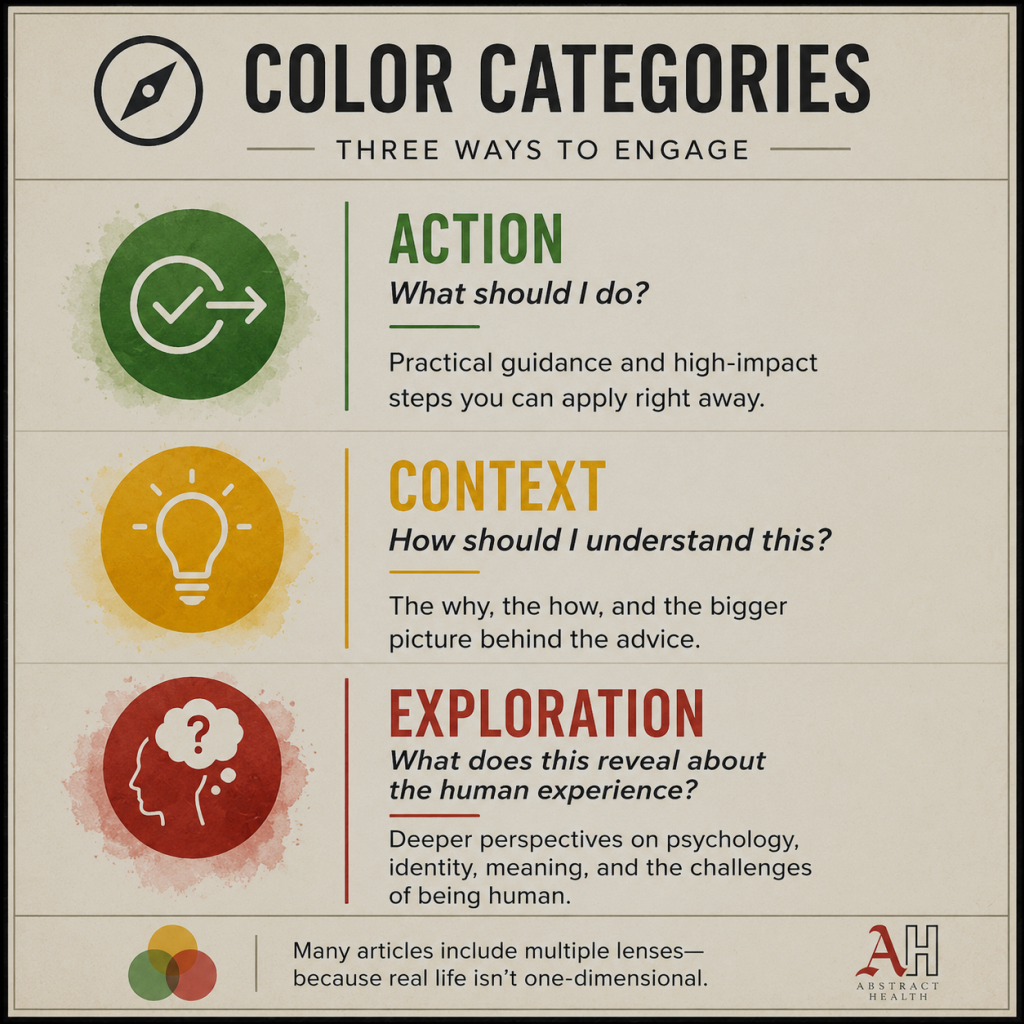
🟡🟢

This article is part of a series exploring what we’ve called The Big Three—sleep, movement, and nutrition. These foundational elements influence nearly every aspect of health, and each one strengthens the others. If you’re new to the concept, I recommend starting with The Big Three before continuing.


🟡 The Meaning Behind Movement

We experience life in two primary ways—through our minds and through our bodies.

The mind thinks, feels, imagines, plans, prioritizes, and decides. The body carries those decisions into the world. Almost every conversation we have, every hug we give, every project we build, every adventure we pursue, and every achievement we celebrate eventually passes through movement.

Our capacity to move shapes our capacity to live.

Movement is how we interact with the physical world. It allows us to experience life, care for others, pursue our goals, and engage with the world around us. Like most human capacities, it grows with use and declines with neglect.

In many ways, movement is unique among the foundations of health.

Sleep has one fairly distinct doorway.

Basic nutrition has one fairly distinct doorway.

Movement has countless.

Sleep asks us to recover.

Nutrition asks us to nourish ourselves.

But movement can be expressed in almost endless ways.

We can walk, hike, dance, swim, garden, climb, lift weights, play sports, chase our children, explore new places, or simply choose the stairs instead of the elevator. Each asks something different of the body, but all remind it that it is still needed.

Different activities produce different adaptations, and some are better suited for particular goals. But when the goal is simply to become a healthier, more capable human being, there are far more valid starting points than most of us realize.

That’s one of the beautiful things about movement.

It doesn’t demand a single expression.

It simply asks to be expressed.

Unfortunately, we now live in a world where movement is no longer woven into daily life. Convenience has become one of humanity’s greatest achievements, but also one of its greatest challenges. Many of the physical demands that once maintained our capacity have quietly disappeared.

Movement now requires intention. And intention requires effort.

That effort can feel like another demand in a life already full of them.

So movement becomes another task. Another obligation. Another thing we’re told we “should” do.

We often justify it by focusing on appearance, weight loss, or avoiding disease. Those are valid reasons, but they’re incomplete.

Movement isn’t valuable because it’s exercise.

It’s valuable because it preserves capacity.

At one time, movement wasn’t something we scheduled. It was simply life. We hunted, gathered, built, carried, climbed, traveled, and played because survival depended on it.

Today, movement is much more optional.

Our biology, however, has not become optional.

It still expects activity. It still adapts to use. And it still declines without it.

So the question becomes:
Do we allow the machine to slowly diminish?
Do we let it become a memorial to life instead of something that actively lives it?
Or do we keep it running?

Movement is not simply about muscles or calories.
It is a conversation with the body.

Every walk. Every lift. Every climb. Every game. Every dance. Every hour spent in the garden.

Each one quietly says:

“Stay capable.”

The body responds accordingly.

Muscles strengthen.
The heart becomes more efficient.
Bones remain resilient.
The brain functions better.
Mood improves.
Blood sugar becomes easier to regulate.

Nearly every major system in the body responds because nearly every major system evolved expecting movement.

When we don’t move, adaptation still occurs.

Capacity gradually shrinks.
Tasks become harder.
Options become fewer.

This isn’t failure. It’s simply adaptation in the opposite direction of what most of us would prefer.

The body doesn’t respond to perfect plans.

It responds to repeated exposure.

Do it reasonably well.
Do enough.
Do it often.

Modern life makes movement feel like an upgrade.

In reality, it is a requirement that modern life has made easy to ignore.

The goal isn’t to become exceptional.

The goal is to preserve enough capacity that your body expands your options instead of quietly limiting them.


🟢 What To Do

Movement doesn’t need to be complicated.

It needs to become part of who you are.

The recommendations below aren’t designed to create elite athletes or maximize performance.

They’re meant to lower barriers, reduce noise, and help you build a lifelong relationship with movement.

Rather than prescribing one specific activity, think in terms of principles.

There are countless doorways into movement.

The principles remain the same.


1. Sit Less

If there’s one place almost everyone can begin, it’s here.

Long periods of sitting work against how the body is designed to function—even if you exercise regularly.

Stand up every 30–60 minutes when possible.

Take short walks.

Look for small opportunities to move throughout the day.

Movement doesn’t have to begin with a workout.

Sometimes it begins by simply sitting a little less.


2. Find a Doorway You’ll Keep Walking Through

Walking. Gardening. Dancing. Swimming. Weight training. Brazilian jiu-jitsu. Hiking. Recreational sports. Playing with your grandchildren.

The “best” activity is often the one that gets you moving safely and consistently.

Don’t spend months searching for the perfect doorway.

Walk through one. If you don’t like it, try another. The goal isn’t to choose perfectly—it’s to keep moving until you find an expression you can return to.


3. Challenge Your Body

The body adapts when it is asked to do something slightly beyond what it’s used to.

Sometimes that’s walking farther.
Sometimes it’s climbing a hill.
Sometimes it’s lifting a heavier object.
Sometimes it’s learning a new skill.

Whatever you choose, make sure it asks something of you.

Without challenge, capacity doesn’t grow.

Capacity grows when we consistently push just beyond our current abilities.


4. Build Strength Intentionally

Although movement has many valid doorways, modern life rarely asks us to meaningfully challenge our muscles.

For that reason, resistance training deserves special attention.

Aim for two or three sessions each week.

Start lighter than you think.

Learn good technique.

Progress gradually.

We’ll explore why muscle matters far beyond appearance in a future article.


5. Keep Your Body Moving Well

Move through different positions.

Reach overhead.

Squat.

Rotate.

Balance.

Get up from the floor occasionally.

Use the range of motion your body was designed to have.

Mobility isn’t another workout.

It’s how we keep movement available.


6. Progress Gradually

Capacity grows through repeated, recoverable challenge.

Don’t chase exhaustion. Build momentum.

Allow your body to adapt.

The goal isn’t to prove what you can do today.

It’s to gradually expand what you’ll be able to do tomorrow.


7. Stay Consistent

The body doesn’t reward occasional perfection.

It rewards repeated exposure.

Some weeks you’ll do more.

Some weeks you’ll do less.

Keep showing up.

Consistency compounds.


Closing

There isn’t one right way to move. There are countless ways to build capacity. Don’t let the search for the perfect program prevent you from beginning.

Choose a doorway. Walk through it.

Stay curious.
Keep learning.
Keep moving.

Because movement isn’t the goal.

Capacity is.

And the greater your capacity, the greater your ability to say yes to the people, places, experiences, and opportunities that make life meaningful.

If you decide you want to go deeper, there are many more layers to explore.

But this is enough to get started.
The Big Three: A Framework for Prioritizing Health

There is no shortage of health information.

Open your phone, turn on the television, browse social media, or walk through a bookstore, and you’ll find an endless stream of advice.

Most of it isn’t wrong. In fact, much of it is genuinely useful. The problem is that it all competes for the same attention. When every article, podcast, influencer, and advertisement claims to hold another important piece of the puzzle, it becomes increasingly difficult to distinguish the foundational from the optional.

Some people become overwhelmed and stop trying altogether.

Others head in the opposite direction—pursuing increasingly smaller optimizations while overlooking the habits that produce the greatest return.

Health itself hasn’t become more complicated.

The human body hasn’t fundamentally changed.

Our attention has.


Most people already possess a surprising amount of health knowledge.

Ask someone what contributes to good health and you’ll likely hear familiar answers:

  • Sleep
  • Exercise
  • Eat well
  • Manage stress
  • Don’t smoke
  • Limit alcohol

They’re not starting from zero. The challenge isn’t a lack of information. It’s understanding the hierarchy of that information. Not all health information deserves the same amount of our attention. Some ideas meaningfully shape health. Others produce modest improvements. Some are only relevant under specific circumstances.  And some simply distract from what matters most.

When we lose sight of those differences, everything begins to feel equally important. Ironically, that’s when progress often slows.

Because when everything becomes a priority…

Nothing really is.


Rather than asking, “What’s the best thing I can do?”

a better question might be: “What are the largest things I can influence?”

That distinction matters.

Not everything that influences health is within our control.
Genetics matter. Environmental exposures matter. Access to healthcare matters. Life circumstances matter. Randomness matters.

But many of those variables are only partially—or not at all—under our control.

Instead of chasing complete control over our health, we should focus on maximizing the variables we can meaningfully influence.

Our goal isn’t perfect health.

It’s to consistently move the odds in our favor with the variables we can actually influence.


This idea resembles the logic behind Maslow’s Hierarchy of Needs. Before pursuing higher-level goals, we first satisfy the foundation. You don’t build a house starting with the roof. You don’t install drywall before pouring the concrete. The foundation isn’t exciting. But it determines how well everything else performs.

Health works much the same way. There is a difference between building health and optimizing health.

Optimization has become incredibly popular.
Cold plunges. Continuous glucose monitors. Supplement stacks. Longevity protocols.

Many of these have contexts where they may provide value. But they should never compete with the foundation for your time, attention, or energy.

The foundation comes first.

Everything else is built upon it.


For most people, three habits account for a disproportionate share of the health we can actually influence.

The Big Three

  • Sleep
  • Movement
  • Nutrition

Surprised? Probably not.

Good.

This isn’t about introducing something you’ve never heard before. It’s about revisiting familiar ideas and organizing them into a clearer hierarchy.

These aren’t the only things that influence health. They’re simply the best place to start. Because they influence nearly everything else.

Energy. Recovery. Mood. Metabolic health. Hormonal regulation. Cognitive performance. Physical function.

Sleep provides the opportunity for the body and brain to recover, repair, regulate hormones, consolidate memories, and prepare for the demands of the next day.

Movement preserves physical function, improves cardiovascular and metabolic health, strengthens muscles and bones, supports mental well-being, and helps maintain independence throughout life.

Nutrition supplies the energy and building blocks the body needs to function, recover, adapt, and protect itself from disease.

We’ll explore each of these topics in much greater depth throughout the following articles.

Without first addressing the Big Three, trying to identify the source of a health problem can become like searching for the source of a smell in a landfill.

The problem isn’t that the answer isn’t there. It’s that too many variables are competing for your attention before the foundation has been addressed.

The signal is buried beneath unnecessary noise.


Knowing what matters is only half the equation. The other half is understanding how to approach it.

Nearly every practical recommendation we’ll discuss can be filtered through three simple questions:

How well?

How much?

How often?

Or, stated another way:

Quality.

Quantity.

Consistency.

Let’s refer to this as The Health Triad.

This isn’t another rule. It’s a lens. A framework for evaluating nearly every future health discussion.

Whenever new information appears, ask yourself: Is this improving the quality, quantity, or consistency of one of the Big Three? Or is it simply another variable competing for attention?


Health recommendations are built around patterns that consistently help the greatest number of people.

They are probabilities—not absolutes. There will always be exceptions. Some people become ill despite doing almost everything right. Others remain healthy despite years of poor habits.

Individual stories matter. But they don’t replace population-level evidence.

Our responsibility is to make decisions based on what reliably shifts the odds in our favor, while remaining humble enough to recognize that certainty doesn’t exist.


Health information will continue to grow. New supplements will appear. New diets will emerge. New technologies will promise better outcomes.

None of those things are inherently bad.
But they should always be evaluated in relation to the foundation.

When the foundation is strong, optimization becomes more meaningful.
When the foundation is weak, optimization often becomes distraction.

We don’t control every outcome.
We influence the probability of outcomes.

And for most people, very few habits influence those probabilities more than sleep, movement, and nutrition. Everything that follows builds from that foundation.

Health doesn’t become confusing because we know too little.
It becomes confusing because we struggle to distinguish the foundational from the marginal.

The purpose of the Big Three isn’t to tell you everything that matters.
It’s to make sure you never lose sight of what matters most.
To restore hierarchy to the countless ideas competing for your attention.


From Framework to Action

Understanding the Big Three is only the beginning.

Knowing what deserves your attention is valuable.

Learning how to apply it is where meaningful change begins.

Over the next three articles, we’ll take a closer look at each of the largest controllable drivers of long-term health:

  • Sleep — Recovery, restoration, and the foundation upon which everything else is built.
  • Movement — Building and preserving the physical capacity to live well.
  • Nutrition — Supplying the body with the energy and resources it needs to function, adapt, and thrive.

We’ll continue using the same lens throughout:

Quality. Quantity. Consistency.

Because the goal isn’t to master every health topic.

It’s to consistently improve the habits that matter most.

Primitive Beings in a Modern Age

The first disconnect.

🟡🟢
We exist as primitive beings in a modern age, and we face a unique challenge: thriving in an environment that changed faster than our biology could adapt.

As we established in the last post—Purpose & Burden—maintaining health requires effort.

While this is true, it doesn’t make it any less unfortunate.

We have to go out of our way to learn:

  • How to sleep
  • How to move
  • What to eat

And in many ways, we are the only species that has to do this.
The only animal that has to consciously figure out how to take care of itself.

This raises a fair question:

Why?

It’s easy to assume something is wrong with us.

A lack of discipline.
A lack of knowledge.
A lack of consistency.

But the issue runs deeper than that.

We are out of place.

A common analogy is a fish out of water—something removed from the environment it was built for.
Awkwardly flopping on dry land.
Cursing the air.

But that’s not quite right.

We’re not gasping on land.

We’re still in the water.

The water has just changed.

For most of human history, life required:

  • Regular physical movement
  • Exposure to natural light and darkness
  • Real, whole, minimally processed food
  • Effort tied directly to survival

Our food came from a plant or a mother.
We moved to build, to hunt, to gather, to protect.
We slept in rhythm with the sun. Darkness was only penetrated by firelight—not bright, artificial light that stimulates the brain and delays rest.

Our physiology was shaped in that environment.

Not over decades.

Over hundreds of thousands of years.

Then, in what is essentially a blink of an eye on that timeline, everything shifted.

The first Homo sapiens appeared roughly 300,000 years ago.

Our biology—our need for movement, nourishment, rest, and recovery—has remained largely the same.

But the environment we live in has changed dramatically in roughly the last century:

  • The rise of ultra-processed, highly convenient foods
  • A shift toward sedentary, desk-based work
  • The introduction of artificial light and extended waking hours
  • A culture that increasingly prioritizes productivity and output

The scale of that shift is difficult to grasp until you zoom out.

As Yuval Noah Harari notes in Sapiens: A Brief History of Humankind, since the 1500s:

  • Human population has increased roughly 14-fold
  • Energy consumption has increased 115-fold

We’ve created a completely different environment.

And yet…

Our biology is largely the same.

Food is no longer something we seek.
It’s something that surrounds us.

Movement is no longer required.
It’s something we have to choose.

Sleep is no longer governed by the sun.
It competes with artificial light, stimulation, and modern demands.

In a very short period of time, we became:

Overfed, but undernourished
Stimulated, but exhausted
Connected, but often disconnected from ourselves—
from our nature and primitive needs

And then we ask:

“Why is this so hard?”

It’s not just you.

It’s the world that surrounds you.

We have become a product of our own advancement—
living in an environment shaped by convenience, efficiency, and technological growth.

But this doesn’t mean modern life is the problem.

It has given us safety, longevity, and opportunity that previous generations never had—especially when compared to our primitive past.

But it does mean this:

The environment no longer supports health by default.

Which means health is no longer automatic.

It requires intent.

Reconciling the Disconnect

This isn’t about rejecting modern life.

It’s about reintroducing the conditions your body still expects.

Not perfectly.
Not obsessively.
But consistently.

That might look like:

  • Choosing foods that resemble their original form more often than not
  • Getting exposure to natural light, especially early in the day
  • Reducing light and stimulation later at night
  • Building movement back into daily life—not just what we do in the gym
  • Creating small boundaries in an otherwise boundaryless environment

These aren’t advanced strategies.

It isn’t about obsession or optimization.

It’s simply a return to baseline conditions.

The foundation.

Because when those basics are in place, we’re in a much better position to experience:

  • More stable energy
  • Improved sleep
  • Easier appetite regulation
  • Movement that feels more natural

Not because we’ve “hacked” our biology.

But because we’ve stopped working against it.

Where This Goes Next

This is only the first layer.

Because it’s not just that the environment has changed…

It has intensified.

And that changes how our brain, behavior, and biology respond in ways that are far less obvious.

That’s where we’ll go next.

© 2026 Abstract Health

Theme by Anders NorenUp ↑