Exploring the space between science and self.

Tag: sleep

Sleep — The Foundation in the Dark

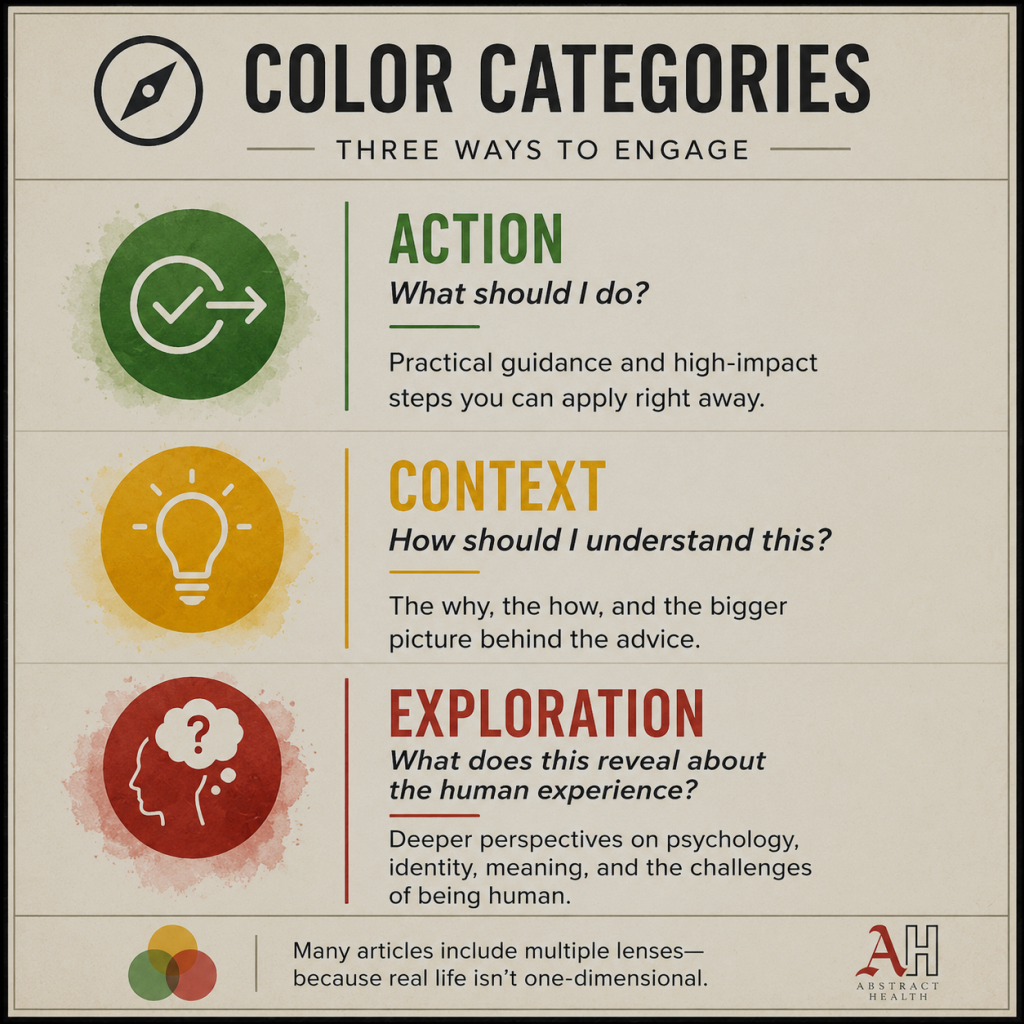
🟡🟢

This article is part of a series exploring what we’ve called The Big Three—sleep, movement, and nutrition. These foundational elements influence nearly every aspect of health, and each one strengthens the others. If you’re new to the concept, I recommend starting with The Big Three before continuing.

We exist in a complex system that requires rest—even when we would prefer not to.

Life is busy.
Hectic.
Chaotic, at times.

And sometimes the only time we get to decompress is when we should be sleeping.

So we make a trade.

We barter time for recovery—
trying to maintain balance as best we can,
trying not to demand too much of the night,
so the day doesn’t demand too much of us.

For a while, it works.

Until it doesn’t.

We all have different relationships with sleep.

Some long for it but have a hard time finding it.
Some fight it.
Some feel most creative and alive at the exact time they should be deep into it.
Some would take a nap every day if life allowed it—drawn to the comfort, the stillness, the peace.
Others see it as an interruption. Something that gets in the way of doing more.

The idea that sleep is important is common knowledge. It goes without saying.
We understand its role in health.
And we feel the consequences when it’s missing—
mentally, physically, emotionally.

But understanding something in theory, and navigating it in real life, are not the same thing.
The clinical need for sleep must pass through the human condition.
And that reality reshapes our relationship with what we should do.

What Sleep Actually Is

Sleep is one of the few states where conscious control fades, and the brain shifts into a different mode of operation.

We don’t just shut off.
The system continues working—
organizing,
repairing,
regulating—

just outside of our awareness.

The Creative Potential of Sleep

There’s a long history of ideas that didn’t come from effort—but from rest.

Dmitri Mendeleev saw the structure of the periodic table in a dream.
Mary Shelley described Frankenstein as she was emerging from a restless night.
Paul McCartney woke up with the melody for “Yesterday” already formed.
These aren’t just interesting stories.
They point to something functional.

During the day, the mind is structured—focused and directed.

At night, that structure loosens just enough to allow new connections.

Creativity isn’t always about pushing harder.
Sometimes it’s about stepping back long enough for the system to do its work.

Sleep as a Foundational Lever

Out of the Big Three—sleep, movement, and nutrition—
sleep is arguably the most foundational.

They all influence one another.

But sleep often becomes the rate-limiting step—
the point at which the system can no longer keep up.

You can think of sleep as an internal organization process.
Like a librarian cleaning up, organizing, and restoring the environment after a full day of activity.

Everything you experienced during the day—
conversations,
stress,
information,
decisions—
all get sorted.

Some things are strengthened. Some are discarded.
Some are connected in ways they weren’t before.

Without that process, things don’t pause.

They accumulate.

Sleep Cycles, Simplified

Sleep isn’t one continuous state.

It moves through cycles—roughly every 90 minutes—
shifting between lighter sleep, deeper sleep, and REM sleep.

Deep sleep supports physical repair.
REM sleep supports learning, memory, and emotional processing.

Deep sleep restores the body.
REM sleep reorganizes the mind.

When sleep is shortened or fragmented,
these cycles get cut short—
and the system doesn’t complete its work.

The Tradeoff We Misunderstand

We often treat sleep as a tradeoff.

More time awake feels like more opportunity.
More productivity.
More control.

But the trade isn’t neutral.

You gain time—but lose clarity, efficiency, and stability.

At a certain point, you’re no longer gaining more time.
You’re simply getting less out of the time you have.

Sleep doesn’t just affect how you feel.
It changes how the system operates.

When sleep is compromised:
Hunger becomes less regulated.
Emotions become more reactive.
Stress responses become amplified.
Recovery slows.
Energy becomes less stable.
Mental precision becomes dulled.

You don’t just feel different.

You function differently.

More effort—less return.

Insight

We often try to fix other inputs.

Better diet.
Better workouts.
More effort.

But sleep sits underneath all of it.

It’s part of the maintenance system—
the one that determines whether anything else actually works.

You can tolerate imperfect nutrition for a while.
You can get by with low movement—for a time.

But when sleep is consistently compromised—
the system begins to shift. And everything built on top of it becomes less reliable.

Before we try to optimize everything else, it makes sense to stabilize the foundation.

Not perfectly. But consistently enough that the system can respond.

Because once sleep is in place—
everything else doesn’t just improve.
It becomes easier to improve.

🟢 What to Do (High-Leverage Actions)

Do it well. Do enough. Do it often.

Start Here (Highest Return for the Effort)

Wake up around the same time every day (±30–60 minutes). The closer to a consistent time, the better—but anything helps. Waking up at a consistent time builds sleep pressure that can help make bedtime easier.

Get light exposure as soon as possible after waking. This helps anchor your circadian rhythm, making it easier to fall asleep that night.

Limit caffeine after early afternoon (~1–2 PM).

Dim lights and reduce screen exposure 1–2 hours before bed.

QUALITY — Sleep Better While You’re There

Keep your room cool, dark, and quiet.

Remove or cover unnecessary light sources (TVs, LEDs, clocks).

Use blackout curtains, a sleep mask, or white noise if needed.

Reserve your bed for sleep and sex.

Avoid alcohol and heavy meals within 2–3 hours of bedtime.

Build a simple, repeatable wind-down routine.

QUANTITY — Give Your Body Enough Time

Aim for 7–9 hours of sleep.

Set a consistent wake time first, then work backward to determine your bedtime.

Don’t rely on weekend catch-up sleep.

Protect sleep like any other important appointment.

CONSISTENCY — Stabilize the System

Keep sleep and wake times within about an hour or less—even on weekends.

Get daily sunlight exposure.

Avoid large late-night meals—not because eating late is inherently “bad,” but because digestion and reflux can interfere with sleep.

Keep exercise timing relatively consistent. Training too close to bedtime may delay sleep onset.

Minimize These

Late caffeine

Late-night screens and bright light

Irregular sleep schedules

Alcohol as a sleep aid

Long or late naps

If You Can’t Sleep

Don’t stay in bed frustrated.

Get up, keep the lights low, and do something relaxing.

Return to bed when you feel sleepy.

Train the association:

Bed = sleep, not stress.

Tips for Sleep Onset

Read a book.

Listen to relaxing music.

Drink warm tea (caffeine-free) or warm milk.

Take a warm shower or bath (keeping lights dim).

Practice deep breathing.

Journal.

Write tomorrow’s to-do list so it isn’t competing for your attention.

Bottom Line

Sleep doesn’t need to be perfect.

It needs to be repeatable and sufficient.

Get this right, and everything else—

nutrition,
movement,
stress—

becomes easier to improve.
The Big Three: A Framework for Prioritizing Health

There is no shortage of health information.

Open your phone, turn on the television, browse social media, or walk through a bookstore, and you’ll find an endless stream of advice.

Most of it isn’t wrong. In fact, much of it is genuinely useful. The problem is that it all competes for the same attention. When every article, podcast, influencer, and advertisement claims to hold another important piece of the puzzle, it becomes increasingly difficult to distinguish the foundational from the optional.

Some people become overwhelmed and stop trying altogether.

Others head in the opposite direction—pursuing increasingly smaller optimizations while overlooking the habits that produce the greatest return.

Health itself hasn’t become more complicated.

The human body hasn’t fundamentally changed.

Our attention has.


Most people already possess a surprising amount of health knowledge.

Ask someone what contributes to good health and you’ll likely hear familiar answers:

  • Sleep
  • Exercise
  • Eat well
  • Manage stress
  • Don’t smoke
  • Limit alcohol

They’re not starting from zero. The challenge isn’t a lack of information. It’s understanding the hierarchy of that information. Not all health information deserves the same amount of our attention. Some ideas meaningfully shape health. Others produce modest improvements. Some are only relevant under specific circumstances.  And some simply distract from what matters most.

When we lose sight of those differences, everything begins to feel equally important. Ironically, that’s when progress often slows.

Because when everything becomes a priority…

Nothing really is.


Rather than asking, “What’s the best thing I can do?”

a better question might be: “What are the largest things I can influence?”

That distinction matters.

Not everything that influences health is within our control.
Genetics matter. Environmental exposures matter. Access to healthcare matters. Life circumstances matter. Randomness matters.

But many of those variables are only partially—or not at all—under our control.

Instead of chasing complete control over our health, we should focus on maximizing the variables we can meaningfully influence.

Our goal isn’t perfect health.

It’s to consistently move the odds in our favor with the variables we can actually influence.


This idea resembles the logic behind Maslow’s Hierarchy of Needs. Before pursuing higher-level goals, we first satisfy the foundation. You don’t build a house starting with the roof. You don’t install drywall before pouring the concrete. The foundation isn’t exciting. But it determines how well everything else performs.

Health works much the same way. There is a difference between building health and optimizing health.

Optimization has become incredibly popular.
Cold plunges. Continuous glucose monitors. Supplement stacks. Longevity protocols.

Many of these have contexts where they may provide value. But they should never compete with the foundation for your time, attention, or energy.

The foundation comes first.

Everything else is built upon it.


For most people, three habits account for a disproportionate share of the health we can actually influence.

The Big Three

  • Sleep
  • Movement
  • Nutrition

Surprised? Probably not.

Good.

This isn’t about introducing something you’ve never heard before. It’s about revisiting familiar ideas and organizing them into a clearer hierarchy.

These aren’t the only things that influence health. They’re simply the best place to start. Because they influence nearly everything else.

Energy. Recovery. Mood. Metabolic health. Hormonal regulation. Cognitive performance. Physical function.

Sleep provides the opportunity for the body and brain to recover, repair, regulate hormones, consolidate memories, and prepare for the demands of the next day.

Movement preserves physical function, improves cardiovascular and metabolic health, strengthens muscles and bones, supports mental well-being, and helps maintain independence throughout life.

Nutrition supplies the energy and building blocks the body needs to function, recover, adapt, and protect itself from disease.

We’ll explore each of these topics in much greater depth throughout the following articles.

Without first addressing the Big Three, trying to identify the source of a health problem can become like searching for the source of a smell in a landfill.

The problem isn’t that the answer isn’t there. It’s that too many variables are competing for your attention before the foundation has been addressed.

The signal is buried beneath unnecessary noise.


Knowing what matters is only half the equation. The other half is understanding how to approach it.

Nearly every practical recommendation we’ll discuss can be filtered through three simple questions:

How well?

How much?

How often?

Or, stated another way:

Quality.

Quantity.

Consistency.

Let’s refer to this as The Health Triad.

This isn’t another rule. It’s a lens. A framework for evaluating nearly every future health discussion.

Whenever new information appears, ask yourself: Is this improving the quality, quantity, or consistency of one of the Big Three? Or is it simply another variable competing for attention?


Health recommendations are built around patterns that consistently help the greatest number of people.

They are probabilities—not absolutes. There will always be exceptions. Some people become ill despite doing almost everything right. Others remain healthy despite years of poor habits.

Individual stories matter. But they don’t replace population-level evidence.

Our responsibility is to make decisions based on what reliably shifts the odds in our favor, while remaining humble enough to recognize that certainty doesn’t exist.


Health information will continue to grow. New supplements will appear. New diets will emerge. New technologies will promise better outcomes.

None of those things are inherently bad.
But they should always be evaluated in relation to the foundation.

When the foundation is strong, optimization becomes more meaningful.
When the foundation is weak, optimization often becomes distraction.

We don’t control every outcome.
We influence the probability of outcomes.

And for most people, very few habits influence those probabilities more than sleep, movement, and nutrition. Everything that follows builds from that foundation.

Health doesn’t become confusing because we know too little.
It becomes confusing because we struggle to distinguish the foundational from the marginal.

The purpose of the Big Three isn’t to tell you everything that matters.
It’s to make sure you never lose sight of what matters most.
To restore hierarchy to the countless ideas competing for your attention.


From Framework to Action

Understanding the Big Three is only the beginning.

Knowing what deserves your attention is valuable.

Learning how to apply it is where meaningful change begins.

Over the next three articles, we’ll take a closer look at each of the largest controllable drivers of long-term health:

  • Sleep — Recovery, restoration, and the foundation upon which everything else is built.
  • Movement — Building and preserving the physical capacity to live well.
  • Nutrition — Supplying the body with the energy and resources it needs to function, adapt, and thrive.

We’ll continue using the same lens throughout:

Quality. Quantity. Consistency.

Because the goal isn’t to master every health topic.

It’s to consistently improve the habits that matter most.

Primitive Beings in a Modern Age

The first disconnect.

🟡🟢
We exist as primitive beings in a modern age, and we face a unique challenge: thriving in an environment that changed faster than our biology could adapt.

As we established in the last post—Purpose & Burden—maintaining health requires effort.

While this is true, it doesn’t make it any less unfortunate.

We have to go out of our way to learn:

  • How to sleep
  • How to move
  • What to eat

And in many ways, we are the only species that has to do this.
The only animal that has to consciously figure out how to take care of itself.

This raises a fair question:

Why?

It’s easy to assume something is wrong with us.

A lack of discipline.
A lack of knowledge.
A lack of consistency.

But the issue runs deeper than that.

We are out of place.

A common analogy is a fish out of water—something removed from the environment it was built for.
Awkwardly flopping on dry land.
Cursing the air.

But that’s not quite right.

We’re not gasping on land.

We’re still in the water.

The water has just changed.

For most of human history, life required:

  • Regular physical movement
  • Exposure to natural light and darkness
  • Real, whole, minimally processed food
  • Effort tied directly to survival

Our food came from a plant or a mother.
We moved to build, to hunt, to gather, to protect.
We slept in rhythm with the sun. Darkness was only penetrated by firelight—not bright, artificial light that stimulates the brain and delays rest.

Our physiology was shaped in that environment.

Not over decades.

Over hundreds of thousands of years.

Then, in what is essentially a blink of an eye on that timeline, everything shifted.

The first Homo sapiens appeared roughly 300,000 years ago.

Our biology—our need for movement, nourishment, rest, and recovery—has remained largely the same.

But the environment we live in has changed dramatically in roughly the last century:

  • The rise of ultra-processed, highly convenient foods
  • A shift toward sedentary, desk-based work
  • The introduction of artificial light and extended waking hours
  • A culture that increasingly prioritizes productivity and output

The scale of that shift is difficult to grasp until you zoom out.

As Yuval Noah Harari notes in Sapiens: A Brief History of Humankind, since the 1500s:

  • Human population has increased roughly 14-fold
  • Energy consumption has increased 115-fold

We’ve created a completely different environment.

And yet…

Our biology is largely the same.

Food is no longer something we seek.
It’s something that surrounds us.

Movement is no longer required.
It’s something we have to choose.

Sleep is no longer governed by the sun.
It competes with artificial light, stimulation, and modern demands.

In a very short period of time, we became:

Overfed, but undernourished
Stimulated, but exhausted
Connected, but often disconnected from ourselves—
from our nature and primitive needs

And then we ask:

“Why is this so hard?”

It’s not just you.

It’s the world that surrounds you.

We have become a product of our own advancement—
living in an environment shaped by convenience, efficiency, and technological growth.

But this doesn’t mean modern life is the problem.

It has given us safety, longevity, and opportunity that previous generations never had—especially when compared to our primitive past.

But it does mean this:

The environment no longer supports health by default.

Which means health is no longer automatic.

It requires intent.

Reconciling the Disconnect

This isn’t about rejecting modern life.

It’s about reintroducing the conditions your body still expects.

Not perfectly.
Not obsessively.
But consistently.

That might look like:

  • Choosing foods that resemble their original form more often than not
  • Getting exposure to natural light, especially early in the day
  • Reducing light and stimulation later at night
  • Building movement back into daily life—not just what we do in the gym
  • Creating small boundaries in an otherwise boundaryless environment

These aren’t advanced strategies.

It isn’t about obsession or optimization.

It’s simply a return to baseline conditions.

The foundation.

Because when those basics are in place, we’re in a much better position to experience:

  • More stable energy
  • Improved sleep
  • Easier appetite regulation
  • Movement that feels more natural

Not because we’ve “hacked” our biology.

But because we’ve stopped working against it.

Where This Goes Next

This is only the first layer.

Because it’s not just that the environment has changed…

It has intensified.

And that changes how our brain, behavior, and biology respond in ways that are far less obvious.

That’s where we’ll go next.

© 2026 Abstract Health

Theme by Anders NorenUp ↑