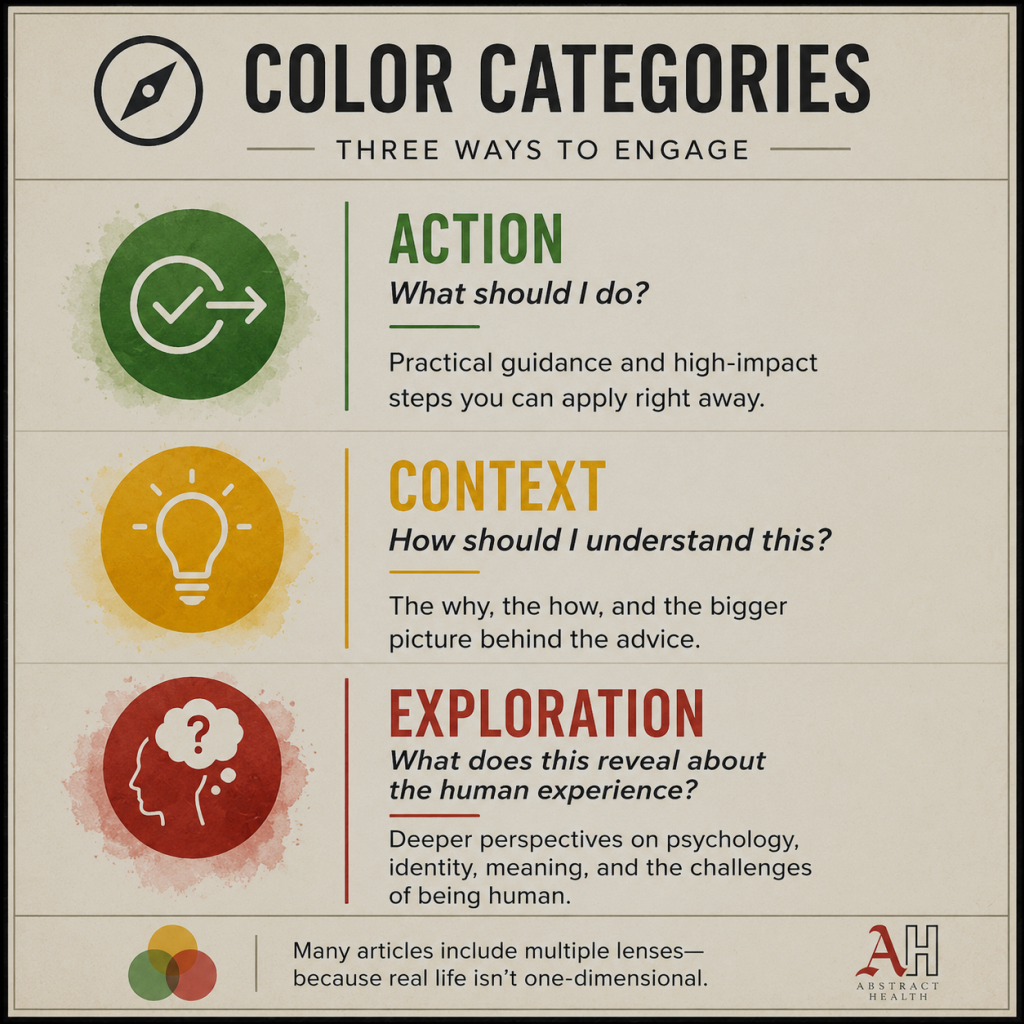
🟡🔴
Credibility is valuable because it is difficult to earn.
We ask a lot of our experts because we assume they have gone through the appropriate education, experience, and intellectual rigor required to give us useful guidance. We place faith in their expertise much like we would a mechanic, electrician, or plumber.
Ideally, we want experts who understand the evidence, respect its limitations, disclose uncertainty, correct themselves when necessary, and resist the temptation to make a claim more exciting than the data allows.
Those are reasonable expectations.
But we should also understand what we are asking.
Being a good steward of information is often harder than being a bad one.
Strongly held positions can create convenient filters. We can emphasize supportive evidence, dismiss contradictory evidence, or interpret uncertainty in whichever direction protects what we already believe.
Experts are no more immune to fusing information with identity than the rest of us.
[Link: The Biggest Mistake in Health]
Someone genuinely trying to understand reality does not get that luxury.
They have to carry the supportive evidence, the contradictory evidence, the uncertainty, and the uncomfortable finding that complicates an otherwise clean argument.
Credibility comes with weight.
The Easier Answer Usually Travels Faster
This becomes especially difficult in public-facing health communication.
People understandably want answers.
Should I eat this? Should I avoid that? Is this supplement worth taking? Is this medication safe? Is this expert right?
Sometimes the answer is yes.
Sometimes it is no.
Very often it is some version of:
Maybe, depending on the person, the dose, the alternative, the outcome being measured, and how strong the evidence actually is.
That does not fit particularly well into a short caption or thirty-second video.
Social media and news outlets tend to reward clarity, confidence, emotion, novelty, and conflict.
Good science communication often requires qualification, restraint, probability, and context.
[Link: Health Media and the Inversion Principle]
The person willing to say, “They’ve been lying to you about this food for decades,” has a substantial rhetorical advantage over the person saying, “The evidence is mixed, the effect is probably small, and this likely matters less than your overall dietary pattern.”
One feels like revelation.
The other feels like homework.
That creates an uncomfortable reality for credible communicators:
Integrity can become a competitive disadvantage.
Credibility Does Not Eliminate Bias
We sometimes imagine credibility as freedom from bias.
It is not.
Credibility changes the forces acting on us.
Researchers, universities, professional organizations, journalists, influencers, and science communicators all operate within environments containing incentives.
That does not mean their conclusions are dishonest.
It simply means pressure exists.
And pressure deserves awareness.
Consider what happens when a health product becomes wildly popular.
Or a study reveals a slight inaccuracy in a long-held best practice.
Scrutiny is appropriate. Health history has earned skepticism. Researchers should ask whether the claims are supported, whether the benefits are meaningful, and whether unintended consequences exist.
Long-held beliefs should be continually tested.
That is science working as it should.
But sometimes the desire to challenge hype gradually becomes a search for flaws, especially when criticism itself attracts attention.
The question shifts from:
What does the evidence actually tell us?
to:
What is wrong with this?
Those questions sound similar.
They are not.
The first begins with curiosity.
The second begins with opposition.
Popular products attract research attention, publications, interviews, clicks, and media coverage. A finding suggesting that something popular is “not as healthy as you think” can be considerably more interesting than one concluding that it is moderately beneficial—or simply not useful enough to matter.
A dramatic correction is often more interesting than a boring conclusion, even when the boring conclusion is the more accurate one.
The concern here is proportionality.
The same forces capable of creating hype can also create reverse hype, where an effort to correct exaggeration begins exaggerating in the opposite direction.
Overcorrection is still distortion.
The responsibility of a credible communicator is not to be enthusiastic or skeptical.
It is to be proportional.
The Pressure to Become More Interesting
There is another pressure that may be harder to recognize.
An expert can spend years explaining the fundamentals.
Sleep. Movement. Nutrition. Resistance training. Taking medications appropriately. Doing the boring things consistently.
Eventually, intellectual boredom can become its own pressure.
So can financial pressure.
So can audience expectations.
The interesting material usually lives farther toward the margins: emerging mechanisms, new supplements, unusual protocols, preliminary research, controversial ideas, and optimization strategies.
There is nothing wrong with exploring those margins.
The problem begins when the threshold for evidence starts changing because the margins are more exciting than the foundation.
Rarely does someone wake up and decide to abandon their integrity.
More often, the threshold moves a little at a time.
A provocative headline here.
A mechanistic study presented with slightly too much confidence there.
A speculative possibility given more attention than its practical importance deserves.
A little more certainty because certainty performs better.
A little more flash because the business doesn’t always survive on substance.
Eventually, enough pressure can begin changing the path. It does not have to be malicious. In many cases, it may simply be physics: apply enough pressure for long enough, and the trajectory begins to change.
When the Expert Becomes the Evidence
Public credibility carries another burden that has little to do with science.
Eventually, we stop evaluating only the information.
We begin evaluating the person. Their temperament. Relationships. Politics. Humor. Mistakes. Ego. Behavior outside their field.
Sometimes this is appropriate. Character matters.
Someone who repeatedly deceives people, abuses power, fabricates evidence, or refuses accountability gives us legitimate reasons to reconsider our trust.
But the problem occurs when one judgment automatically becomes every judgment.
Is this person correct?
Are they trustworthy?
Are they likable?
Are they ethical?
Should I support them?
Should they continue holding authority?
Those questions overlap, but they are not interchangeable.
A personal failure does not automatically make technical work false.
An unpleasant personality does not invalidate expertise.
At the same time, expertise should not provide moral immunity.
The difficult question is determining the gear ratio between the failure and the credibility we assign to the person.
There is no universal conversion rate between personal failure and intellectual credibility.
Severity matters. Relevance matters. Harm matters. Certainty matters. Patterns and accountability matter.
Public figures should expect increased scrutiny. Influence comes with responsibility. That is not necessarily a bug of public life.
It is a feature of it.
But expecting responsibility is different from expecting infallibility.
Someone can be brilliant in one area and painfully ordinary—or considerably worse—in another.
What Credibility Should Require
None of this means lowering the standard.
We should ask credible experts to protect their integrity.
Represent evidence proportionally.
Admit uncertainty.
Correct mistakes.
Separate what is known from what is plausible.
Recognize the influence they have acquired.
And notice when money, attention, identity, opposition, or intellectual excitement begin pulling on their conclusions.
Credibility deserves responsibility. But responsibility works in both directions.
We should allow experts to be uncertain, to change their minds, to say, “I was wrong.”
We should distinguish mistakes from patterns and imperfection from harm.
And we should resist rewarding irresponsible certainty while punishing responsible nuance.
If every correction becomes humiliation, people become less willing to correct themselves.
If every personal flaw becomes professional disqualification, we create a standard that no human being can satisfy.
Making Credibility Survivable
Credible public communication requires more than knowing enough.
It requires resisting incentives, navigating uncertainty, tolerating criticism, communicating clearly, maintaining professional integrity, and sometimes finding a way to earn a living while doing it.
That is a substantial burden.
If we want scientists, clinicians, researchers, and educators participating in public conversations, we should care about making that burden survivable.
We do not need experts who are flawless.
We need experts willing to remain good stewards of what we currently understand.
People willing to keep their confidence proportional to the evidence.
People willing to resist hype and reverse hype.
People willing to say something less exciting because it is more true.
We should ask a lot of them.
But we should also allow them to be human.
Credibility should carry a burden.
But it should not carry an impossible one.

Leave a Reply