Understanding life’s demands, protecting our capacity, and learning to see the balance more clearly.
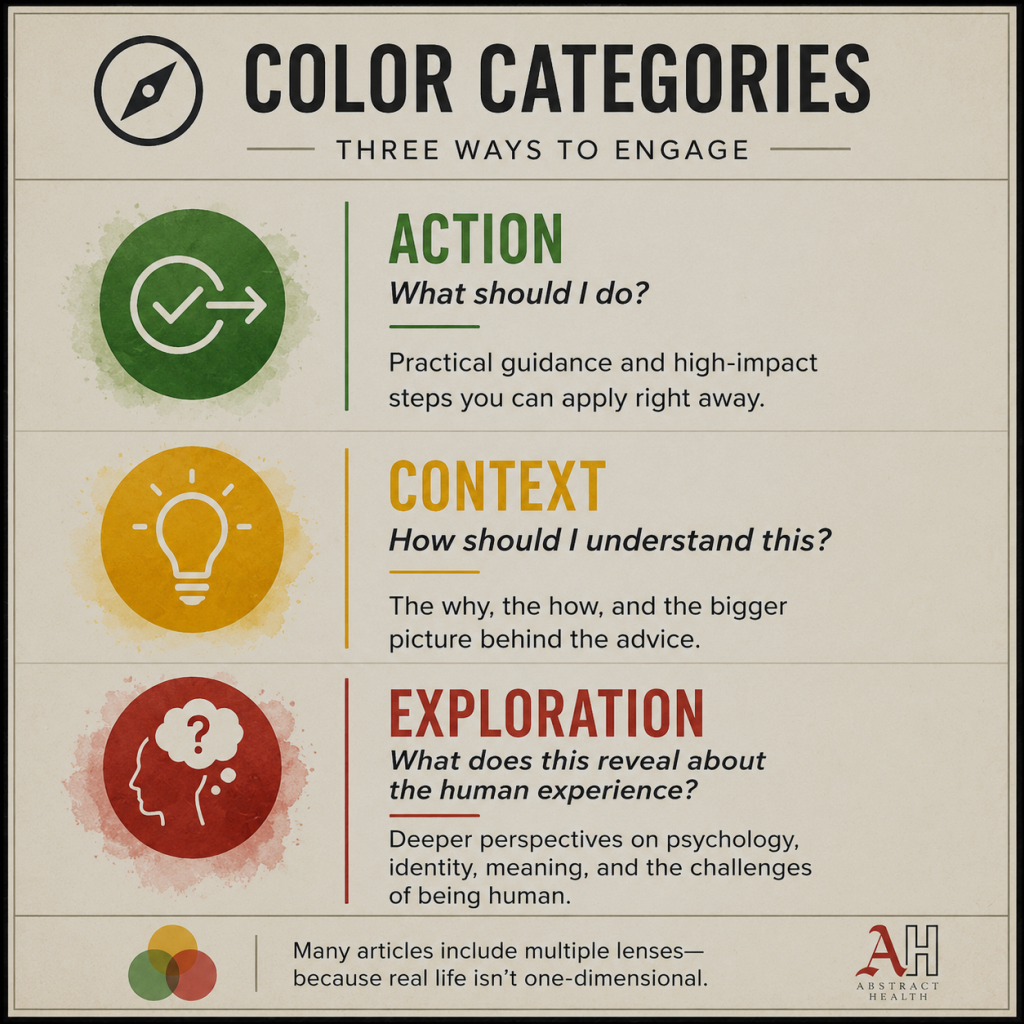
🟡
Stress is an unavoidable part of being human.
We have responsibilities, expectations, relationships, deadlines, and problems to solve. We encounter uncertainty, disappointment, unexpected changes, and circumstances that don’t unfold the way we would prefer.
Some challenges are relatively minor. Others can change the trajectory of our lives.
And while we can occasionally eliminate a problem, life has a remarkable ability to introduce another one.
That isn’t necessarily a bad thing.
Challenges can provide opportunities for growth, adaptation, learning, and meaningful accomplishment. Physical exercise, for example, deliberately introduces stress because an appropriate challenge, followed by adequate recovery, can make us more capable.
One of life’s more unfortunate realities is that growth often comes through friction.
But not all stress is productive. Not all challenges are chosen. And not every difficult experience contains some hidden opportunity for personal growth.
Sometimes life is simply difficult.
So the goal probably shouldn’t be to eliminate stress entirely. Nor should it be to become so resilient that we can tolerate an unlimited amount of it.
A more useful goal is to understand the relationship between three things:
The demands we face.
The capacity we have available to meet them.
And our perspective of the balance between the two.
The Weight We Carry
Imagine two people working in the same office.
They have similar responsibilities and encounter many of the same challenges throughout the day.
Yet one seems relatively comfortable navigating those demands while the other feels increasingly overwhelmed.
It would be easy to explain the difference with personality or resilience, but there is often more to the story.
One person may have slept well, have relatively few responsibilities outside of work, and feel supported by the people around them.
The other may be struggling with sleep, caring for a family member, dealing with financial stress, or carrying the emotional weight of an unresolved problem.
Their workload may be similar.
Their total load is not.
And neither is their available capacity.
The same thing happens within a single person.
A problem that feels manageable on Monday may feel overwhelming on Thursday.
The problem itself may not have changed.
But perhaps we’ve slept poorly, another deadline appeared, something is happening at home, or our patience is already running thin.
The demand stayed the same.
Our capacity changed.
That gives us a useful way to think about stress:
Stress is the weight of life’s demands relative to our perceived ability to carry them.
This isn’t a literal equation. Human stress is more complicated than that. But it gives us a practical model.
Demands, Capacity, and Perspective
Think of demands and capacity as sitting on opposite sides of a balance.
Demands are what life is asking of us.
Work. Family responsibilities. Finances. Health concerns. Conflict. Decisions. Uncertainty.
Even positive things can become demands. Raising children, pursuing meaningful work, creative interests, training for an event, or caring deeply about someone all require something from us.
Capacity is what we currently have available to meet those demands.
Time. Energy. Health. Skills. Sleep. Recovery. Money. Social support. Psychological tools. The ability to ask for help.
As demands rise relative to available capacity, stress generally rises with them.
That already gives us two possible places to intervene:
We can reduce demands.
Or we can protect and develop capacity.
But there’s another part of the model.
Perspective rotates around the boundary.
Perspective doesn’t necessarily change the actual weight on either side. It changes how we understand the relationship between them.
Sometimes we make a demand seem larger than it is.
An uncertain outcome becomes a guaranteed disaster. An inconvenience becomes an emergency. A mistake becomes proof that we’re failing.
At other times, we underestimate our capacity.
We overlook support. Forget what we’ve handled before. Or fail to recognize options because we’re fixated on the one we originally expected.
But perspective can distort things in the opposite direction too.
We can minimize legitimate problems. Overestimate our capacity. Convince ourselves that exhaustion is weakness. Or continue tolerating demands that are genuinely unreasonable.
Sometimes a clearer perspective tells us:
This actually is too much.
That is still successful perspective-taking.
The goal isn’t positivity.
It’s accuracy.
Sometimes we need to recognize that we’re more capable than we initially believed.
Sometimes we need to acknowledge that our limits are real.
And sometimes we need to accept that the problem isn’t our attitude.
The demands themselves need to change.
Position Versus Disposition
Comedian Jimmy Carr has discussed a related distinction that I’ve found useful: position versus disposition.
Our position is where we are.
Our circumstances, environment, responsibilities, demands, and available resources.
Our disposition is how we tend to approach that position.
Our temperament, outlook, interpretation, and response.
People can have tremendous success, comfort, or status and remain deeply unhappy.
Others can have relatively modest circumstances and still experience joy, connection, gratitude, and meaning.
That doesn’t mean circumstances don’t matter. They matter enormously.
Financial instability, unsafe environments, illness, destructive relationships, and unreasonable workloads create real demands that cannot be resolved by simply changing our attitude.
But circumstances don’t completely determine our experience either.
Sometimes we can change the situation.
Sometimes we can change how we relate to it.
And sometimes we need to do both.
The value of disposition isn’t that it allows us to convince ourselves everything is fine.
It gives us another place to look for agency.
Seeing the Balance More Clearly
Our minds are constantly interpreting the world.
We anticipate outcomes, make assumptions, and try to understand what other people or situations mean.
Most of that is useful.
But interpretation is not always reality.
Sometimes uncertainty feels like danger.
Sometimes a problem feels urgent simply because we’re anxious about it.
And sometimes we continue thinking about something long after that thinking has stopped being useful.
When that happens, three questions can help:
What do I actually know?
What are the facts, and what am I assuming?
What can I realistically influence?
Can I change the situation, ask for help, set a boundary, prepare differently, or change how I’m approaching it?
How much of my attention does this deserve?
Is continued attention helping me act, or am I repeatedly spending a finite resource without changing anything?
Something can matter deeply even when we have very little control over it.
Something deserving of care does not always deserve our constant, personal attention.
If we have little realistic influence over it, we should be cautious about how much space we allow it to occupy in our minds.
Sometimes recognizing that difference protects capacity all by itself.
Reduce the Load
Once we understand the balance, the practical options become clearer.
Sometimes we need to reduce demands.
That might mean simplifying responsibilities, resolving something we’ve been avoiding, adjusting expectations, asking someone else to share the load, setting a boundary, or saying no.
It may also mean recognizing that something simply isn’t important enough to deserve the amount of ourselves we’ve been giving it.
Not every problem deserves the same priority.
Not every disagreement requires a response.
And not every frustration deserves permanent residence in our thoughts.
Sometimes the healthiest thing we can do is put something down.
Protect the Capacity
Other times, the demand itself is reasonable.
We’re simply depleted.
This is where very ordinary health behaviors become important.
Sleep. Movement. Nutrition. Recovery. Breaks. Time outside.
Doing something enjoyable.
Seeking support.
None of these are revolutionary strategies.
Sometimes we don’t need a more complicated solution.
We need maintenance.
A short walk may interrupt repetitive thinking.
A few slow, deep breaths may help settle physiological arousal.
Dedicated exercise can help shift our state and clear some of the mental noise.
Stepping away for ten minutes may help us return to a problem with better judgment.
Sleep can restore resources that no productivity technique can replace.
And another person’s support may not remove the weight we’re carrying, but it can increase our capacity to carry it.
These strategies don’t erase difficult circumstances.
They help preserve the resources we need to meet them.
Creating Space Before We Respond
The final piece is emotional regulation.
Stress doesn’t simply affect how we feel. It can affect how we think, communicate, make decisions, and behave.
When we’re overwhelmed, immediate relief can become more appealing than solutions that require more effort. We might avoid a difficult conversation, sacrifice sleep to finish more work, withdraw, become impatient, or reach for something that makes the next hour easier while quietly making tomorrow harder.
Sometimes temporary relief is exactly what we need. The problem begins when our short-term solutions repeatedly create additional long-term demands.
We borrow relief from the future to make the present more manageable. Eventually, the interest begins to accumulate.
Emotional regulation gives us an opportunity to interrupt that process.
It doesn’t mean suppressing emotion or pretending to be unaffected. It means recognizing what is happening inside of us before automatically turning that feeling into behavior.
And it also means remembering that our first thought or emotional interpretation is not always the most accurate one.
We can feel threatened without actually being in danger. We can feel rejected without knowing another person’s intent. We can feel certain that something has gone terribly wrong while still having an incomplete picture of what happened.
The feeling itself is real. The story we immediately attach to it may not be.
That gives us room to notice:
I’m getting defensive.
I’m overwhelmed.
I’m exhausted, and everything feels harder than usual.
I’m angry, and there may be a legitimate reason why.
Awareness creates options.
Maybe we need a few breaths, a walk, some sleep, or a little time before responding. At other times, we may need to speak up, ask for help, or create enough space to decide what the situation actually requires.
And maybe we need to stop trying to regulate ourselves around a situation that genuinely needs to change.
Our emotions provide information. Regulation helps us decide what to do with it.
What Does This Situation Require?
That may ultimately be the most useful question.
Not:
How do I stop feeling stressed?
But:
What does this situation actually require?
Do I need to reduce a demand?
Restore capacity?
Ask for help?
Correct an assumption?
Set a boundary?
Take action?
Recover?
Let something go?
There won’t always be a clean answer.
Sometimes several answers will be true at once.
Psychological health isn’t about becoming unaffected by difficult circumstances.
And resilience shouldn’t mean endlessly expanding our ability to tolerate more.
Sometimes resilience means continuing.
Sometimes it means adapting.
Sometimes it means resting.
And sometimes it means deciding that something has asked enough of us already.
The purpose of protecting our capacity isn’t to make us endlessly productive.
Capacity matters because of what it allows us to do with our lives.
We cannot control every demand life places in front of us. We cannot avoid every loss, conflict, uncertainty, disappointment, or difficult season.
But we can become better at recognizing what we’re carrying, protecting the resources available to us, and developing a perspective that neither exaggerates our problems nor asks us to pretend they aren’t real.
Challenge is part of the human experience.
The goal, then, isn’t to build a life without stress. It’s to recognize which demands are worth carrying, which ones can be put down, when our capacity needs to be restored, and when our perspective needs to change.
Some things will still be heavy, but that isn’t always a sign that something has gone wrong.
Some weight comes from the things we value most—the privileged burden of a meaningful life.
The aim isn’t to avoid the weight. It’s to carry the right things, with enough capacity left to still live well.
Challenge is inevitable. Carrying all of it is not.