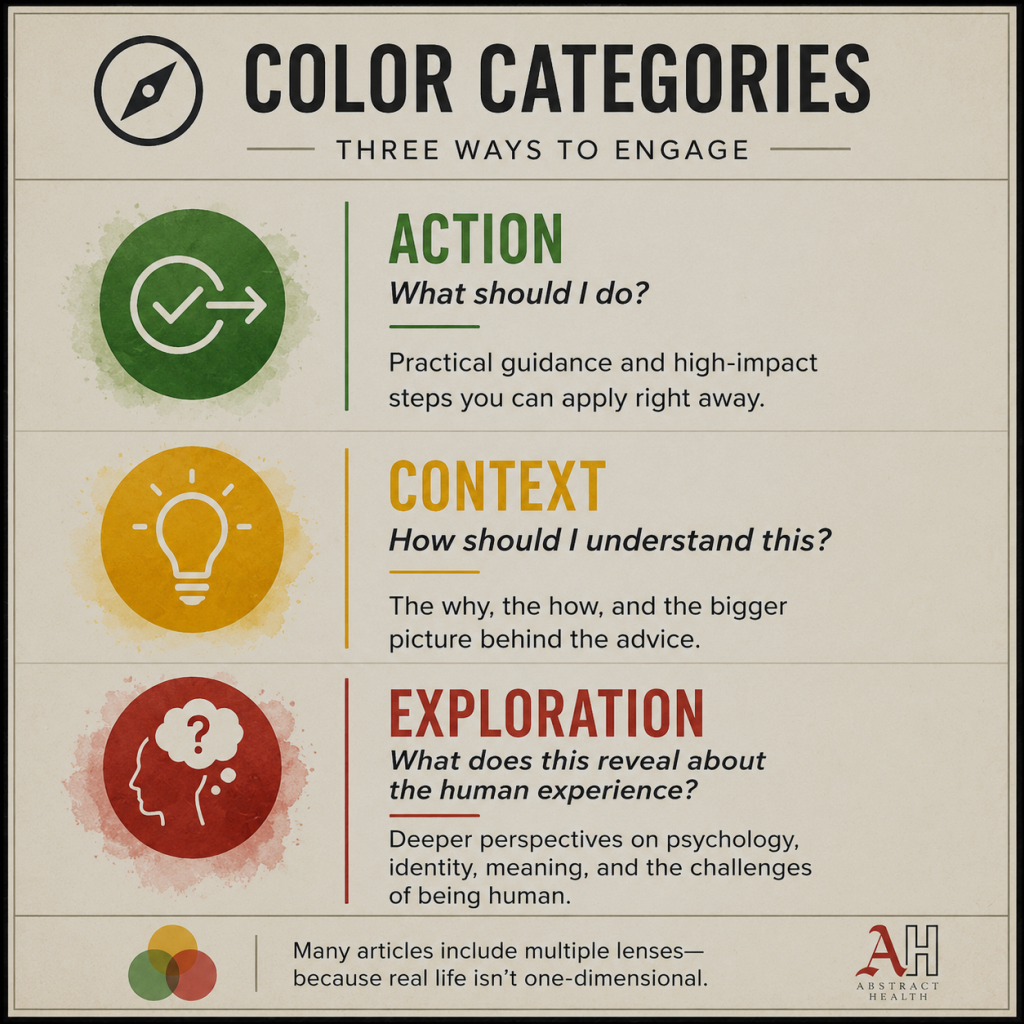
🟡
Your favorite expert is wrong.
And if they understand that, it may make them more likely to be right—at least until better information gives them reason to change.
It may also be one of the best reasons to trust them.
This does not mean the information they provide is useless, or that expertise is some elaborate illusion. It means something far less dramatic and much more important:
Even the most knowledgeable people are working with incomplete information.
They are building the clearest understanding they can from evidence that is still accumulating, experience that is limited, and a reality far more detailed than any one person can fully comprehend.
The job of an expert is not to become infallible. It is to be reliably useful while remaining willing to change.
This is uncomfortable for us because we want certainty. At a deep level, uncertainty feels dangerous. We want clear answers, definitive guidance, and something we can follow without hesitation. We want to find someone who has figured it out so that we no longer have to carry the burden of questioning it ourselves.
In the last article, we discussed what happens when information becomes identity. But experts can become part of that identity too.
We find someone whose ideas make sense to us. They may share our values, our background, or our frustrations. Their explanations feel coherent, their confidence feels reassuring, and their guidance may genuinely improve our lives.
Eventually, however, it can become difficult to separate our trust in the person from our evaluation of the information. We stop asking whether a particular claim is well supported and begin assuming it must be true because of who said it.
That is a dangerous amount of responsibility to give anyone.
The Blunt Edge of Knowledge
We often describe the most advanced thinkers in a field as being at the “tip of the spear.”
It is an appealing image because it suggests precision: a single sharp point representing the furthest edge of human understanding. One correct answer, with one expert standing valiantly at the peak.
But where serious and informed debate still exists, our knowledge may not be sharp enough to produce one definitive point.
The tip is often blunt.
Imagine our understanding as a cone. At the bottom, there is a wide range of possibilities. There is noise, contradiction, confusion, and relatively little ability to distinguish one explanation from another.
As knowledge improves, the cone narrows.
Patterns emerge. Principles become more reliable. Some possibilities are eliminated, and the signal becomes easier to distinguish from the noise.
But the cone does not always narrow into a perfect point.
Near the top, there may still be a small range of reasonable interpretations. Multiple perspectives can exist there simultaneously, each supported by credible evidence, experience, and reasoning.
At that level, disagreement is not always a battle between truth and ignorance. It may be a disagreement about nuance, context, application, or the relative importance of small differences.
This does not mean that every position is equally valid.
The cone has still narrowed considerably. There are ideas that have been filtered out because they are unsupported, implausible, or repeatedly contradicted by better evidence.
Uncertainty is not the same as knowing nothing.
It simply means that our current understanding may support a range of reasonable conclusions rather than one absolute answer.
Nutrition provides an easy example.
A well-constructed plant-based diet can support health, longevity, and performance. So can a well-constructed omnivorous diet.
There are meaningful differences between them. Individual needs, genetics, culture, access, preferences, and medical conditions can all affect which approach is most appropriate.
But arguing that one is universally superior in every possible context usually requires exaggerating relatively small distinctions while ignoring the large amount of territory the two approaches share.
Up close, the experts defending these positions may appear to be standing far apart—debating from a distance.
Zoom out, and they are often standing within the same narrow plateau, looking from slightly different angles.
The Map Is Not the Terrain
No single expert sees the entire landscape.
Each person builds a map from the evidence, education, and experience available to them. Some maps are exceptionally detailed, but usually only in certain areas.
A researcher may understand one mechanism with extraordinary depth. A clinician may see how that mechanism behaves in complicated human beings. Another discipline may reveal environmental, psychological, or social factors that further modify that person’s reality.
Each map can be valuable without being complete.
When we layer credible maps together, the overlapping areas become especially useful. Recurring patterns begin to reveal the parts of the terrain we can navigate with the greatest confidence.
This is why both depth and breadth matter.
Depth allows an expert to see details that most people cannot. Breadth prevents those details from being mistaken for the entire landscape.
Following one voice too closely can create a kind of blindness through precision. We may gain tremendous clarity in one direction while gradually losing perspective everywhere else.
Does this mean we all have to become experts at evaluating experts?
Not quite.
Not all sources deserve equal weight, and consuming a larger number of opinions does not automatically create a more accurate understanding. A fringe claim does not become credible simply because it provides an alternative perspective.
Track record matters.
Relevant education and experience matter.
Intellectual honesty matters.
The willingness to distinguish strong evidence from speculation matters.
We can also look for patterns across multiple credible sources. When respected researchers, experienced professionals, and reputable organizations independently arrive at similar conclusions, that overlap should carry more weight than the certainty of one unusually persuasive person.
Consensus is not infallible. But it is still meaningful.
It represents many imperfect maps pointing toward similar features in the terrain.
When the Margins Become the Main Discussion
One of the ways we cope with uncertainty is by giving disproportionate attention to the questions that have not yet been settled.
Rather than accepting “we don’t know yet,” we continue searching for increasingly specific answers.
Over time, marginal differences can become primary discussions—not because they are the most important parts of the field, but because they are among the few places where uncertainty remains.
The fundamentals become familiar, so they stop feeling interesting.
Meanwhile, the unsettled edges feel new. They provide room for debate, novelty, and confident interpretation. A subtle distinction gets enlarged until it appears to challenge everything we previously understood.
We begin asking small, preliminary, or highly context-dependent findings to resolve much larger questions than they are capable of answering.
The hierarchy becomes distorted.
The small area of uncertainty begins receiving more attention than the much larger foundation of agreement beneath it.
This is one reason experts can appear to disagree far more than they actually do. Public discussion tends to concentrate on the remaining areas of friction, while the enormous amount of shared understanding goes largely unmentioned.
We mistake refinement for contradiction.
But the fact that experts continue debating the final details does not mean the foundation has disappeared. It often means the foundation is strong enough that they now have the luxury of examining smaller and smaller differences.
The attraction to these margins can be especially strong early in a professional career.
When our own knowledge is expanding quickly, every new mechanism, study, or competing theory can feel as though it might reorder the entire map. What newer professionals often lack is not intelligence or effort, but the perspective that comes from watching promising ideas weaken, change, or disappear as the evidence develops.
Seasoned professionals have typically watched this cycle play out many times. They may remain curious about emerging ideas, but they are less likely to mistake novelty for importance.
They have seen findings that initially appeared revolutionary become narrow exceptions, minor adjustments, or historical footnotes. Many eventually realize that repeatedly gambling their attention on high-risk, high-reward ideas rarely produces guidance more useful than what already exists within the overlapping areas of the map.
Those overlapping areas are familiar for a reason.
They have survived repeated scrutiny.
Professional maturity does not mean ignoring the frontier or becoming resistant to change. It means allocating attention more proportionately. A mature expert can explore what might be true without allowing it to displace what has already proved reliable.
They continue investigating the edge.
They simply stop mistaking it for the foundation.
This progression is not guaranteed. Experience can also harden into complacency. But when expertise matures well, curiosity remains while hierarchy improves.
What Makes an Expert Trustworthy
The most trustworthy experts are not necessarily the people who sound the most certain.
They are the people whose confidence is proportional to the strength of the evidence.
They can speak clearly about what is well established without pretending that every remaining question has been resolved. They can hold a strong position while remaining willing to revise it.
They are comfortable saying:
“I don’t know.”
“I’m not sure.”
“I need to look into that further.”
“I’ve changed my mind.”
These statements are sometimes interpreted as weakness because we have learned to associate confidence with competence.
But humility is not the refusal to commit to anything. It is the ability to recognize where confidence is justified and where the limits of our knowledge begin.
Theoretical physicist John Archibald Wheeler captured this beautifully:
“We live on an island surrounded by a sea of ignorance. As our island of knowledge grows, so does the shore of our ignorance.”
As our knowledge expands, so does our awareness of what remains unknown. That growing boundary creates more territory to explore—but also more room for people willing to manufacture certainty.
An expert who stops adapting does not necessarily become wrong overnight. They become a time capsule.
They remain a representation of what was understood at a particular moment. As evidence accumulates and context changes, the distance between their map and our best current understanding may slowly begin to widen.
That is why disagreement can be valuable. It creates friction that forces ideas to be examined. It can reveal blind spots, expose weak assumptions, and clarify exactly where two perspectives begin to separate.
Not every opposing argument is correct, honest, or worth equal consideration.
But thoughtful disagreement among credible people is not a failure of expertise. It is one of the ways expertise improves. It is how we keep the map up to date.
The goal is not to abandon conviction.
It is to hold our convictions loosely enough that they can still be refined.
One of Many
We seek experts partly for convenience.
None of us has enough time to independently investigate every subject that affects our lives. We have to rely on other people. We have to decide which voices have earned more of our trust.
But trust should not require intellectual surrender.
Even the best source should not become our entire source of information. Once one person supplies our complete worldview, we are no longer evaluating their conclusions. We are inheriting them.
I hope Abstract Health becomes a source that people trust.
But I am one of many, and there should never be one.
My responsibility is not to present myself as the final authority. It is to gather what I can, think carefully, communicate honestly, and contribute another useful map.
Your responsibility is not to accept that map without question.
It is to compare it with other credible maps and consider how well it applies to the terrain of your own experience.
At the end of the day, being a professional—or communicating about any meaningful subject—is a little like being a parent. It is not about perfection.
It is about intention, attention, and adaptability.
No parent has every answer. No teacher does either. No scientist, physician, researcher, dietitian, or communicator does.
The responsibility is not to become infallible.
It is to guide carefully with the understanding we currently possess, remain honest about its limitations, and continue learning as that understanding evolves.
Absolute truth may be a destination we never fully reach.
But it can still provide a direction.
And the experts worth following are the ones willing to keep moving toward it.