Exploring the space between science and self.

Tag: health perspective

Hyperoptimization and Diminishing Returns

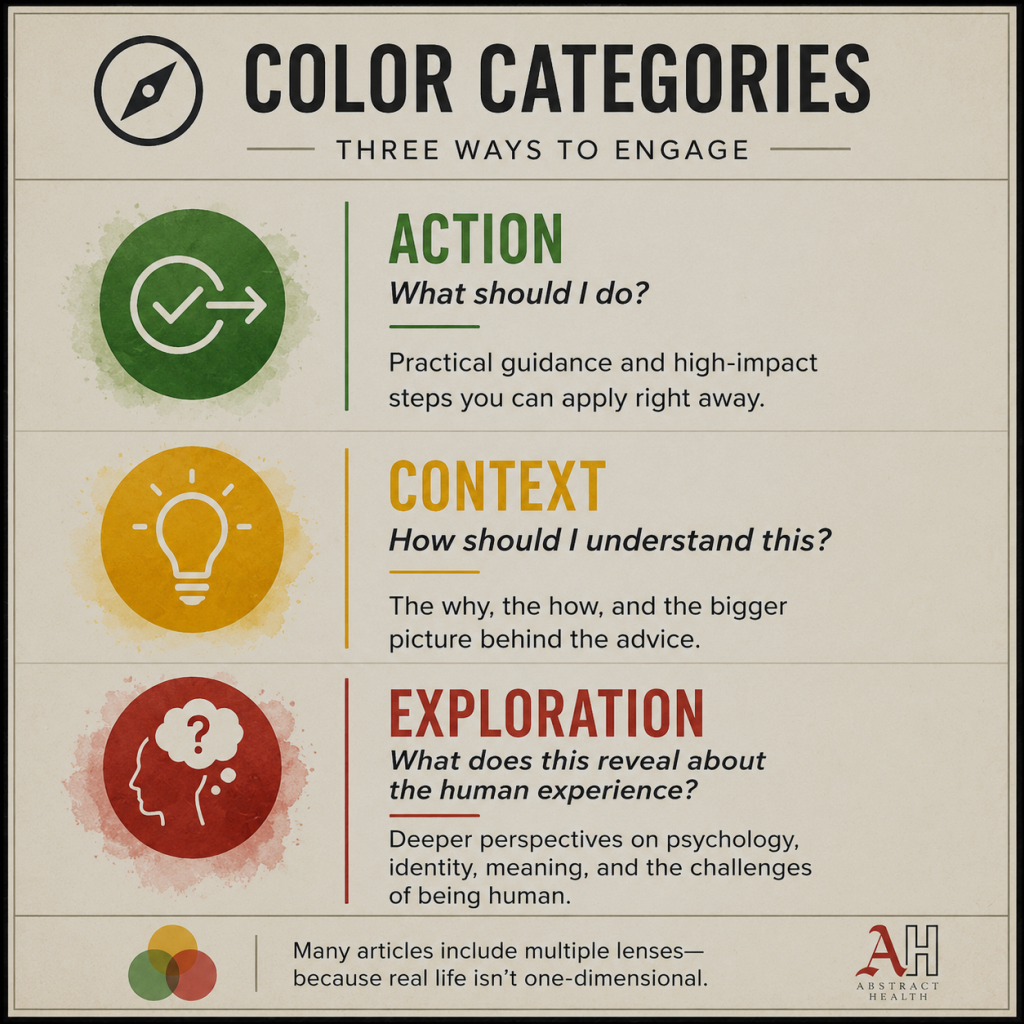
🟡

“The perfect is the enemy of the good.” — Voltaire

Sometimes the pursuit of health starts to shift focus.

We begin by wanting to feel better. More energy. Less pain. Better mobility. Improved labs. More experiences. More years with the people we love.

These are reasonable goals.

But somewhere along the way, many people drift from pursuing health toward pursuing optimization. Those are not always the same thing.

Modern health culture often creates the impression that every variable and topic deserves equal attention. Every ingredient, every supplement, every meal timing strategy, every recovery tool, every environmental exposure, and every new biological “hack.”

But the human system does not weigh everything equally.

Some variables matter tremendously.

Others matter only slightly—if at all.

The difference between sleeping four hours and sleeping eight hours.

The difference between being sedentary and moderately active.

The difference between eating mostly nutrient-dense foods and eating mostly ultra-processed foods.

These are among the highest-return investments we can make in the health of the human system.

Yet once our foundational needs are reasonably met, the return on additional optimization often begins to shrink.

Not because nuance is meaningless. Not because marginal variables are useless.

But because our biology appears to reach a point of diminishing returns.

The foundational improvements tend to create the largest changes. Later improvements often require more effort for increasingly smaller outcomes.

This pattern is not unique to health.

The difference between no maintenance and routine maintenance on a vehicle is enormous.

The difference between routine maintenance and elite performance modifications is comparatively small.

Yet modern health culture frequently convinces people that the performance modifications are the priority.

This inversion creates confusion.

People begin obsessing over electrolyte packets, supplement stacks, peptides, cold plunges, seed oils, greens powders, red light therapy, and countless other strategies that promise incremental improvements.

Experimentation on top of a foundation of fundamentals is perfectly reasonable.

Deprioritizing adequate sleep, regular movement, sound nutrition, stress management, and other foundational behaviors in favor of that experimentation is not.

We also must consider the cost of optimization.

Every health strategy requires an investment of time, money, energy, attention, or mental bandwidth. As those investments grow, we should continually ask whether the benefits are truly worth what they displace.

Sometimes they are.

Often, they probably aren’t.

The body is influenced by nuance, but it is governed by fundamentals.

And unfortunately, fundamentals are difficult to market.

Sleep is not exciting.

Walking is not exciting.

Managing stress is not exciting.

Eating enough protein and vegetables is not exciting.

Consistency is not exciting.

These things are simple, repetitive, and often unremarkable. There is no secret knowledge attached to them. No exclusive club.

Marginal optimization, however, feels advanced. It creates endless discussion. Endless products. Endless content. And endless opportunities for monetization.

There was a demand for optimization, and naturally, a market emerged to meet it.

This is where the topic can easily start to sound cynical or conspiratorial, but that’s not necessarily the case. It’s simply the reality created by the right combination of variables.

As discussed in Back to the Primitive: Swapping Intensity for Intent

These systems didn’t emerge from a singular malicious intent.

They are the natural result of:

  • Consumer preference
  • Technological advancement
  • Economic incentive

This is where many people unknowingly become trapped. Not necessarily in poor health behaviors, but in the psychological burden of excessive optimization.

This happens when our perspective causes us weigh everything equally.

Diminishing returns are not just physiological.

They can become psychological. Logistical. Financial. Social.

A strategy that provides a tiny physiological benefit may simultaneously increase stress, consume time, create anxiety, complicate schedules, strain relationships, or reduce enjoyment of life.

At that point, we have to ask an important question: Is the tradeoff worth it?

Because health does not exist in isolation from life.

The purpose of health is not to become imprisoned by routines, fear, or perfectionism.

The purpose of health is function. Freedom. Resilience. Presence.

The ability to participate more fully in life.

Optimization becomes problematic when the pursuit itself begins consuming the life it was meant to improve. It can also become self-perpetuating as people lose sight of the difference between foundational practices and marginal refinements.

This idea echoes Goodhart’s Law: “When a measure becomes a target, it ceases to be a good measure.”

Health metrics are useful because they point us toward better health. But when optimizing the metrics becomes the primary objective, it’s easy to lose sight of why they mattered in the first place.

This does not mean nuance is irrelevant.

Elite athletes may care deeply about marginal gains. Certain medical conditions may require highly specific strategies. Some people genuinely enjoy optimization as a hobby.

There is nothing inherently wrong with that.

But for most people, the overwhelming majority of meaningful health outcomes are likely driven by foundational variables:

Sleep.

Movement.

Nutrition.

Stress management.

Relationships.

Purpose.

Avoiding major destructive behaviors.

These are the big rocks.

Everything else exists around them, like sand and pebbles that fill in the spaces between the monoliths.

Modern wellness culture often sells the final 5% as though it were the first 95%.

But most people would experience dramatically greater benefit by improving the fundamentals they already know matter.

Not perfectly. Just consistently.

Because the goal is not perfect health.

The goal is to build a life that health supports—not one that health consumes.

To use health as a means of better experiencing life.

Sometimes the healthiest thing we can do is stop trying to optimize every variable and start living the life our health was meant to support.

After all, the perfect is often the enemy of the good.

Human Stat Points and the Reality of Change

🔴🟡

Learning, improvement, and growth are built-in parts of the human experience.

From the moment we are born, we are constantly developing skills, behaviors, habits, beliefs, and ways of navigating the world. This process is influenced by family, environment, education, work, relationships, hobbies, interests, and countless other variables.

Interestingly, this process is not entirely unlike what we experience in many games.

In the gaming world, it is common to begin with a character that has a pre-loaded distribution of traits and attributes. Strengths and weaknesses. We then work to change that distribution. As the game unfolds, we gradually invest points into the areas we wish to improve or that become important to the way we play.

Human beings are remarkably similar.

Our consistent traits and habits are somewhat similar to stat points in a video game.

Over time, different behaviors and tendencies become more or less developed depending on environment, awareness, repetition, stress, social connections, personality, upbringing, resources, and circumstance.

Hydration. Daily movement. Sleep consistency. Cooking at home. Protein intake. Time outdoors. Emotional regulation. Walking. Resistance training. Deep breathing. Boundary setting. Interrupting sitting. Limiting alcohol. Meaningful conversation. Stress management. Recovery.

Some of these habits become strengthened naturally through supportive environments, passive reinforcement, and intentional growth.

Others deteriorate through neglect, chronic stress, injury, aging, trauma, circumstance, or poorly engineered modern environments.

If we are aware of the ability to increase these attributes—we can start to pursue change in a more realistic and meaningful way.  

A way that makes sense regarding the currently available resources in our actual life.

Sustainable consistency—not infrequent perfection.


This is where the Human Stat Points framework becomes useful.

Imagine life as a collection of sliders within various categories.
Health. Career. Parenting. Relationships. Finances. Recreation. Learning. Household responsibilities.

At any given moment, you possess a limited pool of resources to distribute among them.
Time. Energy. Attention. Motivation. Recovery capacity. Mental bandwidth. Emotional bandwidth.

The mistake many people make is assuming every slider should be maxed out all the time.

Reality does not work that way.

A new parent may temporarily invest more points into parenting and fewer into fitness.

Someone building a business may allocate more points toward work and fewer toward leisure.

Someone recovering from illness may need to direct points toward healing while other areas temporarily receive less attention.

These tradeoffs are not necessarily failures. They are often reflections of reality.
Life requires resource allocation. This does not mean improvement is impossible.

It means improvement must be prioritized.

Every meaningful change requires resources.
Time. Attention. Effort. Recovery.

Which means every “yes” is also a quiet “not right now” to something else.

Mature change is often less about adding everything and more about deciding what deserves investment during a particular season of life.

Most beneficial health recommendations are commonly known.
Walk more. Sleep more. Exercise more. Cook more. Read more. Connect more. Stress less. Spend more time outside. Prepare more meals at home. Limit alcohol. Lift weights. Do cardio. Practice mindfulness.

Each recommendation sounds reasonable in isolation, but they are presented to us as a package.

The burden comes from accumulation.

Every recommendation draws from the same finite pool of resources. Eventually the demands exceed available capacity. And what is often interpreted as laziness can simply be resource depletion.

Many people assume they are failing because they cannot do everything. In reality, they are attempting to satisfy more obligations than their current capacity allows.

This is one reason health advice often feels simultaneously helpful and overwhelming.

Each individual recommendation may be beneficial. But when dozens of beneficial recommendations are stacked together, they begin to feel like obligations rather than opportunities.

Over time, health transforms from a source of support into a source of burden.
And burden changes behavior.

It’s easer to mentally deprioritize something when it seemingly becomes more of a burden than a benefit. When people feel they must perform perfectly across every category, they often experience things like frustration, guilt, shame, decision fatigue, burnout, etc.

Part of the problem is that we often approach change irrationally.

Most people understand that major life changes rarely happen overnight.
Yet when it comes to behavior change, we often forget to apply that same logic.

We seek the overhaul.
The overnight transformation.
The cold turkey solution.
The resolution.

In mountaineering, climbers sometimes experience what is known as summit fever. The summit becomes the only acceptable outcome. As a result, they begin ignoring changing conditions, realistic pacing, fatigue, and risk.

Sometimes the only focus is to scratch and claw our way to the top.

Although we may know what to do, we often do not give ourselves time to figure out how to integrate the knowledge into the complexity of our unique lives.

Consistency and maintenance relies upon lived experience, not temporary application of information.

Change is incremental. It requires time. Consistency. Patience. Resilience.

If we are truly committed to change, we do not begin by sprinting toward the ideal endpoint.

We simply begin walking in the preferred direction.

Slowly. Consistently.
And we adjust as we go.

Is this the answer we want? No. But it is reality.

So why waste time on fiction?


Health is rarely a perfectly balanced character build.
Some people consistently hydrate well but struggle with sleep.
Some move regularly but overconsume alcohol.
Some eat nourishing meals but remain chronically overstimulated and mentally exhausted.
Some maintain physical health while neglecting emotional regulation and relationships.
Others struggle because the environment surrounding them creates friction against beneficial behaviors.

The goal is not perfect optimization or maxing every slider simultaneously.
The goal is not becoming biologically flawless.

The goal is gradually improving the areas where improvement is realistic, sustainable, and meaningful.
In a way that works best for the individual.
 

And importantly, awareness itself is often part of that progress.

Sometimes meaningful change begins long before behavior fully changes. Simply becoming aware of the forces influencing the system can fundamentally alter the relationship a person has with themselves.

Awareness creates the possibility of intentionality. And intentionality, repeated consistently over time, slowly begins moving the sliders.

This perspective also creates space for compassion.
Because many people are not failing due to laziness or lack of intelligence.

Often, they are attempting to distribute limited resources across an overwhelming number of competing demands while operating inside systems and environments that constantly pull beneficial habits off course.

We often think of a full list of stat points as the ideal, and we get frustrated with ourselves for not being able to achieve it.

We lose sight of how much progress we can make by just being consistent with small things and progressing as we go.

Other times we can’t keep up. Or perhaps choose not to.

That deferred maintenance can accumulate to the point of affecting the way we look at ourselves.

Eventually, people can stop viewing themselves as under-supported systems and begin viewing themselves as broken people.

One of the biggest misunderstandings in modern health culture is that people often try to negotiate directly with outputs while overlooking the inputs that influence them.

Sometimes the outputs are simply reflections of prolonged input imbalance, accumulated wear, and insufficient capacity.

And importantly:

Deferred maintenance may make things more difficult in the moment, but that doesn’t eliminate the opportunity for future improvement.

Stat points can still improve.

And that matters.

Perhaps that is the real goal of health.

Not perfection. Not optimization culture. Not becoming superior.

But understanding that life requires tradeoffs and then allocating resources intentionally according to your current reality and values.

The answer is rarely complete optimization.
The answer is rarely complete neglect.
The answer is usually found somewhere in between.

The healthiest life is rarely the most optimized life.
It is often the one that allocates its resources intentionally, adapts to changing circumstances, and continues moving in a better direction over time.

Not perfect.

Not complete.

Just progressively better.

© 2026 Abstract Health

Theme by Anders NorenUp ↑