🟡🟢
This article is part of a series exploring what we’ve called The Big Three—sleep, movement, and nutrition. These foundational elements influence nearly every aspect of health, and each one strengthens the others. If you’re new to the concept, I recommend starting with The Big Three before continuing.
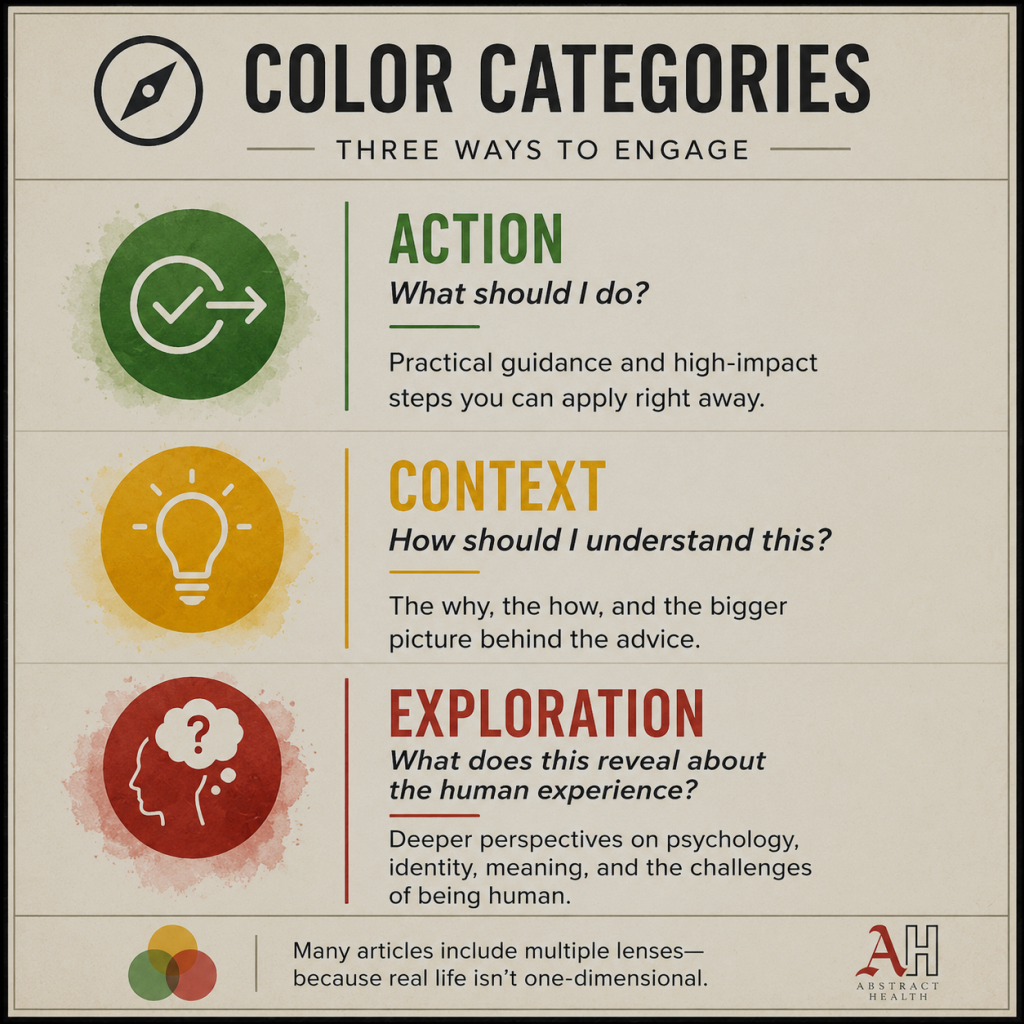
🟡 Our Challenges
Nutrition is difficult.
Realistically, it always has been.
There was a time when the greatest concern was simply having enough food. In other places and times, it was food safety, nutrient deficiencies, or the limits of what could be grown and preserved.
These days our challenges are different.
Not necessarily because we don’t know what to do, but because we did what humans have always done—we tried to improve things.
We improved transportation, communication, medicine, engineering, computing, and manufacturing. When we encounter a problem, we naturally look for ways to make it better.
Food was no exception.
We wanted food that tasted better, lasted longer, cost less, required less preparation, and could be available whenever we wanted it. In many ways, we succeeded. Food became safer, more affordable, more abundant, and more convenient than at almost any point in human history.
But every improvement comes with tradeoffs.
We became exceptionally good at making food rewarding. It became sweeter, saltier, richer, more shelf-stable, and easier to access. As a result, food also became easier to overconsume. Sometimes we improved nutritional quality along the way. Sometimes we sacrificed it.
At the same time, nutrition science was rapidly evolving. Researchers were asking better questions, collecting better evidence, and refining what we thought we knew. That’s exactly what science is supposed to do, but it also meant that recommendations changed as our understanding improved.
Then came marketing.
Health became profitable. Supplements, detoxes, miracle foods, fad diets, and endless nutrition claims all competed for our attention. Somewhere in the middle of all of that, nutrition stopped feeling straightforward.
Not because there wasn’t truth.
Because there were suddenly thousands of voices trying to explain it.
This idea was introduced briefly in Why Abstract Health?
So What Is Food Actually For?
When we strip away the marketing, the labels, and the trends, food has a remarkably simple purpose.
It provides the resources your body needs to build, repair, adapt, and function.
That’s what nutrition is.
It’s not a diet. It’s not an identity. It’s not a collection of rules.
It’s a resource delivery system.
Every heartbeat, every muscle contraction, every immune response, every hormone, and every act of repair depends on having the resources to do so. The body doesn’t respond to diet labels or marketing terms. It responds to nourishment.
Once you begin looking at food through that lens, much of nutrition becomes easier to understand.
Why Real Food Matters
Real food isn’t valuable simply because it’s natural.
It’s valuable because it tends to provide the resources your body needs in abundance.
Protein.
Fiber.
Vitamins.
Minerals.
Healthy fats.
Water.
And countless other compounds that support normal physiology.
That doesn’t mean every real food is equally valuable, nor does it mean every processed food lacks value. Most foods exist somewhere along a spectrum. Some provide many of the resources the body needs. Others provide fewer. Most fall somewhere in between.
The goal isn’t to memorize where every food belongs on that spectrum.
The goal is to build an overall pattern that consistently provides your body with the resources it needs to thrive.
Returning to the Fundamentals
Fortunately, the body has never cared much about trends.
It doesn’t know whether you’re eating Mediterranean, vegetarian, high-protein, or something else entirely. It simply responds to the nutrients and energy it receives—and the quantities in which it receives them.
That’s why the fundamentals continue to matter.
Not because they’re exciting.
Because they’re what the body is actually responding to.
This isn’t an argument against nutritional science. Clinical nutrition, medical nutrition therapy, biochemistry, and individualized recommendations all have an important place. As health becomes more complex, nutrition often becomes more specific.
But many people arrive at those conversations only after years of neglecting the fundamentals.
Think back to our discussion about vehicle maintenance. A well-maintained vehicle rarely needs specialized repairs. An aging vehicle with years of neglected maintenance often does. The increasing complexity reflects the condition of the system—not the foundation of maintenance itself.
The same principle applies to nutrition.
🟢 What to Do
1. Make Real Food Your Foundation
Build most of your meals from foods that reliably provide the resources your body needs. Protein-rich foods, vegetables, fruits, legumes, starchy tubers, whole grains, dairy, nuts, and seeds all make it easier to obtain protein, fiber, vitamins, minerals, and other nutrients that support healthy function.
The goal isn’t to eliminate every processed food.
It’s to make resource-rich foods the foundation rather than the exception.
2. Build Balanced Meals
Instead of asking whether an individual food is healthy, ask whether the meal is balanced.
Aim to include a source of protein, plenty of plant foods, and enough energy to support your body’s needs.
You don’t need to build the perfect plate.
You need a consistently well-built one.
3. Repeat the Fundamentals
Nutrition isn’t determined by your healthiest meal.
It’s determined by the pattern you repeat over weeks, months, and years.
Drink water regularly.
Leave room for foods you genuinely enjoy.
Recognize that some foods provide more resources than others, but don’t let perfection become the enemy of consistency.
The greatest benefits in nutrition rarely come from finding the perfect food.
They come from building a pattern you can sustain.
The Recalibration
Nutrition has become complicated because food became more rewarding, science became more detailed, and health became more marketable.
But the body’s needs never became nearly as complicated.
It still asks for the same things it always has.
Enough energy.
Enough protein.
Enough nutrients.
Enough consistency.
Food isn’t the goal.
Capacity is.
Nutrition matters because it provides the resources your body needs to build, repair, adapt, and preserve the capacity to live well.
That doesn’t require perfection. It requires a consistently balanced diet built primarily from real food.