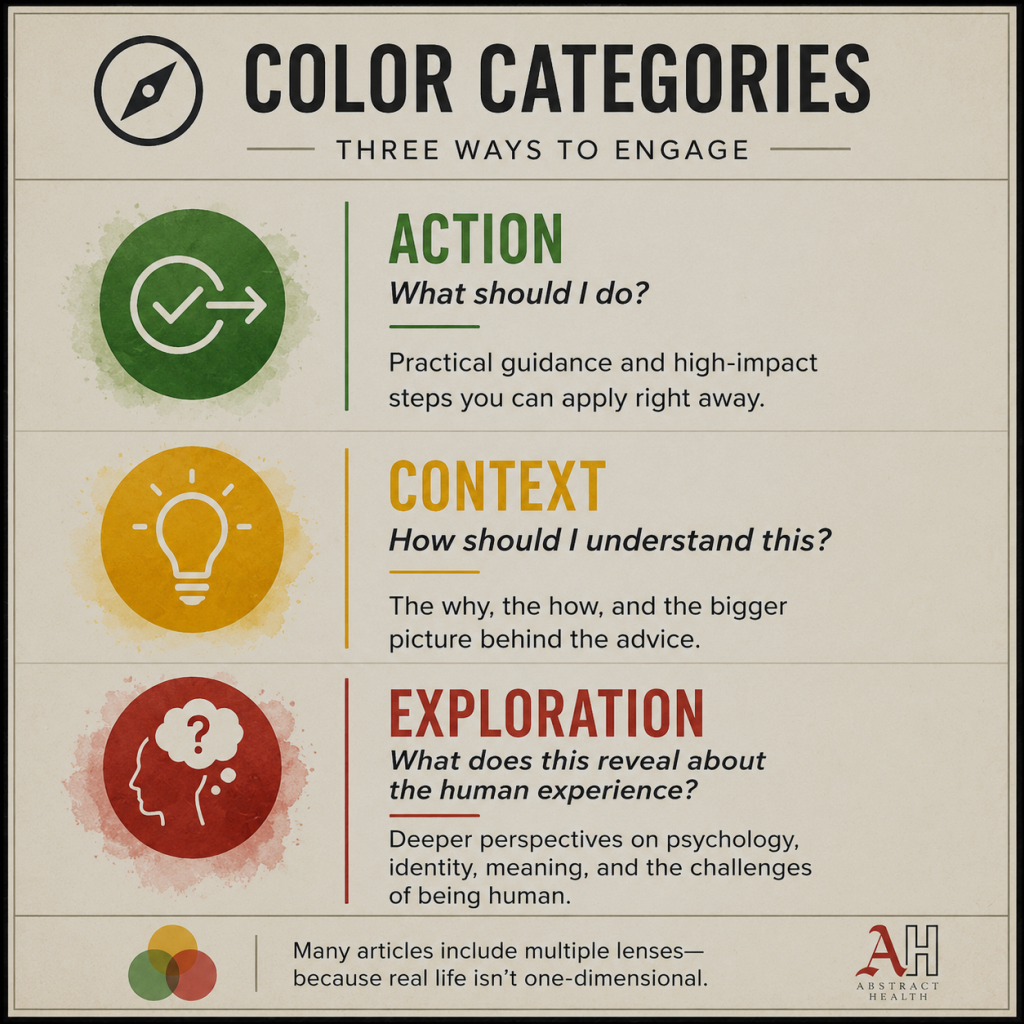
🔴
We don’t like feeling unstable.
We despise uncertainty.
And somewhere along the way, many of us learn that we are
supposed to appear as though we have things figured out—even when we don’t.
We are expected to know what we believe. To have an opinion.
To defend it. To remain consistent.
Changing our mind can look like weakness. Being wrong can
feel like embarrassment. Admitting uncertainty can sound like incompetence.
So we learn to build a version of ourselves that appears
more certain than the person underneath it actually feels.
And then we spend an incredible amount of energy maintaining
it.
Maybe this is one of the stranger parts of being human.
We don’t just develop beliefs about the world.
Eventually, we begin using those beliefs to explain who we
are.
When Beliefs Become Identity
At first, an idea is simply an idea.
We encounter some information. We evaluate it. We form a
conclusion.
But conclusions rarely stay isolated for long.
They become connected to our experiences, our communities,
our politics, our professions, our values, the people we admire, and the people
we distrust.
Eventually, we stop being someone who believes
something. We become someone who is something, and that changes the
stakes.
Questioning the belief can begin to feel like questioning
the person.
Changing our mind no longer feels like updating information.
It feels like losing something.
This is where ego becomes much more interesting than simple
arrogance.
Ego can be quiet.
It can simply be our subconscious commitment to preserving
the person we already believe ourselves to be.
We want the story of ourselves to remain coherent.
Knowledge can become wrapped up in that story too.
Being knowledgeable makes us feel competent. It can give us
status within a group, a sense of contribution, or simply the comfort of being
the person who knows.
There is nothing particularly sinister about that.
We want to matter. We want to feel capable. We want to
belong.
Empathy in all things.
But once knowledge becomes part of how we establish our
worth, changing our mind can begin to threaten more than an idea. It can
threaten our place in the world. And our minds are remarkably capable of
protecting us from that discomfort.
We notice evidence that supports what we already believe. We
scrutinize evidence that challenges it. We seek out people and sources that
continually hand our own beliefs back to us.
Eventually, confirmation bias can harden into dogma.
And the strangest part is that it rarely feels like dogma
from the inside.
It feels like seeing clearly.
The Weight of the Portrait
So much of our energy can become devoted to maintaining the
portrait.
Over time, we add layers of paint.
Competence.
Certainty.
Status.
Defensiveness.
Overcompensation.
Tribal identity.
The version of ourselves we want other people to see. The
version we want to see when we look inward. But every layer requires maintenance.
And the more effort we spend protecting that portrait, the
less energy remains for changing it—or simply appreciating what is already
there.
Sometimes we even recognize that a belief is beginning to
crack before we are willing to admit it.
We may be more open to another perspective than we care to
let on—even to ourselves.
So we cradle the existing idea, and we wait.
Another piece of evidence arrives.
Then another.
Eventually, the old belief becomes increasingly difficult to
justify.
But sometimes we carry it much longer than its truth
deserves. Not because the evidence remains convincing. Because removing it has
become invasive.
We are no longer replacing an idea. We are reconstructing
part of ourselves.
That is harder.
Stability feels safer.
And intuitively, it makes sense that it would.
But evidence has no obligation to preserve our identity.
Put candidly, facts don’t care about our feelings.
Not as a tool for condescension or a way to dismiss the very
real emotions that come with having our worldview disrupted, but as a simple
description of the natural world.
Reality does not rearrange itself to protect us from
discomfort.
It does not become more or less true depending on how
disruptive the truth might be to us.
That can be a brutal realization.
Reality does not negotiate with us.
And at some point, growth requires us to surrender to that.
Being Wrong Is Part of the Process
Many of us were conditioned to experience being wrong as an
insult.
But that conditioning came from other imperfect people who
were often taught the same thing.
And on and on the cycle goes.
We ridicule people for not knowing. We reward certainty. We
confuse confidence with competence.
We sometimes treat changing your mind as evidence that you
never knew what you were talking about in the first place.
Then we wonder why people become defensive.
There should be nothing humiliating about discovering that
something you believed no longer appears to be true. That is the process
working. Being wrong is part of learning. Recognizing that we can be wrong is
part of maturity.
And willingly letting go of information when it no longer
represents reality may be one of the clearest demonstrations that we actually
care about understanding.
There is immense courage in that kind of vulnerability.
Into the Current
We previously conceptualized healthy skepticism as a less
noisy, middle ground between trust and distrust.
But I’m not sure it’s comfortable.
Imagine standing in a river.
Near the banks, the current is weaker. There is something to
grab onto. Maintaining our position requires relatively little effort.
Farther toward the middle, the water becomes stronger.
More turbulent.
Holding position requires constant adjustment.
Our beliefs may work similarly.
There is psychological comfort near the edges.
A tribe can tell us what to believe.
An authority can tell us what is true.
Distrust can become a universal explanation.
Conformity can relieve us of the burden of questioning.
The farther we move away from those certainties, the more
exposed we become.
We may have to defend an institution we generally distrust.
Criticize someone we deeply respect.
Accept evidence that favors a conclusion we dislike.
Abandon an argument that once belonged to us.
Sometimes we disappoint both sides.
Healthy skepticism can leave us socially and psychologically
beaten and battered precisely because it refuses to guarantee loyalty to a
conclusion.
It requires us to remain in the current.
That doesn’t mean perfect neutrality is possible—or even
desirable.
Evidence does not always point directly toward the middle.
Sometimes reality should move us strongly toward one
conclusion.
The goal is not to occupy some mathematically perfect
midpoint.
The goal is to remain aware of the forces pulling us toward
the banks.
Our identity. Our politics. Our profession. Our experiences.
Our heroes. Our fears. Our need to belong.
Perhaps objectivity is not a position we finally achieve. Perhaps
it is a position we continually correct toward.
Healthy skepticism, then, is not standing still.
It is remaining psychologically mobile enough that reality
can continue to move us.
If You Love Something, Let It Go
There is an old saying:
If you love something, let it go. If it comes back, it’s
yours.
Perhaps we should treat some of our beliefs the same way.
Let them go.
Not necessarily abandon them. Just loosen our grip.
Question them. Expose them to competing explanations. Seek
out the strongest argument against them rather than the weakest.
Try, sincerely, to understand why another thoughtful person
might see the same information differently.
Allow ourselves to entertain the possibility that we could
be wrong.
If we eventually return to the same conclusion, then nothing
was lost.
In fact, something was gained. The belief has now survived
scrutiny. We understand its weaknesses better. We have better reasons for
holding it. Our confidence can become more justified.
And if we don’t return?
Then letting go allowed us to move closer to something
better.
Either outcome is useful.
The dangerous outcome is refusing to release the belief at
all.
Because at that point, we are no longer testing an idea.
We are protecting ourselves.
The Ratchet
Learning may work a lot like a ratchet.
A ratchet doesn’t advance through one enormous pull.
You pull the handle forward.
Then you have to release it.
It moves backward.
Click.
You pull again.
Click.
Then again.
From a distance, that release can look like lost progress. It
isn’t.
The release is what makes the next advance possible.
Our understanding may work the same way.
We develop a belief. We gain confidence in it. Then
something challenges it. We loosen our grip. We reconsider.
Maybe we return to essentially the same conclusion.
Maybe we move slightly.
Maybe something we once believed strongly becomes something
we now hold with greater uncertainty.
Maybe we abandon it altogether.
Click.
Another conversation.
Click.
Another experience.
Click.
Another study.
Another perspective.
Another realization that something we once considered simple
is more complicated than we thought.
Click.
Most of these changes are not dramatic.
But repeated over decades, they can move us an enormous
distance.
One Hard Pull
The alternative is one hard pull on the ratchet.
We form our worldview and hold it there.
We find our politics. Our philosophy. Our nutritional
ideology. Our explanation for how health works. Our heroes. Our villains. Our
tribe. Our explanation for ourselves.
Then we spend years defending the position. Sometimes with
tremendous intelligence.
We gather more information, but primarily in service of
strengthening what we already believe.
There can be a strange illusion of learning here.
We know more facts. We have better arguments. We become more
articulate.
Yet the underlying belief never moves.
The handle is under enormous tension.
But the ratchet hasn’t advanced.
Certainty can look like strength.
Consistency can look like integrity.
But there is nothing inherently virtuous about remaining
loyal to an old conclusion.
Sometimes integrity requires changing it.
The important question is not whether our beliefs today
perfectly resemble the beliefs we held ten years ago.
It is whether those ten years of evidence, experience,
criticism, conversation, and reflection were actually allowed to affect them.
The Freedom to Be Wrong
One of the major milestones in psychological growth may be
realizing that we no longer have to carry all of this weight.
We don’t have to defend every previous version of ourselves.
The person we were five years ago had five fewer years of experience. Of course
we should be different.
We don’t betray that person by changing. We continue their
education.
And once we understand that, being wrong becomes less
threatening.
Uncertainty becomes more tolerable.
Criticism becomes more useful.
Questions become more interesting.
Our identity becomes less dependent on every belief we
happen to hold being correct.
We begin to recognize that changing our mind doesn’t mean we
have lost ourselves.
It means the self is capable of changing.
That is freedom.
Accuracy Over Confidence
Objectivity does not require the absence of confidence.
It requires our confidence to remain responsive to evidence.
Strong evidence may justify strong confidence.
Weak evidence should leave more room for uncertainty.
And better evidence should be capable of moving us in either
direction.
Which leads to a principle I find increasingly useful:
Objectivity is the willingness to exchange confidence for
accuracy.
Sometimes that exchange costs very little.
Sometimes it requires us to admit publicly that we were
wrong.
Sometimes it means reconsidering someone we admired.
Sometimes it means questioning a community we belong to.
Sometimes it means repainting part of the portrait.
Sometimes it means swimming back into the current.
But the alternative is allowing yesterday’s need for
stability to dictate tomorrow’s understanding.
Keep Clicking
Knowledge isn’t about arriving at perfect certainty.
It’s about continually reducing error.
That is how nearly every serious field of study progresses.
No one enters science expecting that one day we will simply
know everything and close the books.
The expectation is revision.
Better measurements. Better models. Better explanations.
New discoveries replacing old assumptions.
Progress is not evidence that the process failed. Progress
is the point.
Yet somehow, we often deny ourselves the same privilege.
We act as though personal growth should culminate in a final
version of ourselves.
Perhaps there is no final version.
Perhaps the goal is simply to remain capable of another
click.
To hold our beliefs firmly enough to function, but loosely
enough to question.
To occasionally let them go and see whether they deserve to
return.
To notice when we have drifted toward the comfort of the
bank and become willing to move back into the current.
To recognize that release is not the opposite of progress.
It is part of the mechanism.
And maybe wisdom has less to do with how confidently we can
defend the person we are, than with how willingly we are to allow ourselves to sacrifice
some confidence to be a little less wrong than we were before.
And maybe wisdom has less to do with how confidently we can defend the person we are than with how willing we are to let that person change in pursuit of something a little closer to the truth.

Leave a Reply